Journaling Prompts for Burnout Recovery

Journaling prompts for burnout offer a gentle way to slow down when exhaustion builds quietly over time. Burnout doesn’t arrive all at once—it grows day by day as you give more than you have, ignore inner signals, and push past your natural limits until even rest no longer feels restorative.
Journaling prompts for burnout are not about fixing yourself or forcing motivation back into place. They are about listening. Writing gives you a safe space to slow down, acknowledge what you’re carrying, and begin restoring your energy with honesty and compassion.
If you’d like to continue with more reflective writing, explore the journaling prompts and guided writing resources to deepen clarity, emotional awareness, and gentle personal growth.
If you feel exhausted, disconnected, or emotionally flat, this practice meets you exactly where you are. No pressure. No performance. Just presence.
Understanding Burnout Through Journaling
Burnout is not a personal failure. It is a signal. It tells you that something in your life has been out of balance for too long. Journaling helps you translate that signal into understanding.
When you write during burnout, you are not searching for the “right” answers. You are creating awareness. Awareness is the first step toward healing and restoring inner harmony.
Many people try to journal their way out of burnout by focusing on productivity, gratitude lists, or forced positivity. While those practices have value, burnout often requires something deeper: permission to be honest about depletion.
How to Use Journaling Prompts for Burnout
Before diving into the prompts, set a gentle intention. These prompts are not meant to be answered all at once. Choose one or two per session. Let your nervous system set the pace.
- Write without editing or judging your words.
- Stop when you feel complete, not when you feel finished.
- Notice how your body feels before and after writing.
- Return to the same prompt multiple times if it resonates.
Journaling Prompts to Acknowledge Exhaustion
The first stage of burnout recovery is acknowledgment. These prompts help you name what you’ve been carrying without minimizing it.
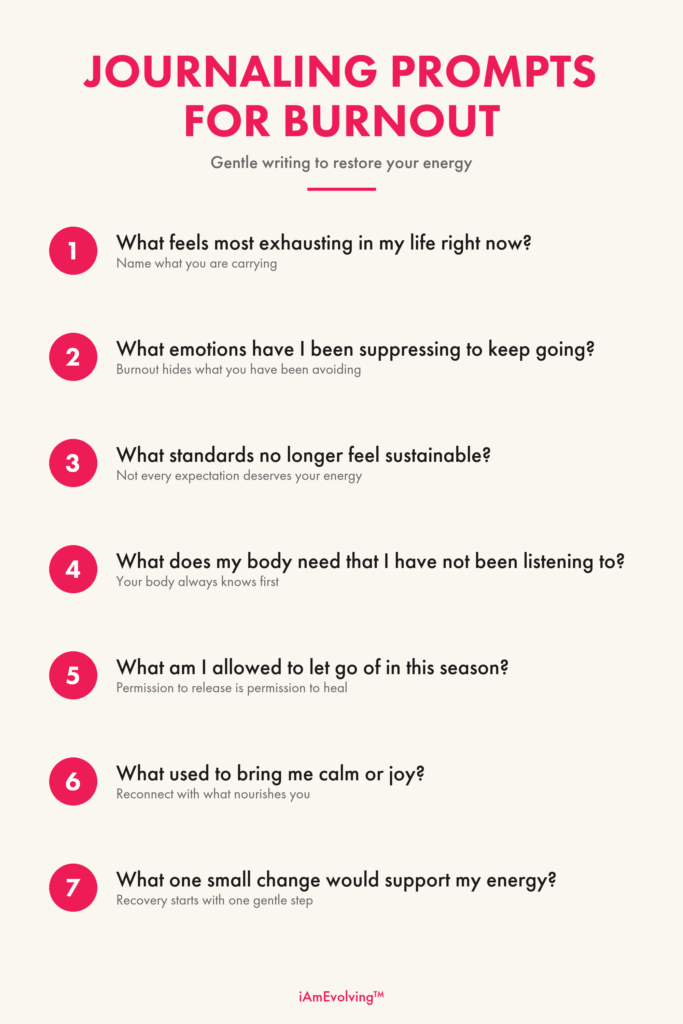
- What feels most exhausting in my life right now?
- Where am I pushing myself even though I feel depleted?
- What emotions have I been suppressing to keep going?
- What does my body need that I haven’t been listening to?
- If my exhaustion had a voice, what would it say?
Get more like this, every week
Journaling Prompts to Release Pressure and Expectations
Burnout is often fueled by invisible expectations. Writing helps bring those expectations into the light so they can soften.
- Who am I trying to be for others right now?
- What standards am I holding myself to that no longer feel sustainable?
- What would it feel like to lower the bar without guilt?
- Which responsibilities could be paused or simplified?
- What am I allowed to let go of in this season?
Journaling Prompts for Emotional Awareness
Burnout often disconnects you from your emotions. These prompts help rebuild that connection gently, without overwhelm.
- What emotion has been most present for me lately?
- Where do I feel tension or heaviness in my body?
- What situations trigger frustration or numbness?
- What helps me feel even slightly more grounded?
- What emotion needs more space to be felt?
Burnout often overlaps with anxiety or emotional numbness. If your writing brings up difficult thoughts or feelings, it may help to understand how journaling supports emotional processing and mental health without forcing solutions.
Journaling Prompts to Reconnect with Yourself
Burnout can make you feel like you’ve lost yourself. These prompts are invitations to reconnect, not to reinvent.
- What used to bring me a sense of calm or joy?
- When do I feel most like myself?
- What parts of me have been neglected?
- What small moments still feel nourishing?
- What does rest mean to me right now?
Journaling Prompts for Gentle Rebuilding
Recovery from burnout is not about doing more. It’s about doing less with intention. These prompts support slow, sustainable rebuilding.
- What is one small change that would support my energy?
- What does a realistic day look like for me now?
- What boundaries would protect my well-being?
- What habits drain me the most?
- What would consistency look like without pressure?
Creating a Burnout Journaling Ritual
Consistency matters, but only when it’s kind. Choose a time of day that feels supportive. Even five minutes is enough.
You may find it helpful to write in the evening, when the nervous system naturally begins to slow. If you struggle with stress or emotional overload, journaling can act as a grounding anchor rather than another obligation.
If you want deeper structure, consider pairing these prompts with a guided journaling framework like the iAmEvolving Journal, which integrates awareness, gratitude, habits, and inner harmony into a single daily practice.
As you continue writing, you may notice patterns, emotions, or needs becoming clearer. This is part of the deeper work of journaling for emotional clarity, where insight develops naturally over time.
Start your daily practice of gratitude, goals, and growth.
Get the Journal →A gentle 7-day reset to help you slow down, feel steadier, and reconnect — in just 5–10 minutes a day.
Start the ResetA simple introduction to daily journaling — gratitude, goals, and habits made easy.
Learn the MethodClosing Reflection
Burnout is not the end of your capacity. It is a turning point. Journaling gives you a way to listen inward, release what no longer fits, and begin restoring yourself without force.
You don’t need to rush your healing. You don’t need to prove anything. One honest page at a time is enough.
If you’d like to continue with more reflective writing, explore the journaling prompts and guided writing resources to deepen clarity, emotional awareness, and gentle personal growth.
Frequently Asked Questions
How often should I journal when feeling burned out?
What if journaling feels overwhelming?
Can journaling really help with burnout recovery?