15 Journal Prompts to Break the Comparison Trap
Comparison journal prompts are guided reflection questions that interrupt the habit of measuring your life against other people’s and turn that restless feeling into honest self-awareness. The comparison trap is the mental loop where every scroll, conversation, or milestone becomes a scoreboard you are quietly losing, and it rarely reflects reality — you are comparing your full, unedited life to someone else’s highlight reel. Writing is one of the most reliable ways out, because a question on paper slows the spiral down long enough for you to see what is actually happening.
This is for you if comparison has become background noise: the tightness when a friend announces good news, the deflation after twenty minutes online, the sense that everyone else got a map you never received. Below are fifteen prompts grouped into three movements — catching the spiral, reframing what you see in others, and returning to your own path. You do not need to use all of them. Pick the one that stings a little, and start there.
Why the Comparison Trap Is So Hard to Escape
Comparison is not a character flaw. It is wiring. For most of human history, reading your standing within a small group was how you stayed safe and connected, so the brain still scans constantly for where you rank. The problem is that the group is no longer twenty people in a village. It is thousands of curated lives streaming past your thumb, each one engineered to show the peak and hide the climb. Your nervous system treats that flood as real social data, and it draws the obvious, painful conclusion: everyone is ahead of you.
What makes the trap so sticky is that it feels like information. Comparison disguises itself as motivation, as honesty, as “just being realistic.” In reality it pulls your attention out of your own life and pins it to a story you invented about someone else’s. Journaling breaks that spell because it forces the vague ache into specific words, and specific words can be examined. Once you can see the thought on the page, you can question it, the same way you would reframe negative thoughts that visit at three in the morning.
There is also a hidden cost most people miss. Every minute spent ranking yourself is a minute stolen from the life you are actually living. The energy you pour into someone else’s timeline is energy that could have gone into your own next step. Seen plainly on paper, that trade rarely looks worth it, and that clarity alone is often enough to loosen the habit.
How to Use These Comparison Journal Prompts
These comparison journal prompts work best as a quiet, repeatable practice rather than a one-time fix. Keep your journal somewhere you will reach for it in the moment comparison hits — on your nightstand, in your bag, or open in a notes app. When you feel the familiar tightening, resist the urge to scroll further and write instead. Five honest minutes will do more for you than an hour of measuring yourself against strangers.
- Choose one prompt at a time. More than that turns reflection into a chore.
- Write by hand if you can. The slower pace gives your thoughts room to settle.
- Do not edit or judge what comes out. The goal is honesty, not a polished answer.
- Return to the same prompt on different days. Your answer will shift, and the shift is the insight.
If comparison usually arrives tangled up with a racing mind, it helps to pair this practice with journaling prompts for overthinking, since the two patterns feed each other. The aim is not to never compare again. It is to notice it sooner and recover faster.
5 Prompts to Catch the Comparison Spiral
You cannot interrupt what you cannot see. This first set slows the moment down so you can catch comparison as it starts, before it hardens into a verdict about your worth. Comparison is fastest in the half-second before you have words for it, so the goal here is simply to put language between you and the reaction. Use them right when the feeling is fresh, while the details are still vivid.
- Whose life was I measuring mine against just now, and what was I actually feeling underneath it?
- What was I doing in the minutes before the comparison started — scrolling, tired, alone, avoiding something?
- If I named the emotion beneath the comparison in a single word, what would it be?
- What story did I tell myself about what their life means? Is that a fact, or a guess I filled in?
- Where do I feel this in my body, and what might that sensation be trying to tell me?
Notice how often the answer to the second question has nothing to do with the other person. Comparison tends to strike when you are already depleted. Naming that context strips it of some of its authority.
5 Prompts to Reframe What You See in Others
Once you have caught the spiral, the next move is to question the picture itself. Comparison runs on incomplete information — you see the result and invent the rest. These prompts widen the frame and turn envy into something useful.
- What am I not seeing about this person’s full life, the parts they would never post or say out loud?
- If envy is a signal, what is it pointing to that I genuinely want for myself?
- Can I be sincerely glad for them and honest about my own longing at the same time?
- What changes if I treat their success as proof it is possible, not proof that I am behind?
- Who first taught me there is only so much room at the top, and is that even true?
Envy is not the enemy here. Handled gently, it is a compass. The thing you resent in someone else is often the thing you have not yet given yourself permission to pursue. When you write down what you are really reaching for, the other person fades from the center of the story and your own wanting takes their place, which is exactly where your attention belongs.
Get more like this, every week
5 Prompts to Return to Your Own Path
The final movement brings your attention home. Comparison thrives on borrowed scoreboards; the antidote is reconnecting with what you actually value and how far you have already come. These prompts are about finding peace in the present moment instead of an imagined finish line.
- What did I move forward on this week that no one saw or applauded?
- What does “enough” look like for me today, apart from anyone else’s measure of it?
- What am I comparing that is not even on my own list of values?
- If I had no one to measure against, what would I still want to build, and why?
- What is one small, true thing I can appreciate about where I am right now?
That last question matters most. Gratitude and comparison cannot occupy the same breath. When you name something real to appreciate, the scoreboard quietly loses its grip. Most of what you are chasing already lives somewhere in your present, waiting to be noticed rather than earned all over again.
Turning These Prompts Into a Daily Reset
When I first started writing my way out of comparison, I expected it to take a dramatic mindset overhaul. It did not. What worked was almost boring: one prompt most evenings, three or four lines, no pressure to reach a tidy resolution. Within a few weeks I noticed the gap between feeling the pang and recognizing it shrinking from hours to seconds. That recognition is the whole skill. You are not trying to become a person who never compares. You are becoming someone who catches it early and chooses again.
Build the habit around something you already do. Anchor it to your evening tea, your commute, or the moment before bed. If you want to go deeper than comparison alone, these prompts pair naturally with broader journaling prompts for self discovery, since untangling whose standards you are living by is some of the most clarifying work there is. Consistency beats intensity every time. A few honest lines a day will reshape your inner narrator faster than any single profound session.
Conclusion
The comparison trap rarely disappears for good, but it does loosen. Each time you meet the spiral with a question instead of a scroll, you teach yourself that your worth is not up for a vote, and that your path does not need to match anyone else’s to be worth walking. The fifteen prompts here are not a test to pass. They are a way back to yourself, available any time the noise gets loud.
Start with the one prompt that made you pause as you read. Write a few honest lines tonight, and let that be enough for now. You are allowed to be a work in progress and still appreciate exactly where you stand today. The page will be there tomorrow, and so will the version of you that is quietly, steadily growing.
Start your daily practice of gratitude, goals, and growth.
Get the Journal →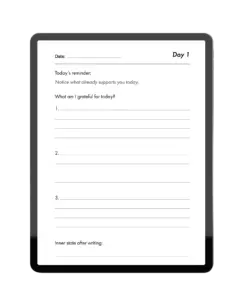
A free 30-day gratitude journal designed for a simple daily practice. Calm, minimal, and printable to help you slow down and reflect.
ExploreFrequently Asked Questions
What are comparison journal prompts?
How do I stop comparing myself to others?
How often should I use these prompts?
Is comparison always a bad thing?
Why does social media make comparison worse?