The Quarter Life Crisis: Why You Feel Behind in Your 20s

A quarter life crisis is the stretch of doubt, comparison, and feeling behind that many people move through between their early twenties and early thirties, usually when the structure of school falls away and adult life refuses to come with instructions. It is not a breakdown or proof that something is wrong with you. It is the ordinary friction of building a life for the first time, before you have any evidence that it will work out.
If you are reading this late at night, wondering why everyone else seems to have a plan while you feel stuck, this is for you. The aim here is not to rush you toward having it all figured out. It is to help you see what is actually happening, notice the thoughts driving the panic, and use a simple reflection practice to find steadier ground. Feeling behind is a stage on the path of personal growth, not the end of it.
What a Quarter Life Crisis Actually Is
A quarter life crisis usually shows up somewhere between 22 and 32, most often in the first few years after school ends or a big milestone passes. The common trigger is the same: the external structure that used to organize your days disappears, and suddenly no one is handing you the next assignment. Without grades, semesters, or a clear finish line, the question quietly shifts from what do I have to do next to who do I actually want to be, and that second question is far harder to answer.
Part of what makes it so disorienting is the gap between how it feels and how it looks from the outside. On paper you may be doing fine, with a job, a degree, maybe a relationship. Inside, there is a low hum of not enough, a sense that real life is happening to other people while you wait for yours to start. That gap is the quiet signature of this stage, and naming it is the first step toward loosening its grip.
Why Your 20s Feel Behind
Most of the pain in your twenties does not come from where you are. It comes from the ruler you are measuring yourself against. Social feeds show you the wedding, the promotion, and the apartment, but never the doubt, the debt, or the three failed attempts behind them. You end up comparing your unedited insides to everyone else’s edited outsides, and that is a contest you will always lose.
There is also the myth of the timeline: established by one age, married by another, settled by the next. That schedule was inherited, not chosen, and it fits almost no real life. When you fall behind an imaginary deadline, the feeling is real even though the deadline is not. Stepping out of the comparison trap is less about achieving more and more about noticing whose scoreboard you have been playing on.
The reframe that helps most is a shift in how you hold ability and progress. A growth mindset treats this stage as raw, in progress, and changeable rather than a final verdict on your worth. You are not behind. You are early, and still forming.
The Signs You’re in a Quarter Life Crisis
You do not need a diagnosis to recognize this stage. It tends to announce itself through a cluster of familiar feelings rather than one dramatic event. Notice how many of these land:
- A constant sense of being behind, even when nothing is actually wrong.
- Comparing your progress to friends and strangers, then feeling worse for it.
- Doubting choices you were once sure about, from your job to your city to your relationship.
- Restlessness paired with paralysis, wanting change but unable to name what.
- Nostalgia for a simpler time when someone else set the direction.
- A quiet fear that you have already missed your window.
If several of these feel familiar, you are not malfunctioning. You are meeting the ordinary questions of early adulthood, and they tend to ease once they are answered on paper instead of replayed in the dark.
Get more like this, every week
A Reflection Practice to Find Your Footing
When the mind spins, it is because too many unspoken questions are competing for attention at once. Writing them down does something the spinning cannot: it slows the questions to one at a time and turns a vague dread into something you can actually look at. Based on the iAmEvolving framework, here is a short practice you can run in about ten minutes on the nights the feeling gets loud.
- Empty the noise. Set a timer for five minutes and write, without editing, everything you feel behind on. Let it be messy. The goal is to get the fog out of your head and onto the page where you can see its real size.
- Separate real from inherited. Read it back and mark which pressures are truly yours and which you absorbed from family, feeds, or an old timeline. Most of the weight usually belongs to the second group.
- Name one honest want. Finish this sentence without worrying about how: if no one were watching, the next thing I would move toward is. One want is enough.
- Choose a single small step. Attach one concrete action to that want, something you could do this week. Direction, not a five-year plan, is what dissolves the stuck feeling.
- Close with one line of proof. Write one thing you have already learned or survived that an earlier version of you would be relieved to know. This trains your attention toward growth instead of deficit.
On the days the blank page feels like too much, gentler entry points help. The prompts in journaling when you feel lost can carry you when you have no words of your own, and returning to the same short practice each night is what slowly turns panic into perspective. A few questions worth coming back to this week:
- What would I attempt this year if I trusted that I still have plenty of time?
- Whose life am I using to measure my own, and is that comparison even fair?
- What did I want at sixteen that I have quietly stopped letting myself want?
- Where have I already grown in a way that does not show up on any resume?
Turning “Behind” Into “Becoming”
The way out of a quarter life crisis is rarely a single decision. It is a slow trade, swapping the question am I behind for a better one: am I moving toward what actually matters to me. That shift takes the pressure off arriving and puts it back on direction, which is the only part you truly control.
Direction gets clearer when you stop chasing goals that were never yours to begin with. Spending time identifying your true goals filters out the borrowed ambitions and leaves the few that make you feel more like yourself. From there, progress stops being a race and becomes a practice.
The last piece is how you speak to yourself while you build. The voice that says you are too late will quietly sabotage the very steps that would prove it wrong. Learning to turn self-doubt into self-belief is not forced positivity. It is offering yourself the same patience you would give a friend who was simply early in their story.
In the years I have spent building iAmEvolving and hearing from readers in their twenties, the same line comes up again and again: everyone else seems to know what they are doing. What I have watched actually help is never a sudden answer. It is the quiet habit of writing the pressure down, sorting the real from the inherited, and taking one honest step, until the feeling of being behind loosens enough for a life to take shape. The iAmEvolving Journal keeps a dedicated space for exactly this kind of reflection, so the practice has somewhere to live beyond the nights you need it most.
Conclusion
A quarter life crisis is not evidence that you took a wrong turn. It is the growing pain of building a life without a map, and almost everyone who now looks settled once stood exactly where you are, convinced they were the only one behind. You are not behind. You are early, still forming, and far more on time than the panic will admit. Be patient with the part of you that is still finding its footing, write the noise down instead of carrying it alone, and take one small step this week toward something that is honestly yours. On the days you feel scattered and far from who you are, learning to reconnect with yourself is a gentle way back to steadier ground.
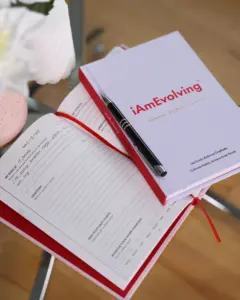
Start your daily practice of gratitude, goals, and growth.
Get the Journal →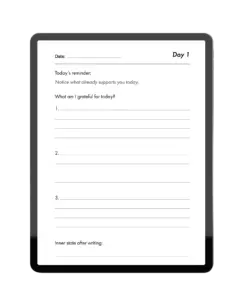
A free 30-day gratitude journal designed for a simple daily practice. Calm, minimal, and printable to help you slow down and reflect.
ExploreFrequently Asked Questions
Is a quarter-life crisis normal?
What age does a quarter-life crisis happen?
How long does a quarter-life crisis last?
What are the signs of a quarter-life crisis?
How do you get out of a quarter-life crisis?