Identifying True Goals: How to Choose What You Actually Want

Identifying true goals is the practice of separating what you actually want from what you feel pressured to want. A true goal is one that holds up when nobody is watching, when no one would clap for it, and when its only payoff is the quiet satisfaction of becoming the person who pursued it. Most of us never reach this layer because we move too fast. We adopt goals from family, social feeds, partners, and old versions of ourselves, and then we wonder why effort feels heavy. Goals borrowed from someone else burn through your energy without ever returning it.
This guide is for anyone who has reached a goal and felt empty, or who has set the same resolution three years in a row without moving. You will learn how to distinguish real desire from pressure, fear, and inherited expectations. By the end, you will have a small set of practical tools you can use this week to test whether a goal is yours and worth pursuing, or whether it belongs back on the shelf.
What Makes a Goal “True”?
A true goal is one rooted in your own values, lived experience, and honest desire. It does not need an audience to feel worthwhile, and it survives bad days because the reason behind it is internal. Goal setting works best when the target itself reflects who you are becoming, not who someone else thinks you should be.
The clearest test is this: imagine reaching the goal in private, with no recognition and no public reveal. If the result still feels worth the effort, the goal is likely true. If the appeal disappears the moment you remove applause, the goal probably belongs to someone else’s expectations.
True goals also tend to feel quieter than performative ones. They come with a steady pull instead of adrenaline or urgency, a sense that something inside you keeps returning to the same idea even when you try to move on. That return is the signal worth listening to. Forced goals fade in two weeks. True ones outlast moods, seasons, and setbacks.
Why Most Goals Aren’t Actually Yours
By the time you sit down to set a goal, dozens of other voices have already weighed in. Parents shape what you think is “stable.” Social platforms shape what looks “successful.” Partners and peers shape what feels “normal.” Most goals are inherited before they are examined, and the inheritance often sounds like your own voice because it has lived in your head for years.
There are three common sources of borrowed goals. The first is fear, which dresses up as ambition: you chase a promotion because being passed over feels unsafe, not because the role energizes you. The second is comparison, which dresses up as inspiration: you build a side project because someone else’s launch made you feel behind. The third is identity protection, which dresses up as growth: you keep an old goal alive because letting it go would force you to admit who you have become. Each of these can produce real action, but the action drains rather than fuels.
You can read more on the difference between strict frameworks and aligned ones in SMART Goals vs Heartfelt Goals. The deeper your goals are rooted in something real, the less willpower they require to keep alive. Borrowed goals demand constant motivation. True goals run on something steadier.
If you only chase what others approve of, you will always be tired. Your real goals will feel like rest, even when they ask hard things of you.
5 Signs a Goal Is Actually True
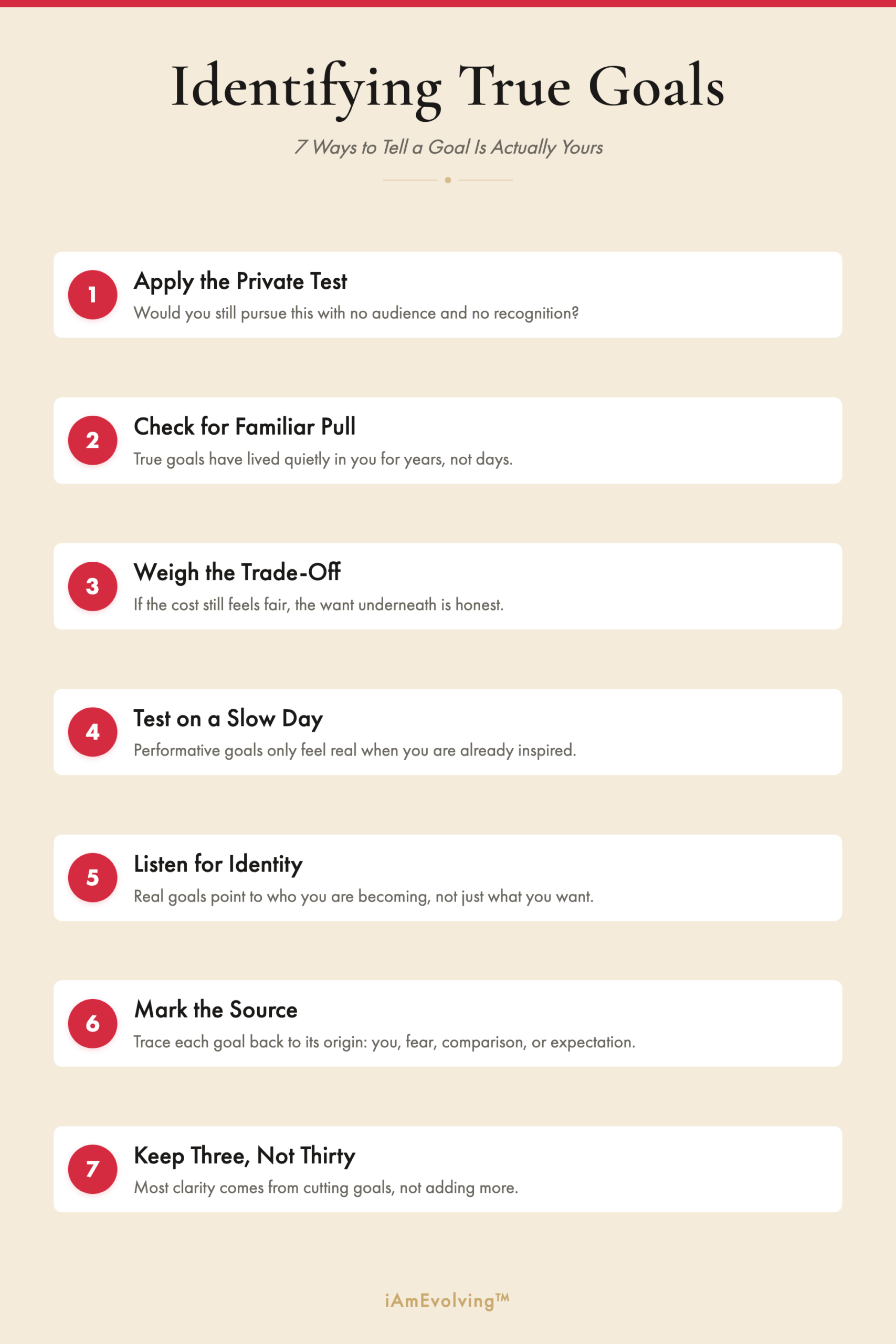
Not every goal that survives a hard week is true, and not every goal that exhausts you is wrong. Use these five signs as a quick honesty check. If a goal scores three or more, it is probably worth pursuing.
- You would still want it without the title. Strip away the label or status, and the underlying activity still appeals. The work itself, not the badge, is the draw.
- It feels familiar, not foreign. The goal is something you have been drawn to for years, not something you discovered last Tuesday on a feed.
- The cost is acceptable. When you picture what you will have to give up, including time, comfort, and certain relationships, the trade still feels fair.
- It survives a slow day. On a low-energy morning, you can still see why this matters. Performative goals only feel real when you are already inspired.
- It points toward who you want to become, not just what you want to have. True goals are usually identity goals in disguise.
Use these as a filter, not a verdict. Sometimes a goal scores poorly because you have not sat with it long enough. Sometimes it scores well because you have rehearsed the answer. Honest scoring requires distance from the question, which is exactly why journaling helps.
Get more like this, every week
A Simple Process for Identifying True Goals
Clarity rarely arrives by thinking harder. It arrives through writing slowly. The process below takes about thirty minutes, and you only need a journal and a quiet room. If you don’t have one yet, print the free goal setting journal and start there.
- List every goal currently in your head. Empty the entire pipeline onto paper, including the ones that feel embarrassing. Do not filter. At this stage you want to see everything, and curation can come later.
- Mark the source of each one. Beside every goal, write where it came from: yourself, a parent, a comparison, a fear, a peer, an old identity. Many goals carry a mix of sources.
- Cross out anything purely external. If a goal exists only because someone else expects it, it is not yours yet. You can revisit it later, but for now, draw a line through it.
- Apply the private test. For each remaining goal, ask: “Would I still pursue this if no one ever knew I did?” Keep only the ones that survive that question with energy intact.
- Choose your top three. Of what is left, pick the three goals that point toward who you want to become, not just what you want to acquire. These are your candidates for serious focus this season.
This is one of the most common goal setting mistakes people repeat: we skip the audit and rush to plan. Plans built on borrowed goals collapse under pressure, no matter how detailed. Plans built on true goals hold even when motivation drops, because the energy comes from inside the goal rather than from a schedule.
Journaling Prompts to Surface Your Real Desires
If listing goals leaves you stuck, journaling prompts can lower the resistance. Write each prompt at the top of a fresh page and respond for five to ten minutes without editing. Do not aim for polished sentences. Aim for honest ones.
- What would I pursue if I knew no one would ever judge the outcome?
- Which of my current goals belongs to a younger version of me who no longer lives here?
- If I had one undisturbed year and unlimited support, what work would I actually choose to do?
- What is something I keep returning to in conversations, even when nobody asks?
- Which goal am I afraid to say out loud, and why?
- If I dropped this goal tomorrow, who would actually be disappointed: me, or someone else?
If you want a deeper structure for this kind of writing, journaling prompts for self-discovery can extend the work over a few weeks. Real clarity often surfaces on the third or fourth pass through the same question, not the first. The first pass tells you what you think you want. Later passes tell you what you actually want.
How a Daily Journal Supports This Practice
Identifying true goals is an ongoing practice. It needs a daily place to live, otherwise the clarity you find on Sunday fades by Wednesday. The iAmEvolving Journal is built around that exact rhythm: top goal, gratitude, habits, and reflection, all on a single page that takes about ten minutes to complete.
The format works because it forces you to rewrite your top goal every day. Goals that are not yours get heavy quickly, and you will notice the resistance long before you reach a deadline. Goals that are yours stay light, even on hard mornings. Daily rewriting is also one of the simplest ways to apply how to set meaningful goals without overcomplicating the process. The page itself becomes a steady feedback loop between intention and life.
When to Let an Old Goal Go
Some goals were true once and stopped being true without you noticing. The version of you who set them has already grown into someone else, but the goal kept its place on the list out of habit. Letting it go is a sign that the audit worked.
The clearest signal that a goal has expired is the way it shows up in your body. You sigh when you read it. You feel guilty rather than energized when you think about it. You put it on every quarterly plan and never start. That pattern is not laziness. It is a goal that has finished being yours. Holding on to it longer only adds shame to a list that should feel like possibility.
Releasing a goal can feel like loss, especially if you announced it publicly or built part of your identity around it. That is normal. Give yourself the space to grieve briefly, then write down what the goal taught you and why it no longer fits. The lesson stays. The obligation does not. Many people find that letting one stale goal go creates room for two true ones to surface, because the bandwidth was never about time. It was about attention.
A useful rule is to revisit your goal list every season, not every year. Quarterly review is short enough to catch shifts before they harden into resentment, and long enough to give true goals real runway. During each review, ask three questions: which goals still pass the private test, which ones have slowly become someone else’s expectation, and which ones you are keeping out of pride. Honest answers will trim the list faster than any productivity system.
Instead of finding a perfect set and protecting it forever, the point of identifying true goals is to keep a living relationship with what matters to you, so the goals you carry forward are always the ones still worth the effort. Letting go is part of that practice, not a break from it.
Conclusion
The goals worth pursuing are the ones that survive your honesty. They do not impress anyone in the room. They do not burn brightly for two weeks and disappear. They show up in your journal again and again, in different words, until you finally listen. Identifying true goals is not about deciding what to chase. It is about giving yourself permission to stop chasing what was never yours.
Take the audit slowly this week. Cross out what does not belong. Keep what survives the private test. The clarity you find will not feel dramatic, but it will feel sustainable, and that is the foundation everything else is built on. If you want a wider frame for this work, revisit goal setting fundamentals to anchor your approach before you build your next plan.

Start your daily practice of gratitude, goals, and growth.
Get the Journal →
A free 30-day goal setting journal PDF with daily prompts, action steps, and reflection space. Printable, minimal, and designed to keep you focused on…
ExploreWhat does identifying true goals actually mean?
How do I know if a goal is mine or someone else’s?
How many true goals should I focus on at once?
What if I cannot tell which of my goals are true?
Can true goals change over time?