Goal Setting Fundamentals That Matter

How to Set Goals That Actually Matter
Before you chase a dream, take a moment to understand what truly matters to you. The goal setting fundamentals aren’t about control. They’re about clarity. When you know your values, every action becomes more intentional, and each day moves you closer to your purpose.
Before strategies, systems, or planners work, the basics have to be clear. Goals don’t fail because people lack discipline. They fail because the foundation is unclear. When your goals are rooted in meaning and alignment, progress becomes natural instead of forced.
The Ultimate Guide to Goal Setting explores the mindset behind intentional living. Here, we focus on the practical side: how to create meaningful goals, stay aligned with them, and use journaling as a tool for steady progress.
Understanding the Foundations of Goal Setting
This is where goal setting actually begins. Not with deadlines or checklists, but with awareness: of what matters to you, why it matters, and how you want to feel as you grow. These foundations shape every goal that follows.
Effective goals begin with awareness. You’re not just writing down ambitions. You’re defining your direction and energy. In the Step-by-Step Guide to Setting and Achieving Goals, you’ll learn how to create clear, emotionally connected goals that inspire consistent action.
Start by reflecting on these questions:
- What matters most to me right now?
- Why do I want this goal?
- Who will I become by pursuing it?
When you write down your answers, you’ll notice that clarity naturally creates motivation.
Why Meaningful Goals Matter More Than Big Ones
In How to Set Meaningful Goals and Actually Achieve Them, we explore the difference between achievement-driven goals and purpose-driven ones. Big goals might look impressive, but if they’re not aligned with your heart, they can lead to exhaustion. Meaningful goals, on the other hand, create energy, not pressure: because they connect to your “why.”
A goal without meaning is just a task.
A goal with meaning becomes a journey.
How Journaling Strengthens Your Focus
Writing your goals brings them to life. It’s not just a planning exercise. It’s a daily practice of intention. The Goal Setting Journal Guide shows you how to use your journal to clarify your direction, stay accountable, and reflect on what’s working.
Each page of the iAmEvolving Journal invites you to reconnect with your goals through reflection. Small, consistent writing builds awareness: and awareness builds results.
Get more like this, every week
Creating Real Change Through Daily Reflection
Real transformation doesn’t happen in a single breakthrough moment. It happens in daily reflection. In How to Use a Personal Goals Journal to Create Real Change, you’ll learn how to check in with your progress and course-correct without judgment. The goal isn’t perfection. It’s evolution.
Your journal becomes a space where growth becomes visible. It shows not just what you’ve achieved, but who you’re becoming along the way.
What Are the Core Goal Setting Fundamentals?
The goal setting fundamentals are the handful of principles that make any goal worth pursuing and possible to keep. They come before any planner or productivity method. When the fundamentals are in place, the technique you choose later, whether a structured framework or a simple seasonal intention, becomes far easier to apply. When they are missing, even the best system tends to fall apart within a few weeks.
At their heart, four fundamentals carry most of the weight:
- Clarity. You can describe the goal in one plain sentence and know what reaching it would look like.
- Alignment. The goal reflects your own values, not borrowed expectations from other people.
- Commitment on paper. The goal is written down somewhere you revisit, not held loosely in your head.
- Reflection. You review progress often enough to adjust before you drift too far.
Notice that none of these depend on a particular app, planner, or system. They are habits of attention more than tools, which is why they transfer to any goal you set, in any season of life. A fitness goal, a creative project, and a quiet intention to be more patient all rest on the same four pillars. Once you can feel when one of them is missing, you gain a kind of early-warning sense: the goal that keeps slipping usually lacks clarity, and the goal that feels exhausting usually lacks alignment.
If you are starting from scratch, the goal setting steps for beginners walk through how to move from a vague wish to a clear, written goal you can act on. Treat these fundamentals as a checklist you return to whenever a goal starts to feel heavy or unclear. The point is not to get them perfect on the first try, but to keep coming back until each one feels true.
Aligning Your Goals With Your Values
Alignment is the fundamental most people skip, and it is the one that quietly decides whether a goal lasts. A goal that looks good to others but feels wrong to you will drain your energy long before you finish it. A goal that matches your values gives energy back, even on hard days, because the effort feels like it belongs to you instead of being borrowed from someone else.
To test alignment, ask whether the goal would still matter to you if no one ever noticed you achieved it. If the honest answer is no, the goal may belong to someone else’s expectations. Learning to tell your real goals from inherited ones is one of the most useful skills you can build, and it saves months of effort spent moving in the wrong direction.
This is also where method matters less than meaning. Some people thrive on precise, measurable targets, while others do better with softer, feeling-based intentions. The comparison between SMART goals and heartfelt goals shows that neither approach is wrong on its own. What matters is choosing the structure that keeps you connected to why the goal mattered in the first place, then letting that connection guide the daily choices.
Turning the Fundamentals Into a Daily Practice
Fundamentals only help when they show up in ordinary days. A goal you set in January and never look at again is a wish, not a plan. The practice that closes this gap is small and repeatable: break the goal into the next visible action, write it down, and check in often enough to stay honest with yourself about your progress.
Start by shrinking the goal. Most people aim too big for a single day and then feel behind by the second week. Learning to turn big goals into daily actions keeps progress within reach, so momentum builds instead of guilt. One clear action a day will almost always outperform an ambitious plan you quietly abandon.
The second habit is returning to your goals in writing. Writing down your intentions turns a passing thought into a commitment you can see, and the simple act of rereading it keeps your focus from scattering across too many directions. A brief weekly review is usually enough to notice what is working and what needs to shift before small problems grow.
Finally, expect ordinary weeks. Motivation rises and falls, and the fundamentals are what carry you through the flat stretches. If you want a steadier rhythm, these ideas on how to stay consistent with your goals when life gets busy can help you protect your momentum without relying on willpower alone.
Why Fundamentals Outlast Motivation
Motivation is a poor foundation for any goal. It feels powerful at the start, then fades exactly when the work turns repetitive. The goal setting fundamentals are what remain when that early energy is gone. Clarity reminds you where you are headed, alignment reminds you why it is worth it, and reflection shows you the progress that motivation alone would have missed.
This is why the people who keep their goals are rarely the most disciplined ones. They are the people who built a simple structure they can lean on when discipline runs low. A written goal, a values check, and a short weekly review do more for follow-through than any single burst of inspiration ever will.
In the iAmEvolving Journal, this is the quiet work the daily pages are designed to support. Each entry invites you to reconnect with what matters, name one next step, and notice how far you have already come. Over months, those small reflections become the difference between a goal you talk about and a goal you live. Fundamentals are not glamorous, but they are durable, and durability is what turns a good intention into a life you recognize as your own.
How Long Until the Fundamentals Start to Work?
Most people notice a small shift within the first two to three weeks of applying the goal setting fundamentals, and a more lasting change around the three-month mark. The early shift is rarely about results. It is about relief. When a goal is clear, written, and aligned with your values, the mental noise of half-formed intentions fades, and you stop carrying the quiet weight of a goal you keep forgetting.
The first few weeks are for proof, not perfection. You are simply testing whether the fundamentals hold: does writing the goal down keep it in front of you, does the weekly review actually change what you do next, does the goal still feel like yours once the novelty wears off. Those early answers tell you far more than any motivational high ever could.
The deeper change is slower and worth the wait. After a few months of steady reflection, the fundamentals stop feeling like a method and start feeling like the way you naturally think. You catch misaligned goals earlier, you break large ambitions into next steps without forcing it, and you trust the process on the days progress is invisible. That quiet competence, built one ordinary page at a time, is the real return on getting the basics right.
Common Goal-Setting Mistakes to Avoid
If you’ve struggled with goal setting before, it’s often because one of the fundamentals was missing. Avoid these traps:
- Setting goals that don’t belong to you. Choose goals that reflect your true values, not outside expectations.
- Focusing only on the finish line. Progress is built in the process, not just in outcomes.
- Skipping reflection. Without regular journaling, it’s easy to lose sight of your direction.
- Ignoring emotional alignment. A goal that doesn’t feel right will rarely last.
Start Small: But Start
If you feel uncertain about where to begin, start with one small, meaningful goal. Use your iAmEvolving™ Journal to write it down, reflect daily, and notice how clarity builds momentum. Each day, your awareness grows: and with it, your ability to create the life you envision.
Goal setting isn’t about achieving everything at once. It’s about evolving with intention, one page, one thought, one action at a time.

Start your daily practice of gratitude, goals, and growth.
Get the Journal →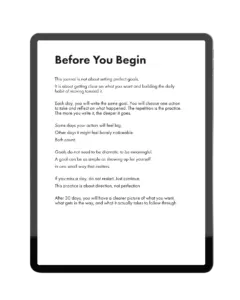
A free 30-day goal setting journal PDF with daily prompts, action steps, and reflection space. Printable, minimal, and designed to keep you focused on…
ExploreExplore More on Goal Setting
- How to Set and Achieve Goals: A Step-by-Step Guide
- How to Set Meaningful Goals and Actually Achieve Them
- How a Goal Setting Journal Can Help You Achieve More
- How to Use a Personal Goals Journal to Create Real Change
Read the full guide on mastering your goals
FAQ
What makes a goal meaningful?
How often should I review my goals?
How does journaling help with consistency?
What’s the simplest way to begin goal setting?