Mid-Year Goal Reset: How to Realign Without Starting Over

A mid-year goal reset is the practice of pausing at the halfway point of the year to honestly review what you set out to do, what actually moved, and what no longer fits, and then realigning your remaining time without scrapping everything you have already built. Most people either ignore June entirely or treat it like a second New Year, complete with fresh resolutions and the same pressure that broke the first round. Both extremes miss the real opportunity.
This guide is for the version of you that is six months into a year that no longer looks like the plan, and is wondering whether to push harder, start over, or let it go. You will find a way to audit your year without judgment, a journaling practice for cutting through the noise, and a clean 30-day method to realign the second half so it actually pulls you forward. Based on the iAmEvolving framework, this is the practice that turns June from a deadline into a checkpoint, a place where the work continues with sharper aim. If you have used the iAmEvolving goal setting guide before, this is the mid-year companion piece.
Why Mid-Year Is Actually the Best Time for a Goal Reset
There is a common myth in personal development that January is the only legitimate moment to set or reset goals. The calendar agrees with that idea, but your life rarely does. By the time June arrives, you have six months of real data: what you committed to, what you actually did, what derailed, and what you quietly stopped caring about. That data is far more useful than the bright optimism of January, which was mostly aspirational guesswork.
A mid-year reset works better than a January reset for the same reason a second draft works better than a first one. You are not inventing from scratch. You are editing from evidence. The questions become sharper. Not ‘what do I want?’ but ‘what is actually working?’ Not ‘what should I add?’ but ‘what should I keep, and what should I let go?’
There is also a quieter advantage. The pressure is lower. No one is watching a June reset the way they watch a January one. You do not have to announce it on social media or post a vision board. You can do this work privately, in a notebook, on a regular Tuesday evening. The lack of fanfare is exactly why it tends to stick.
Many people also find that what they wanted in January is not what they want in June. That shift is six months of growth showing up in your preferences. Treat it as information, not as betrayal of your earlier self. The whole point of a weekly goal reflection practice is to track that movement honestly, instead of forcing the second half to match a plan that no longer fits the person making it.
There is one more reason mid-year reset works. By month six, your habits, schedule, and energy patterns are real, not theoretical. You know when you actually have focus, what derails your evenings, and which projects light you up versus drain you. A goal set in January assumes a version of you that has not lived through 2026 yet. A goal reset in June can finally take into account the version of you that has.
The Honest Audit: What Worked, What Drifted, What Changed
Before you reset anything, you need a clear picture of where the year actually stands. The instinct is to skip this step because it can feel uncomfortable. You might find that the goals you have been carrying around for five months have barely moved. The discomfort of an honest audit is much smaller than the cost of building the next six months on a wrong assumption.
Open a notebook and give yourself thirty minutes. Write down every goal, project, or commitment you remember setting since January. Do not curate. Include the ones you abandoned in February, the ones you forgot about by April, and the ones you are still half-pretending to work on. Then sort them into four categories.
- Worked. Real, measurable progress. Keep the system.
- Drifted. You started, but momentum stalled. Worth examining why.
- Changed. The underlying goal evolved into something different. That is growth.
- Done with it. You no longer want what this goal was pointing at. Let it go.
The fourth category is the hardest. Most people keep dragging around abandoned goals because letting them go feels like quitting, when really it is editorial honesty. A goal you no longer want is not a failure to follow through. It is information about who you have become this year. Cutting it cleanly frees up the energy you have been spending pretending you still care.
For the drifted category, do not rush to diagnose. Some goals drift because the system was wrong. Some drift because the timing was wrong. Some drift because the goal was someone else’s idea borrowed too quickly. The next two sections will give you the prompts to figure out which is which. For now, just see clearly. If you have read about common goal setting mistakes, you will recognize most of what shows up in this audit. Those mistakes are patterns you can see now that you could not see in January, and they say nothing bad about your character.
The Mid-Year Goal Reset Journal: 7 Honest Questions
Once you have your audit, the next move is to interpret it. A list of goals sorted into four buckets tells you what is happening. The journal tells you why. This is where the mid-year goal reset becomes a practice instead of a one-time exercise.
Pick one prompt per session. Five to ten minutes is enough. Write without editing. Grammar does not matter here, and neither does coherence. The goal is to get the answer onto the page so you can look at it.
- Which of my January goals do I still actually want, written in my own words today, not in the language I used six months ago?
- Where did the year surprise me (a new interest, an unexpected relationship, a sudden constraint) and how should that surprise change what I aim for?
- What is one thing I have learned about how I actually work this year, that the January version of me did not know?
- Which goal am I carrying out of obligation, not desire? If no one would notice me dropping it, would I?
- If the second half of the year went exceptionally well, what is the smallest visible change I would notice in my day-to-day life by December?
- Where am I confusing ‘I should want this’ with ‘I want this’?
- What is one specific commitment I can make to the next 30 days that would honor what I have actually learned?
Question seven is the bridge. It pulls the reflection into action without forcing you to redesign your entire year in one sitting. If question one or two leaves you stuck, pair it with the practice of identifying what you actually want, which walks you through separating real desire from inherited expectation. Use one question per night for a week and the picture starts to clarify. The shape of what you actually want in the second half emerges from the page, not from forcing yourself to decide.
Get more like this, every week
Pruning, Not Rewriting: Choosing What Continues
Once the audit and the journal entries are on the page, you will notice that the answer is rarely ‘set new goals.’ More often it is ‘keep three, drop two, sharpen one.’ That is the difference between a mid-year reset and a panic-fueled rewrite. You are editing, not redrafting.
There is a useful rule. The second half of the year should carry forward roughly seventy percent of what worked in the first half, refine about twenty percent of what drifted, and let go of the remaining ten percent. The exact numbers do not matter. The principle does. Continuity is what compounds. Constantly starting over erases the slow gains you already made.
When you decide what to keep, be specific about what you are keeping. ‘Working out more’ is too vague to survive July. ‘Three twenty-minute strength sessions a week, scheduled before nine in the morning’ has a chance. Mid-year is the right moment to tighten the language of your goals, because you now know what your actual life can hold.
When you decide what to let go, give it a clean ending. Write the goal down, write one sentence about what you learned from chasing it, and close it. No spiritual goodbye, no big ceremony. Just a sentence on a page that says ‘this is no longer mine.’ That small act of closure matters because unfinished business takes up far more bandwidth than completed business, even when the completion is a clean cut.
For the goals you are sharpening, look at the structural issue, not the willpower issue. Most mid-year reset goals fail again because the same broken structure carries forward. If you missed your morning workout in March, the reset version probably should not be ‘morning workout, harder this time.’ It should be ‘evening workout, anchored to dinner cleanup.’ Build on what your year has already taught you about the emotional energy behind your goals, not on what you wished was true in January.
A 30-Day Realignment Practice for the Second Half
A mid-year goal reset that ends with a list of decisions and no daily practice will dissolve by week three. The reset only lands if there is a short, repeatable structure that turns the new direction into something you actually do. Thirty days is the right window: long enough to build evidence, short enough to commit to without dread.
Here is a simple weekly rhythm to anchor the next month.
- Monday. Review the audit and the prompt answers from last week. One paragraph on what you actually did and what you actually felt.
- Tuesday and Thursday. Take direct action on the one or two goals you decided to keep and sharpen. Twenty minutes minimum. No planning, just doing.
- Wednesday. A five-minute check-in. One question. Am I still aimed where I said I was aimed?
- Friday. A longer journal entry. Choose one of the seven questions above. Pair it with what actually happened that week.
- Weekend. Rest, recover, plan a single anchor for the coming Monday.
That structure is deliberately light. The temptation in a reset is to over-design: long morning routines, complex habit trackers, color-coded calendars. Those collapse by the second week of work travel or a sick kid. The structure above survives because it has fewer than three working parts, and the only required step is showing up at the page.
For the visualization side of the practice, spend two minutes on goal visualization each Sunday evening. Picture the smallest specific scene from the next week where you show up as the version of you the reset is pointing at. The specificity is what makes it stick.
If thirty days feels like too long to commit to right now, scale it down. The 7-day goal setting sprint gives you a tighter container for the same work, useful when you need momentum more than perfection. Whatever the length, the point is making a single contained promise to yourself, keeping it, and using that evidence as the foundation for the next thirty days.
Conclusion
A mid-year goal reset is neither a second New Year nor a confession that the year did not work. Think of it as a practical mid-year check-in with someone who happens to be the only person actually living your year. You. The audit, the prompts, the pruning, and the 30-day rhythm above are designed to be useful on a regular Tuesday, not at a retreat or on the first day of a quarter.
If you do this work honestly, the second half of 2026 will not look like the first half. Some commitments will continue, some will close, and one or two new ones will sharpen into focus. Rather than a redesigned year, aim for the smaller, steadier thing the iAmEvolving Journal exists to build: a life where what you say you want and what you actually do are slowly aligning. To go deeper on the practice, pair this reset with weekly goal reflection each Sunday and watch the second half start to feel like yours again.

Start your daily practice of gratitude, goals, and growth.
Get the Journal →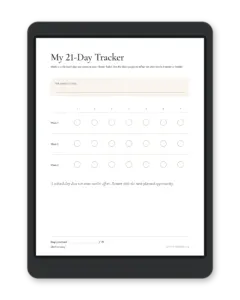
A free 21-day habit tracker PDF with daily check-ins, guided reflection prompts, and mindset reminders. Clean, minimal, and printable.
ExploreFrequently Asked Questions
What is a mid-year goal reset?
When is the best time to do a mid-year reset?
Should I scrap my January goals and start over?
How long does a mid-year goal reset take?
What if my goals changed completely in six months?