Journaling When You Feel Lost in Life: A Structured Way Back
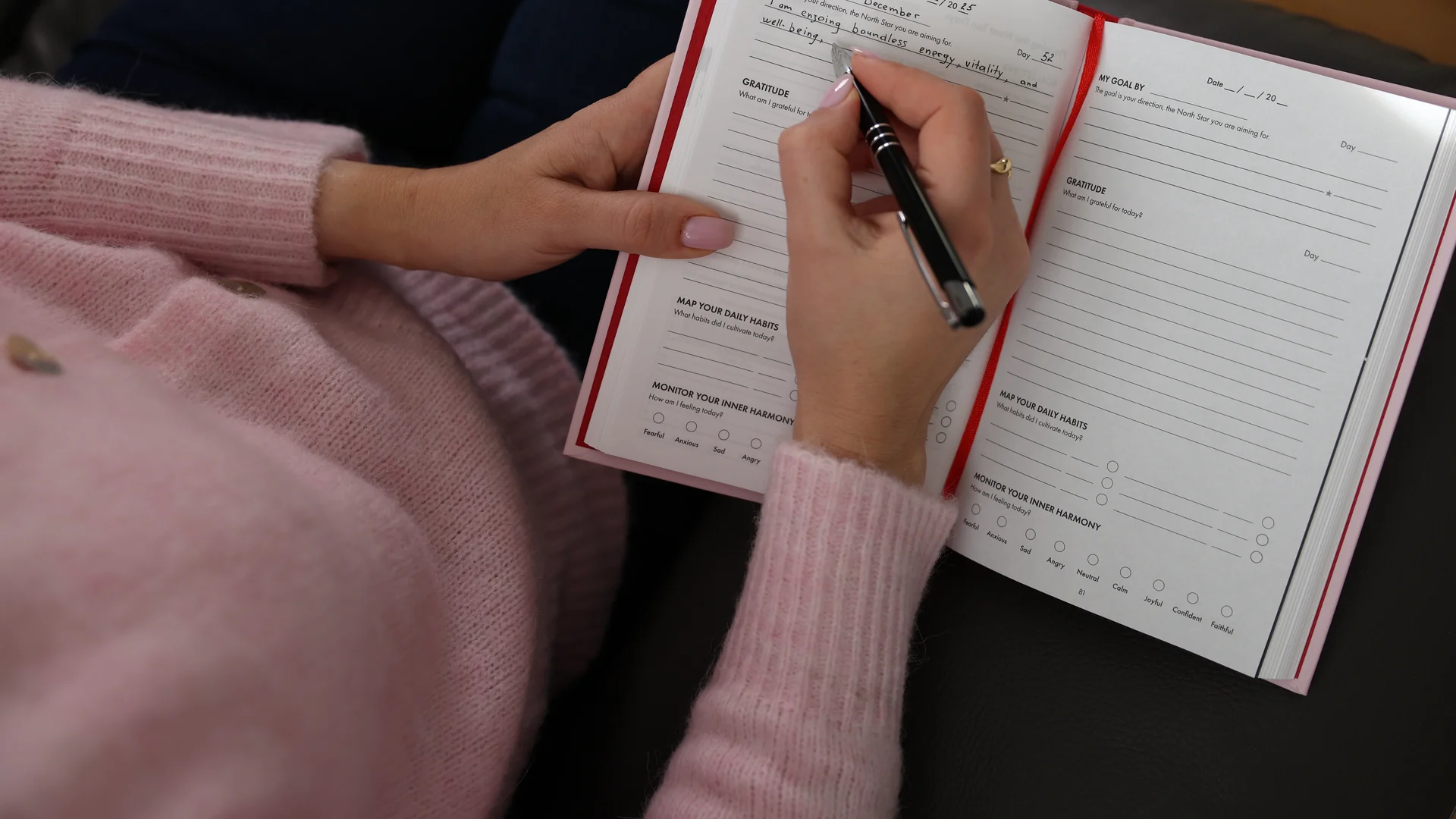
Journaling when you feel lost is not about producing a five-year plan or a tidy purpose statement. It is the quiet work of putting onto paper the strange, drifting feeling of not knowing what you want anymore, so it stops circling silently inside you. The lost feeling is rarely loud. It is more like a fog that thickens around a life that, from the outside, still looks fine. You go to work, you answer texts, you make plans for the weekend, and somewhere underneath all of it you have stopped recognizing the person doing those things.
This guide is for anyone in that exact place: high-functioning, quietly disoriented, and tired of pretending you still know what you want. You will find a way to name what is actually happening, a set of honest prompts you can use this week, a weekly rhythm that does not depend on motivation, and the small signs that you are slowly finding your way back. If you have used journaling for other seasons of your life, the same instinct applies here, only softer and slower.
What Feeling Lost Actually Looks Like Up Close
Feeling lost in life rarely arrives as a single event. There is no funeral, no breakup, no diagnosis. There is just a slow accumulation of days that feel less and less like yours. You answer a question about what you want for dinner and realize you have no opinion. Someone asks what you have been excited about lately and you cannot think of anything honest to say. The calendar fills, the months pass, and you cannot quite remember when you last felt like the author of any of it.
It often shows up as a strange flatness around things that used to matter. Your hobbies feel like obligations. Conversations you once loved feel like static. You scroll longer than you mean to, not because the feed is interesting but because it is something to do with the part of your mind that does not know what it wants. You are not in pain exactly. You are in fog.
There is usually a physical layer too. A heaviness when the alarm goes off. A tightness in the shoulders by mid-afternoon. A sense that you are watching your own life from a half-step behind, narrating it instead of living it. The body is honest before the mind catches up. It already knows you have drifted further from yourself than you meant to.
Naming this is the first quiet act of returning. Feeling lost is not depression, though it can sit next to it. It is not grief, because no one has died. It is not trauma, because there was no single event to point at. It is something more ordinary and more common than that: a season where the script you were following stopped fitting, and the next one has not arrived yet. That gap is real, and it deserves a page.
Why Journaling When You Feel Lost Works Better Than Thinking About It
When you try to think your way out of a lost season, the same three or four worries cycle through your head all day. Should I leave my job. Is this the right city. Do I still love this person. Why am I not more excited about my life. The loop runs on a track and never picks up new information. By the end of a week of thinking, you are more tired and no closer to anything resembling a direction.
Paper slows the loop down. When you write a sentence, you have to choose one word and then the next, which forces a precision that thinking never demands of itself. You discover that what felt like one giant fog is actually four or five smaller, more specific feelings. One is about work. One is about a friendship that has gone quiet. One is about a goal you outgrew but never officially set down. The page separates them so you can see them one at a time instead of all at once.
Writing also lets you be honest in a way that conversation rarely allows. There is no one to reassure, no one to manage, no one whose face you are watching for a reaction. You can write the thing you are not yet ready to say out loud, and nothing bad will happen. That alone is a kind of return. Many readers tell me their first real breakthrough came from a page they almost did not write, a page they later used as a quiet doorway back to reconnect with themselves after months of drift.
Seven Honest Prompts for Journaling When You Feel Lost
These prompts are deliberately not inspirational. They are designed to let you tell the truth on paper without flinching. Pick one per session. Write for ten to fifteen minutes without editing. If a prompt makes you uncomfortable, that is usually the one to choose. You do not need to answer all of them this week, or this month. They will still be here.
- If I am honest, the part of my life I have stopped recognizing the most is…
- The last time I felt like the author of my own days was… and what was different then was…
- If no one would be disappointed, what would I quietly stop doing?
- If no one would be impressed, what would I quietly start?
- The story I keep telling about who I am sounds true but feels old. The part that feels oldest is…
- What am I tired of pretending to want?
- If this lost season is trying to tell me something, the most uncomfortable version of that message is…
Notice that none of these ask you to know your purpose. They ask you to notice where the truth lives in you right now, even when it is small. Direction is downstream of honesty, never the other way around. If you want a softer entry point on a hard day, the gentler prompts in journaling for emotional clarity can be a good place to begin before returning to this list.
Get more like this, every week
A Weekly Rhythm That Does Not Depend on Motivation
One of the hardest parts of a lost season is that motivation is exactly the resource you do not have. The practice has to be small enough that a tired, foggy version of you can still do it on a Tuesday night. The rhythm below is built for that version of you, not the inspired one.
The whole week takes about an hour and a half total, spread thin. There is no streak to break and no perfect day. You miss a day, you pick it back up. That is the practice.
- Three weekday mornings, five minutes each. Open the page and write one sentence: “Today I feel…” Finish it honestly, even if the honest answer is flat or numb. Then write one sentence: “One small thing I can pay attention to today is…” Close the book.
- One weekday evening, fifteen minutes. Choose one prompt from the seven above. Write without editing.
- One weekend session, thirty to forty minutes. Re-read the week’s pages. Underline any sentence that surprised you, embarrassed you, or felt unusually true. Write a single paragraph at the end called “What this week was actually about.”
That weekend re-read is where the work compounds. You start to notice that the same word keeps appearing on different pages. The same name. The same room. The same quiet refusal. That repetition is data. The lost feeling is not random. It has a shape, and the page is how you start seeing it.
If you want a sturdier weekly container for this rhythm, the structure inside reflective journaling pairs well with these prompts and keeps the practice from drifting into venting.
The Small Signs That You Are Slowly Finding Your Way Back
Coming back to yourself after a lost season is almost never a single, cinematic moment. It is a slow brightening, easy to miss if you are watching for the wrong thing. The signs are small, ordinary, and quietly reliable. Most of them show up first on the page before they show up in your life.
- You start having opinions again. About a meal, a song, a movie, a route to work. Small preferences come back online before big ones do.
- You notice you are looking forward to something. Not a vacation, just a small thing on a regular Tuesday. The forward-lean is back, even faintly.
- You catch yourself in a longer breath, the kind your chest had been refusing for months.
- You write a sentence that uses the word “I want” without flinching, and you mean it.
- You feel honest tiredness at the end of a day, instead of the numb tiredness of a day you mostly absorbed.
- You stop performing okayness for people who would still love you if you were not.
- You feel curiosity again. About a topic, a person, a question. Curiosity is one of the surest signs of life alignment returning, long before purpose puts on its full clothes.
None of these signs require you to have figured anything out. They simply mean the version of you that went quiet is beginning to speak again. Your job is not to chase those signs. Your job is to keep showing up to the page often enough that you do not miss them when they arrive.
Conclusion
Feeling lost is not a verdict on your life. It is a season, and seasons respond to small, repeated acts of honesty more than to grand decisions. You do not have to know what you want by Friday. You do not need a five-year plan by the end of the month. You only need to keep showing up to a page that lets you be more honest there than you are anywhere else, and to trust that direction will grow back out of that honesty the way grass grows back out of soil you finally stopped trampling.
The iAmEvolving Journal was built for seasons exactly like this one. Its weekly reflections, intention pages, and gentle prompts are designed to hold you while you slowly come back to yourself, without demanding that you already know who that is. Start with one of the seven prompts tonight. Five minutes is enough. The fog does not lift all at once, but it does begin to thin around any page where you are willing to tell the truth.
Start your daily practice of gratitude, goals, and growth.
Get the Journal →
A free 30-day goal setting journal PDF with daily prompts, action steps, and reflection space. Printable, minimal, and designed to keep you focused on…
ExploreIs journaling when you feel lost the same as journaling through depression?
Journaling when you feel lost addresses an existential drift, the quiet sense of not knowing what you want or who you are becoming, without an acute clinical episode underneath it. Depression is a medical condition with specific symptoms like persistent low mood, loss of interest, sleep changes, and sometimes hopelessness, and it benefits from professional support. The two can overlap, but feeling lost is more often a season of disorientation than a diagnosis. If your low mood persists for more than two weeks or includes thoughts of self-harm, please reach out to a qualified therapist or doctor alongside any journaling practice.
How long does it usually take for journaling to help when you feel lost?
Most people notice a small internal shift within two to three weeks of a consistent practice of fifteen to twenty minutes, three to four times a week. The shift is rarely a sudden clarity about purpose. It is more often a quieter mind, fewer late-night spirals, and small preferences beginning to return. Deeper directional clarity, the kind that influences real decisions about work or relationships, usually takes two to three months of steady weekly reflection. The practice works on a slower timeline than the mind wants, which is part of why it works at all.
What if my journal entries just feel flat or empty when I sit down to write?
Flat entries are not a failure of the practice, they are an honest report from a tired nervous system. Write the flatness itself. Sentences like “I do not have anything to say tonight” or “Today felt like nothing” are valid entries and often the doorway to a more honest line two or three sentences later. The goal is not to produce profound writing. The goal is to keep the page open often enough that the truer thought, when it finally arrives, has somewhere to land. Consistency matters far more than depth in the early weeks.
Should I share what I write with anyone while I am in this lost season?
Most journaling done during a lost season works best as a private practice, at least for the first several weeks. The page needs to be a place where you do not manage anyone’s reaction to your honesty. Once a clearer thought emerges and stabilizes over several entries, it can be useful to share a small piece of it with a trusted friend, partner, or therapist. The order matters: write first, name it to yourself second, share with someone third. Sharing too early often turns a fragile thought into a debate before it has finished forming.
What is the single best prompt to start with if I have never journaled before?
If you have never journaled before and you are in a lost season, the strongest starting prompt is: “If I am honest, the part of my life I have stopped recognizing the most is…” Set a timer for ten minutes and write without editing or judging. This prompt works because it bypasses the need to know your purpose and instead asks you to notice where the truth already lives in you. From that single honest sentence, the rest of the practice tends to unfold naturally over the following weeks.