Neuroplasticity and Journaling: How Writing Rewires Your Brain

Neuroplasticity journaling is the practice of using structured daily writing to reshape how your brain processes thoughts, emotions, and experiences. Neuroplasticity refers to the brain’s ability to form new neural connections and weaken old ones throughout your entire life. Every time you write about gratitude, reframe a negative thought, or reflect on a pattern you want to change, you are physically strengthening the neural pathways that support that new way of thinking.
This is not a metaphor. Brain imaging studies have shown that expressive writing activates the prefrontal cortex, the region responsible for reasoning and emotional regulation, while reducing activity in the amygdala, the brain’s threat-detection center. The result is measurable: clearer thinking, lower stress reactivity, and a gradual shift toward more constructive thought patterns. The journaling guide covers the broader practice, but this post focuses specifically on the neuroscience of why writing changes your brain and how to use that knowledge deliberately.
Researchers at UCLA, the University of Texas, Indiana University, and Stanford have all documented measurable shifts in brain activity from consistent writing practice. Functional MRI scans show that even ten minutes of structured journaling can change the balance between the brain’s reactive and reflective networks. These changes are observable, repeatable, and surprisingly fast to take hold. The foundational habits behind a sustainable practice are covered in more depth in journaling foundations, which pairs naturally with the neuroscience covered here.
What Is Neuroplasticity and Why Journaling Activates It
Neuroplasticity is your brain’s ability to reorganize itself by forming new synaptic connections. Until the late 20th century, scientists believed the adult brain was essentially fixed. We now know it continues changing throughout life in response to repeated experiences, behaviors, and focused attention.
Journaling activates neuroplasticity because it combines several brain-changing factors at once: focused attention, emotional processing, language production, and deliberate repetition. When you write about a specific thought pattern every day, you are training your brain to process information through that lens more automatically. This is the same mechanism behind cognitive behavioral therapy, which has decades of research supporting its effectiveness in changing thought patterns through structured reflection.
Repetition is what matters most. A single journal entry creates a temporary signal. Writing about gratitude, goals, or self-awareness daily for weeks creates a durable neural pathway. Your brain literally builds infrastructure to support the thinking patterns you practice most often.
How Writing Changes Your Brain Chemistry
The act of writing by hand engages your brain differently than typing or thinking. Research published in Psychological Science shows that handwriting activates regions associated with memory, comprehension, and creative thinking more fully than keyboard input. When you write about an emotional experience, multiple brain systems work together simultaneously.
Your prefrontal cortex activates when you organize thoughts into sentences. This is the part of your brain responsible for planning, reasoning, and impulse control. At the same time, your amygdala, which triggers your stress response, begins to quiet down. Research by Matthew Lieberman at UCLA found that putting feelings into words, a process called “affect labeling,” reduces amygdala reactivity in real time.
This is why journaling feels calming. Even when it feels like venting, you are shifting your brain from a reactive state to a reflective one. Over time, this shift becomes easier and more automatic because the neural pathways supporting reflection grow stronger with each session.
For a broader look at the research supporting these findings, the science behind journaling covers additional studies on writing and cognitive function.
Three Ways Journaling Rewires Your Neural Pathways
1. Gratitude Writing Strengthens Positive Pattern Recognition
When you write about what you are grateful for, your brain activates the medial prefrontal cortex and the anterior cingulate cortex, both involved in reward processing and moral cognition. A study from Indiana University found that gratitude writing produced lasting changes in brain activity even weeks after the writing stopped. Participants who wrote gratitude letters showed greater neural sensitivity to gratitude three months later, without any additional writing.
This means gratitude journaling keeps working after the good feeling fades. It trains your brain to notice positive experiences more readily, creating a self-reinforcing cycle. To understand more about how gratitude changes your brain at the neurological level, that post covers the specific studies in greater detail.
2. Reflective Writing Breaks Rumination Loops
Rumination, the habit of replaying negative thoughts on repeat, is one of the strongest predictors of anxiety and depression. Your brain treats looping thoughts as unresolved problems, keeping your stress response active even when no real threat exists.
Writing disrupts this loop by externalizing the thought. When you put a worry on paper, your brain registers it as addressed rather than unresolved. The thought stops demanding your attention. Research by James Pennebaker at the University of Texas found that expressive writing about difficult experiences for just 15 to 20 minutes over four consecutive days led to significant improvements in mental health outcomes. The practice of reflective journaling builds on this mechanism by creating a structured space for processing experiences rather than replaying them.
3. Reframing Exercises Build New Default Responses
Every time you write a reframe (“I failed” becomes “I learned something I needed to know”), you create a competing neural pathway. The old pathway does not disappear immediately, but the new one grows stronger with each repetition. Over weeks and months, the reframed response begins to fire automatically, replacing the old pattern.
This is the same principle behind cognitive behavioral therapy, but you are doing it independently on paper. The journal becomes your own therapist’s notebook. If journaling for overthinking is something you struggle with specifically, structured reframing exercises are one of the most effective approaches.
Get more like this, every week
What the Research Says About Neuroplasticity and Journaling
The evidence connecting writing to measurable brain change comes from multiple fields: neuroscience, psychology, and behavioral medicine.
- Pennebaker (1997): Four days of 15-minute expressive writing sessions produced improvements in immune function, reduced doctor visits, and lower self-reported stress for up to six months afterward.
- Lieberman et al. (2007): Affect labeling (putting emotions into words) reduced amygdala activation, confirming that naming feelings through writing calms the brain’s stress response.
- Kini et al. (2016, Indiana University): Gratitude writing changed neural activity in the medial prefrontal cortex, with effects detectable three months after the writing exercise ended.
- Mueller and Oppenheimer (2014): Handwriting engages deeper cognitive processing than typing, improving retention and comprehension of written content.
Taken together, these studies confirm that journaling is an active intervention that changes brain structure and function when practiced consistently.
How to Journal for Neuroplasticity
All you need to use journaling for brain change is consistency and intention, not a complicated system. Here is a simple framework:
Write by hand. The motor activity of handwriting engages more of your brain than typing. If you have to type, do it slowly and deliberately.
Include one gratitude entry daily. Even a single specific observation (“I am grateful for the conversation I had with my sister this morning”) activates the reward-processing regions of your brain.
Reframe one negative thought per session. Write the thought as it is, then rewrite it with more accuracy and compassion. This is the single most effective neuroplasticity exercise you can do on paper.
Reflect on patterns weekly. Every seven days, read your entries and note what repeats. Awareness of your patterns is the first step to changing them.
Keep sessions to 10 to 15 minutes. Longer is not better. Consistency over months matters more than duration on any single day.
A guided format makes this framework easier to keep. If you are deciding which one to use, our tested picks for the best personal growth journal compare how each layout handles gratitude, reframing, and the weekly pattern review.
The Neuroscience of Journaling: What Happens Inside Your Brain
The neuroscience of journaling sits at the intersection of three fields: cognitive neuroscience, behavioral psychology, and clinical research. When researchers scan the brains of people writing, they observe coordinated activity across multiple regions rather than isolated firing in any one area. Journaling is a whole-brain activity, and that is part of why its effects are so durable.
The prefrontal cortex coordinates the entire process. The dorsolateral prefrontal cortex (DLPFC) manages working memory and language sequencing, while the ventromedial prefrontal cortex (VMPFC) processes the personal meaning of what you write. These regions communicate with the hippocampus, which retrieves the autobiographical memories you draw on, and the angular gyrus, which integrates language with abstract concept formation. This is why journaling can feel like thinking finally catching up with itself. Several regions that normally work in parallel are pulled into the same conversation.
At the same time, the brain’s regulatory systems shift. The amygdala dampens when emotions are named, a finding replicated dozens of times since Lieberman’s original fMRI work in 2007. The anterior cingulate cortex, which mediates between cognition and emotion, becomes more active during reflective writing. This combination, heightened executive function alongside a dampened threat response, is the neurological signature of meta-cognition: the ability to think about your own thinking. It is also why a few honest sentences on the page often clear what an hour of worry could not.
The neuroscience of journaling also explains why handwriting outperforms typing for cognitive benefit. Forming letters by hand engages the motor cortex, the cerebellum, and the visual cortex simultaneously, creating a richer neural trace. A 2020 study in Frontiers in Psychology found that handwriting produced significantly more theta and alpha brain wave activity than typing, both of which correlate with memory consolidation and learning. Practical guidance on building this into a daily habit lives in the science behind journaling post, which complements the neural picture here with longer-term outcome data.
How Long Does It Take to Rewire Your Brain Through Journaling?
The honest answer is that change happens in stages, and each stage has its own neurological signature. You will not feel a dramatic shift after a single entry, but the groundwork begins immediately. Knowing what to expect at each phase is often the difference between quitting early and staying long enough to see the rewiring take hold.
In the first few days, the change is functional rather than structural. Pennebaker’s research showed measurable improvements in mood and stress after just four consecutive days of 15-minute writing sessions. Your brain is not rewired yet, but the reactive and reflective networks are already adjusting their balance. This is the easiest stage to abandon, because the effort is obvious while the results are still hard to see.
Across two to four weeks of daily practice, the new pathways begin to consolidate. Repetition is what turns a temporary signal into durable wiring, so the value comes from showing up rather than writing more on any single day. Most people notice they catch a spiraling thought sooner, or reach for a reframe without forcing it. Protecting the daily cue matters more than motivation at this point, which is why pairing the practice with a reliable trigger helps. The mechanics of that are covered in how to build a journaling habit.
By the two to three month mark, the rewired response starts to feel like your default rather than a deliberate exercise. The Indiana University gratitude study found neural changes still detectable three months after the writing ended, evidence that the structure you build does not collapse the moment you pause. Consistency over a season, not intensity in a single week, is what makes the change stick.
Conclusion
Your brain is not fixed. It is constantly being shaped by what you pay attention to, what you repeat, and what you reflect on. Journaling gives you direct access to that process. Every entry is a small act of rewiring: strengthening the pathways you want and letting the ones you do not need grow weaker.
The iAmEvolving Journal was designed around this science. Its daily structure, combining goals, gratitude, habit tracking, and inner harmony reflection, engages the exact brain systems that drive lasting change. You are not just filling pages. You are building a different mind, one entry at a time.
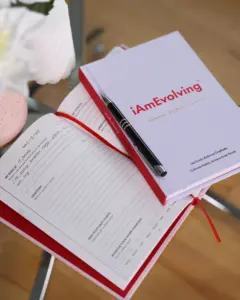
Start your daily practice of gratitude, goals, and growth.
Get the Journal →
A free 30-day goal setting journal PDF with daily prompts, action steps, and reflection space. Printable, minimal, and designed to keep you focused on…
ExploreFrequently Asked Questions
Can journaling really change your brain?
How long does it take for journaling to rewire your brain?
What happens in the brain when you journal?
What type of journaling is best for neuroplasticity?
Is handwriting better than typing for brain benefits?