Journaling Prompts for Burnout Recovery

Journaling prompts for burnout offer a gentle way to slow down when exhaustion builds quietly over time. Burnout doesn’t arrive all at once—it grows day by day as you give more than you have, ignore inner signals, and push past your natural limits until even rest no longer feels restorative.
Journaling prompts for burnout are not about fixing yourself or forcing motivation back into place. They are about listening. Writing gives you a safe space to slow down, acknowledge what you’re carrying, and begin restoring your energy with honesty and compassion.
Burnout is widely described as a state of emotional, physical, and mental exhaustion caused by prolonged, unrelieved stress, and expressive writing is one of the most accessible tools for processing that stress. Journaling prompts for burnout work by turning vague overwhelm into specific, namable experiences. That act of naming is the first measurable step toward recovery, because you cannot soften pressure you have not yet put into words.
If you’d like to continue with more reflective writing, explore the journaling prompts and guided writing resources to deepen clarity, emotional awareness, and gentle personal growth.
If you feel exhausted, disconnected, or emotionally flat, this practice meets you exactly where you are. No pressure. No performance. Just presence.
Understanding Burnout Through Journaling
Burnout is not a personal failure. It is a signal. It tells you that something in your life has been out of balance for too long. Journaling helps you translate that signal into understanding.
When you write during burnout, you are not searching for the “right” answers. You are creating awareness. Awareness is the first step toward healing and restoring inner harmony.
Many people try to journal their way out of burnout by focusing on productivity, gratitude lists, or forced positivity. While those practices have value, burnout often requires something deeper: permission to be honest about depletion.
How to Use Journaling Prompts for Burnout
Before diving into the prompts, set a gentle intention. These prompts are not meant to be answered all at once. Choose one or two per session. Let your nervous system set the pace.
- Write without editing or judging your words.
- Stop when you feel complete, not when you feel finished.
- Notice how your body feels before and after writing.
- Return to the same prompt multiple times if it resonates.
Journaling Prompts to Acknowledge Exhaustion
The first stage of burnout recovery is acknowledgment. These prompts help you name what you’ve been carrying without minimizing it.
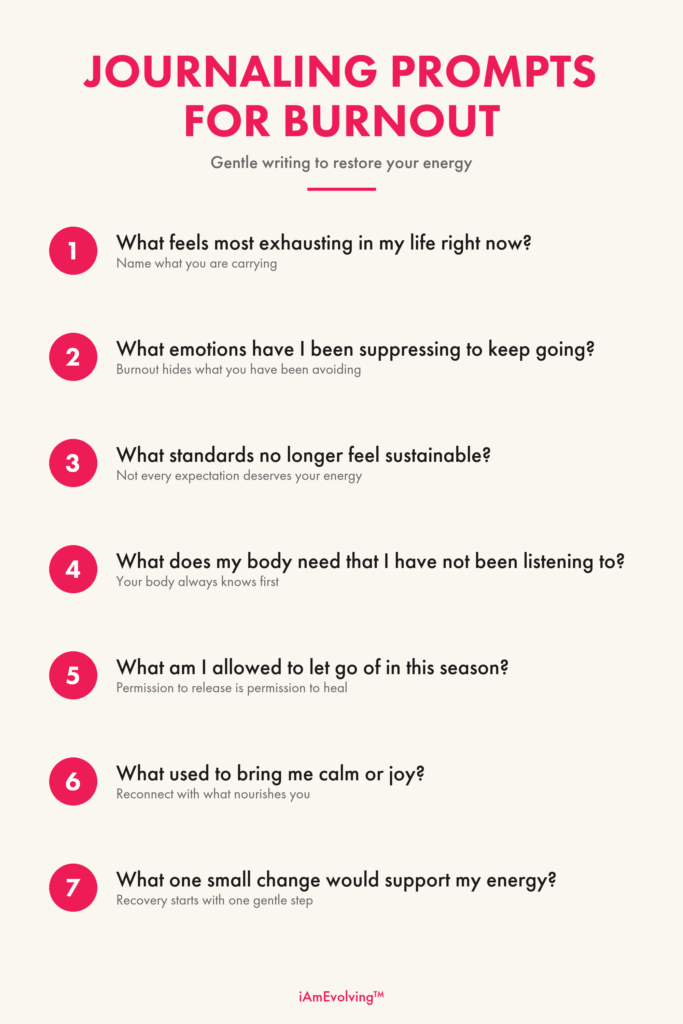
- What feels most exhausting in my life right now?
- Where am I pushing myself even though I feel depleted?
- What emotions have I been suppressing to keep going?
- What does my body need that I haven’t been listening to?
- If my exhaustion had a voice, what would it say?
Get more like this, every week
Journaling Prompts to Release Pressure and Expectations
Burnout is often fueled by invisible expectations. Writing helps bring those expectations into the light so they can soften.
- Who am I trying to be for others right now?
- What standards am I holding myself to that no longer feel sustainable?
- What would it feel like to lower the bar without guilt?
- Which responsibilities could be paused or simplified?
- What am I allowed to let go of in this season?
Journaling Prompts for Emotional Awareness
Burnout often disconnects you from your emotions. These prompts help rebuild that connection gently, without overwhelm.
- What emotion has been most present for me lately?
- Where do I feel tension or heaviness in my body?
- What situations trigger frustration or numbness?
- What helps me feel even slightly more grounded?
- What emotion needs more space to be felt?
Burnout often overlaps with anxiety or emotional numbness. If your writing brings up difficult thoughts or feelings, it may help to understand how journaling supports emotional processing and mental health without forcing solutions.
Journaling Prompts to Reconnect with Yourself
Burnout can make you feel like you’ve lost yourself. These prompts are invitations to reconnect, not to reinvent.
- What used to bring me a sense of calm or joy?
- When do I feel most like myself?
- What parts of me have been neglected?
- What small moments still feel nourishing?
- What does rest mean to me right now?
Journaling Prompts for Gentle Rebuilding
Recovery from burnout is not about doing more. It’s about doing less with intention. These prompts support slow, sustainable rebuilding.
- What is one small change that would support my energy?
- What does a realistic day look like for me now?
- What boundaries would protect my well-being?
- What habits drain me the most?
- What would consistency look like without pressure?
Signs Burnout Is Asking You to Start Journaling
Burnout often arrives long before you have words for it. You may notice fatigue that no weekend can fix, a quiet detachment from work that used to matter, or a sense of moving through the day on autopilot. These are the early signals that journaling for burnout can help you hear.
Other signs are easier to miss. Reading the same sentence three times. Snapping at small frustrations. Forgetting things you usually remember. Feeling resentment toward people you love. Each of these is your nervous system asking for slower attention. When the strain is rooted in your job, it helps to recognize the specific patterns of emotional burnout at work so your writing has a clear and honest focus.
You do not need to wait until you collapse to start. Burnout journal entries do not have to be long or eloquent. A few minutes of honest writing helps you separate what is yours to carry from what you have been carrying for everyone else. The page becomes a place where the pressure has somewhere to go.
If any of these signals feel familiar, treat the awareness itself as progress. The willingness to write about it is already part of recovery.
How Journaling Supports Burnout Recovery
Recovery from burnout is rarely linear, and journaling supports it precisely because it does not push for fast results. Writing slows the inner pace enough for your body and mind to begin syncing again. It gives the part of you that has been performing a chance to set the role down.
When you return to a burnout journal regularly, three quiet shifts begin to happen. You notice your needs sooner, before they reach the breaking point. You name your feelings with more accuracy, which lessens their grip. And you start choosing rest as a value rather than a reward. If exhaustion has left you depleted for weeks, pairing this practice with practical ways to rebuild your energy after emotional burnout gives your recovery somewhere concrete to go.
This is the slow architecture of recovery. Not an escape from your life, but a different relationship with it. If you would like a complementary daily practice, learning how to start a self-care journal can give your recovery a steady, supportive container.
What a Gentle Burnout Recovery Journal Page Looks Like
A gentle burnout recovery journal page does not look like a productivity log or a perfect gratitude list. It looks like a slow conversation with yourself. The structure is loose. The pace is honest. The goal is not insight but presence.
If you would like a real example to follow, here is one shape a recovery page can take. Begin with the date and one sentence describing your energy on a scale of one to ten. Then write a paragraph that finishes the line, today my body feels. Let the words be unedited. If grief, exhaustion, or anger appear on the page, allow them to stay.
Next, choose one prompt from the list above and answer it for ten or fifteen minutes. Use the margin for any phrase that surprises you. End the page with a soft closing line, such as what I most need right now is, and let the answer be small. A nap. A walk. Permission to do less.
You can repeat this same shape every day for a week. The repetition is part of how the nervous system learns it is safe to rest. The pages do not need to look impressive. They only need to be true. Over time, you will see your own patterns appear, and that quiet visibility is what begins to soften the weight you have been carrying.
Creating a Burnout Journaling Ritual
Consistency matters, but only when it’s kind. Choose a time of day that feels supportive. Even five minutes is enough.
You may find it helpful to write in the evening, when the nervous system naturally begins to slow. If you struggle with stress or emotional overload, journaling can act as a grounding anchor rather than another obligation.
If you want deeper structure, consider pairing these prompts with a guided journaling framework like the iAmEvolving Journal, which integrates awareness, gratitude, habits, and inner harmony into a single daily practice.
As you continue writing, you may notice patterns, emotions, or needs becoming clearer. This is part of the deeper work of journaling for emotional clarity, where insight develops naturally over time.
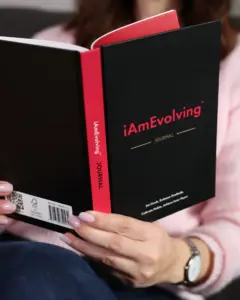
Start your daily practice of gratitude, goals, and growth.
Get the Journal →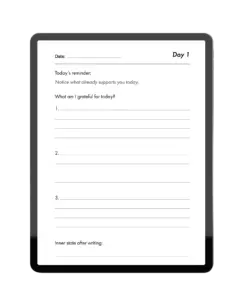
A free 30-day gratitude journal designed for a simple daily practice. Calm, minimal, and printable to help you slow down and reflect.
ExploreClosing Reflection
Burnout is not the end of your capacity. It is a turning point. Journaling gives you a way to listen inward, release what no longer fits, and begin restoring yourself without force.
You don’t need to rush your healing. You don’t need to prove anything. One honest page at a time is enough.
If you’d like to continue with more reflective writing, explore the journaling prompts and guided writing resources to deepen clarity, emotional awareness, and gentle personal growth.
Frequently Asked Questions
How often should I journal when feeling burned out?
What if journaling feels overwhelming?
Can journaling really help with burnout recovery?