Journaling Through a Faith Crisis: Honest Questions on Paper

A faith crisis happens when the beliefs that once anchored your life begin to feel borrowed, hollow, or wrong, and the certainty you grew up with stops answering the questions you actually have now. Journaling through a faith crisis is the slow, private work of putting those questions onto paper before you decide what to do with them. It is not a test of loyalty to any tradition, and it is not a step toward leaving one either. It is a way to listen to yourself honestly while the noise inside you sorts itself out.
This guide is for anyone in that quiet middle place: not fully believing, not yet sure what comes next, and tired of pretending you already have the answer. You will find a way to name what you are actually feeling, seven honest prompts you can use tonight, a method for sitting with doubt without spiraling, and a small daily practice that can hold you while your beliefs reorganize themselves. If you have ever turned to journaling through grief for help with a loss, the same instinct applies here.
What a Faith Crisis Actually Looks Like Up Close
A faith crisis rarely arrives as a single dramatic moment. For most people it is a slow accumulation: a sermon that lands wrong, a prayer that feels like talking into a quiet room, a question your mind keeps returning to that no one in your community wants to discuss out loud.
You might notice it as a strange double life. You still show up at services or family meals and say the right words, while a different conversation runs underneath. You hear yourself singing a song you no longer mean, and feel a small flicker of guilt that you do not mean it. You read a passage you have read a hundred times and suddenly notice a contradiction you cannot un-see.
There is often a physical layer too. A tight chest in the parking lot before service. Insomnia after a conversation with a parent. A tearfulness that catches you off guard while driving. The body knows something has shifted before the mind agrees to admit it.
Naming the experience honestly is the first piece of work. A faith crisis is not the same as falling away, which assumes a destination. It is not the same as deconstruction, which has become a brand. It is what is actually happening to you when your inner sense of what is true and your outer life of belief stop matching. The gap between those two is real, it has weight, and it deserves the honesty of a page.
Why Paper Holds Doubt Better Than Your Mind Can
Spoken doubt almost always becomes a debate. You raise a question with a friend, a partner, a pastor, a parent, and within thirty seconds the conversation has turned into who is right rather than what you are feeling. Even silent doubt becomes a debate when it stays inside your head, because the same anxious loop runs over and over without any new information ever entering it.
Paper does something different. It slows you down to the speed of your handwriting. It does not interrupt you, defend itself, or get hurt. It does not need you to land on a conclusion before the entry ends. You can write “I do not know if I believe any of this anymore” and the page will simply hold the sentence, the way a quiet friend would, without flinching.
Decades of research on expressive writing have shown that putting difficult experiences into words measurably reduces the rumination and anxiety that come with them. The same mechanism applies here. Writing forces the half-formed question in your chest to become a complete sentence on the page, and a complete sentence is something you can actually look at, edit, and live with.
There is also a private dignity in this. You can pray on paper without anyone else knowing what the prayer was. You can ask a question that would shock your community and then close the notebook. Journaling for anxiety and depression already uses this same property of the page: it holds what the body cannot keep carrying. A faith crisis adds one more thing the page can hold for you.
Seven Honest Questions to Start Journaling Through a Faith Crisis
Start small. Pick one prompt, set a timer for ten minutes, and write without stopping to edit yourself. You can write in fragments, in lists, in single sentences. The goal is not a polished essay. The goal is an honest record of where you actually are tonight.
These seven prompts are designed to surface what is underneath, not to push you toward any particular outcome. If you have used journaling prompts for self-discovery before, the method here is the same; only the territory is harder.
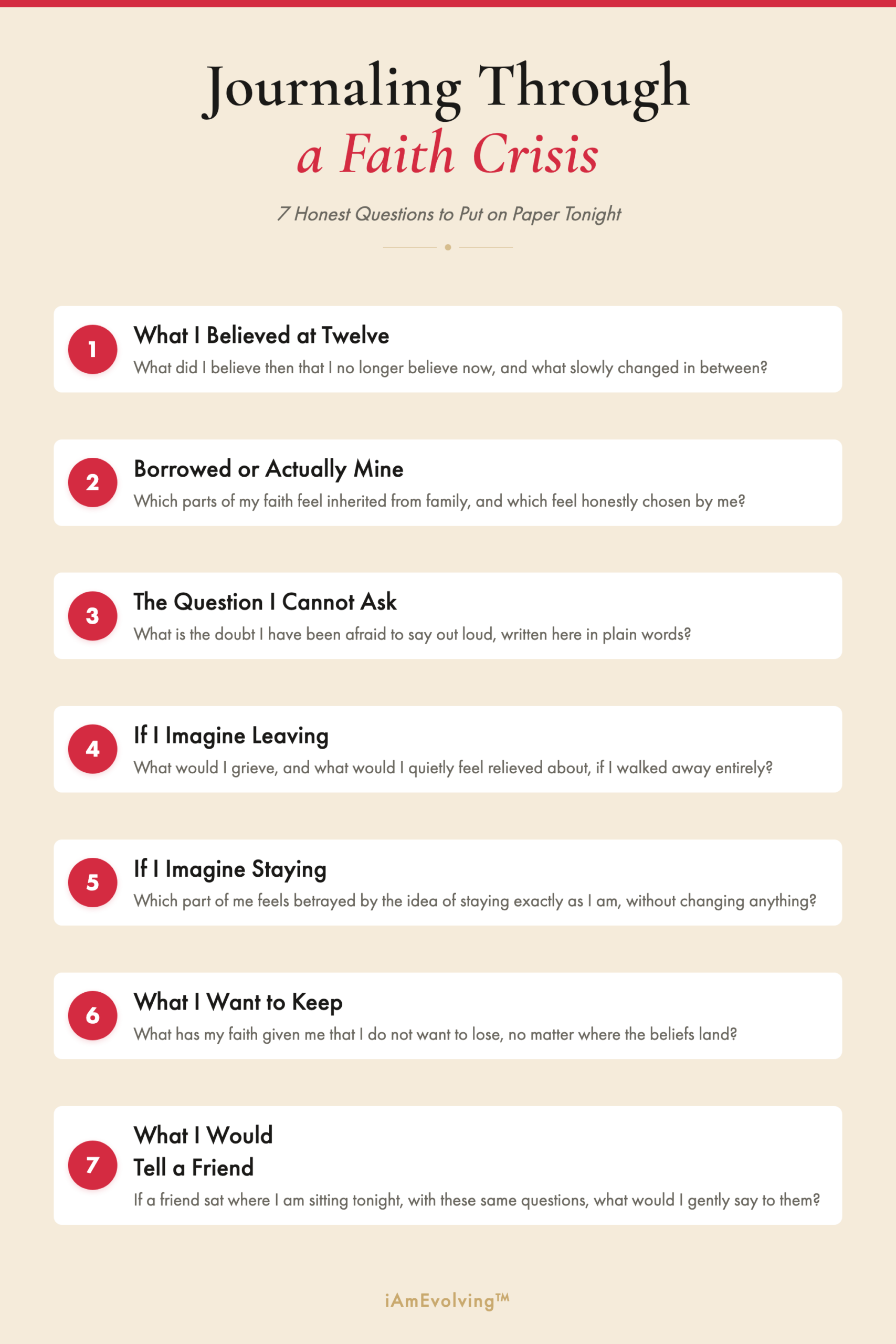
- What did I believe at twelve that I no longer believe at my current age, and what changed in between?
- Which parts of my faith feel borrowed from family or community, and which feel actually mine?
- What is the question I have been afraid to ask out loud, written here in plain words?
- When I imagine leaving this tradition entirely, what do I feel grief for, and what do I feel relief about?
- When I imagine staying without changing anything, what part of me feels betrayed?
- What has my faith given me that I do not want to lose, regardless of where my beliefs eventually land?
- What would I tell a friend who was sitting where I am sitting right now, with the same questions in their lap?
You do not need to answer all seven in one sitting. One question, written honestly, will tell you more than seven answered defensively. Come back to the same prompt across several nights and watch how the answer changes. That movement is the work.
Get more like this, every week
When Doubt Crosses Into Grief, and What to Do With It
At some point, the questions stop being interesting and start being painful. You realize you are not just rearranging beliefs; you are mourning a version of yourself who used to find comfort in a story that no longer fits. That mourning is real and it deserves to be treated as grief, not as a problem to fix.
The losses are often quiet but heavy. The loss of an automatic answer to suffering. The loss of an imagined reunion after death. The loss of a community whose love seemed to assume you would always believe what they believe. The loss of a younger self who prayed with her whole chest and trusted the room to hold her.
When journaling reaches this layer, the work shifts. The page is no longer for arguments; it is for letters. Write a letter to the version of yourself who first believed. Thank her for what that belief did for you. Tell her what you are still carrying and what you have set down. Write a letter to a God you may no longer be sure of, in the same voice you would use to write to an old friend you are not ready to lose.
Move slowly through this layer. Pause when you need to. If the work begins to feel like prayer again, let it. The arc from fear to faith can pass back through the page in unexpected ways, and the version of belief that survives this kind of honest writing is often more durable than the one that came before.
Building a Quiet Daily Practice That Can Hold You
A faith crisis can last weeks, months, or years. A practice that only shows up when the crisis flares will leave you exhausted between flare-ups. What helps more is a small daily rhythm that the questions can settle into, the way water settles into a low spot in the ground.
The iAmEvolving framework treats journaling as a daily anchor rather than a crisis tool, and the same approach works here. A ten-minute window in the morning or evening, the same notebook each day, the same opening line if it helps: “Today, honestly, where am I with this?” Repetition makes the page familiar. Familiarity makes hard truths writeable.
A simple weekly structure can hold the practice without becoming another rule:
- Monday and Wednesday: the open question of the week, written long-form.
- Tuesday and Thursday: gratitude that does not require any specific belief, like a body that walked you through the day, a person who answered the phone, a window that caught the light.
- Friday: one of the seven prompts above, picked at random.
- Saturday and Sunday: whatever the week left unsaid.
Reflective journaling works especially well here because the goal is not to decide; the goal is to notice. Over a season of small entries, you begin to see the shape of your actual beliefs emerging on the page, instead of the shape you were told they should be. The practice does not give you certainty. It gives you something better: real contact with yourself.
Conclusion
A faith crisis is not a problem to be solved by Sunday. It is a season of your inner life that is asking for honesty, time, and a place to put the questions while you live with them. The page is one of the few places in adult life where you are allowed to be completely undecided out loud, without anyone needing you to land somewhere by the end of the conversation.
You do not have to know yet what you believe. You only have to be willing to write what is actually true for you tonight: the question, the grief, the small surprising piece of gratitude, the prayer that snuck out anyway. The iAmEvolving Journal exists to make that nightly contact a little easier to keep, especially in seasons like this one. If you are new to the practice, start journaling for self-improvement covers the basics of building the daily ten minutes. Then come back to your honest questions and let the page do what it is good at: hold you, slowly, until the next sentence is ready.
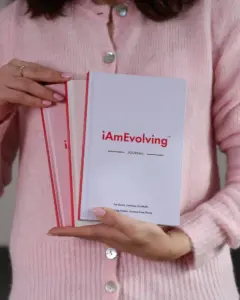
Start your daily practice of gratitude, goals, and growth.
Get the Journal →
A free 30-day gratitude journal designed for a simple daily practice. Calm, minimal, and printable to help you slow down and reflect.
ExploreFrequently Asked Questions
How do I start journaling through a faith crisis without making it worse?
Is it dangerous to write down doubts about faith?
What if journaling makes me feel further from God or my tradition?
How long does a faith crisis usually last?