Back to School Reset: Helping Your Teen Start the Year Grounded

The first weeks of a new school year can flatten a teenager. The schedule triples overnight, the social stakes reset, and the pressure to perform lands before anyone has caught their breath. A back to school reset is the small, deliberate pause that lets your teen meet all of it from steadier ground instead of being swept along by it. It is less about a color-coded binder and more about helping a young person stay connected to themselves while everything speeds up, and it asks only a few honest minutes a day. The start of a new school year is the easiest moment to begin, because a new practice sticks best when everything else is already changing.
This guide is for parents who want to help without hovering, and for teens who feel the weight of a busy schedule and want a calmer way to carry it. You will find the reasons a reflective habit matters at this age, simple prompts your teen can actually use, and a realistic plan for keeping it going past the first hopeful week. If you want the bigger picture of how this fits into a daily practice, the journaling guide is a good companion to this article.
Why a Back to School Reset Matters More Than a Perfect Planner
The teenage years stack a lot on a young mind at once: shifting friendships, academic expectations, social media comparison, and the slow, important work of figuring out who they are. Most teens have no neutral place to set all of that down. A journal becomes that place. Writing externalizes a worry so the brain can look at it instead of looping on it, which is part of why studies consistently link expressive writing to lower stress and better focus.
There is also a less obvious benefit that matters more over time. When a teen writes regularly, they start noticing their own patterns: which classes drain them, what actually helps before a test, when their mood dips and why. That self-knowledge is the foundation of emotional maturity, and it transfers far beyond school. A back to school reset gives a young person a steady, low-pressure way to hear their own thoughts in a world that is constantly talking over them, and the entries never need to be perfect.
When I started journaling as a teenager, no one told me what to write, so I mostly didn’t. The page felt like a performance I might fail. What changed everything years later was a single repeating prompt that asked nothing impressive of me, just an honest answer to one small question. That is the whole secret with teens. Lower the bar far enough that showing up feels easier than skipping, and the habit has room to grow on its own.
What Makes a Back to School Reset Actually Stick
The difference between a journal that lasts and one that gets abandoned by October usually comes down to a few design choices. Teens will not keep a practice that feels like more homework. It has to be short, private, and free of grading. The most reliable approach to journaling for teens keeps each entry small and removes any pressure to write well.
A few principles make the habit stick:
- Keep it short. Three to five minutes is enough. A full page is optional, never required.
- Protect the privacy. The journal is theirs. If a teen suspects a parent is reading it, honesty disappears and the practice loses its value.
- Use prompts, not blank pages. A blank page intimidates. A single specific question gives the mind somewhere to start.
- Anchor it to something they already do. After brushing teeth, before homework, on the bus. The habit rides on an existing routine.
- Let it be messy. Spelling, grammar, and neatness do not matter here. This is thinking, not an assignment.
Based on the iAmEvolving framework, the structure matters as much as the willingness. A guided format that pairs a goal, a gratitude note, and a feelings check gives a teen a clear path through the page, so the practice never depends on being in the mood to write. When the bar is this low and the path is this clear, consistency becomes realistic. And consistency, not intensity, is what turns a few scattered entries into a habit a teen actually relies on during a hard week.
Simple Daily Prompts to Get Started
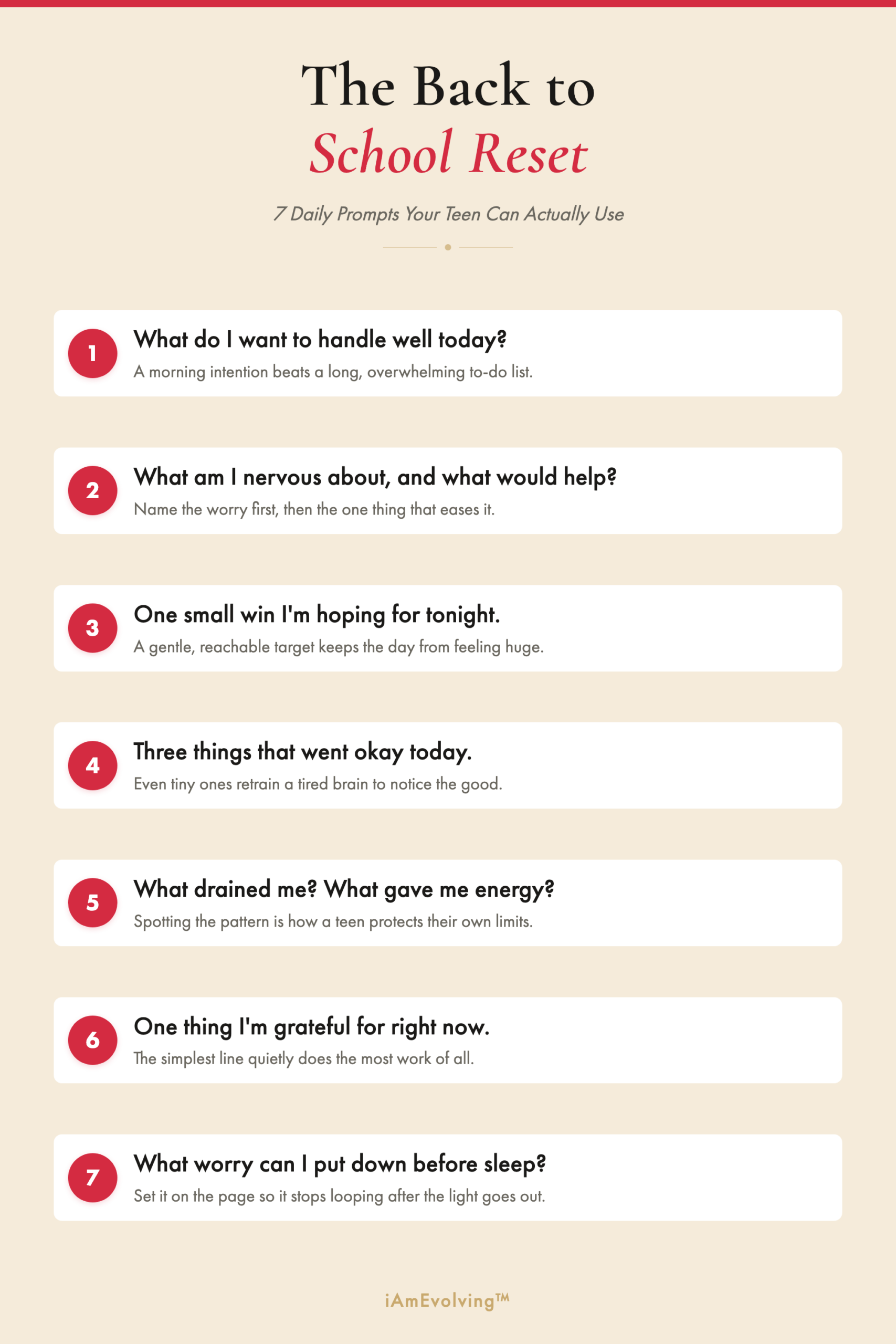
The strongest back to school reset routines mix three ingredients: a goal to aim at, a moment of gratitude to steady the mood, and an honest emotional check-in. Your teen does not need all three every day. Rotating through them keeps the practice from feeling repetitive. Here is a simple set to start with.
During the first week back, it helps to lean on the goal prompts while everything still feels new and the calendar is light. As the term gets heavier, the gratitude and emotional check-in prompts tend to do more of the work. Let the balance shift naturally with the season instead of forcing the same entry every single day.
Morning prompts (set the tone)
- What is one thing I want to handle well today?
- What am I a little nervous about, and what would make it easier?
- One small win I am hoping for by tonight.
If mornings are rushed, even one sentence counts. Pairing this with an existing wake-up routine works well; the same logic behind an adult morning journaling routine applies just as cleanly to a teenager getting ready for class.
Evening prompts (process the day)
- Three things that went okay today, even small ones.
- What drained me, and what gave me energy?
- One thing I am grateful for right now.
- If today was hard, what do I want tomorrow to feel like instead?
The gratitude line matters more than it looks. Research on gratitude practice shows it shifts attention away from threat and toward steadiness, which is exactly what an overstimulated teenage nervous system needs at the end of a long day.
Get more like this, every week
How to Help the Habit Stick Through the School Year
The first week is easy. The eighth week, during midterms and a packed calendar, is where most journals go quiet. Helping a teen build a durable journaling habit means planning for the dip before it arrives, not scrambling once it has.
A few moves make the difference between a habit and a good intention:
- Stack it on an existing cue. Tie writing to something that already happens every day, so the teen does not have to remember it from scratch.
- Aim for “good enough,” not perfect. A two-word entry on an exhausting night keeps the chain alive. Missing a day is normal; missing two in a row is the real signal to simplify.
- Make the journal visible. A notebook left on the nightstand gets used. One buried in a drawer does not.
- Resist the urge to check in too often. Asking “did you journal today?” turns a private practice into a chore. Model it instead by keeping your own.
Habits form through repetition under low resistance, not willpower under high pressure. The goal for the school year is not a flawless streak. It is a practice your teen returns to often enough that, by spring, picking up the journal on a stressful night feels automatic.
When School Stress Shows Up in the Pages
At some point the journal will hold something heavier than a to-do list: test anxiety, a friendship that fell apart, the dread of a Monday. This usually means the practice is working exactly as intended. Naming a hard feeling on paper reduces its grip, and a teen who can write “I am overwhelmed and I do not know why” has already taken the first step toward understanding it.
When anxiety is the recurring theme, more targeted writing helps. A short set of journaling prompts for anxiety gives a worried mind a structured way through the spiral instead of around it. Useful questions for a stressed teen include:
- What exactly am I worried about, and how likely is it really?
- What part of this is actually in my control?
- What is one small thing I can do in the next hour?
- What would I tell a friend who felt this way?
If the writing surfaces something that looks like more than ordinary school stress, the journal becomes useful in another way: it gives a parent and teen something concrete to talk about, and it can help a counselor or therapist understand what has been going on. A journal is a useful self-regulation tool, but it cannot replace support when a young person genuinely needs it.
Conclusion
A back to school reset will not fix a hard semester, and it does not need to. What it offers is steadier: a few honest minutes a day where your teen can set down the noise, notice their own patterns, and remember that their inner life is worth paying attention to. Start small, keep it private, and let the prompts do the heavy lifting on the days motivation is thin.
If your teen writes only on the hard nights this year, that is still a win. The habit does not have to be perfect to be protective. Hand them the notebook, point them at a prompt, and let them take it from there at their own pace.
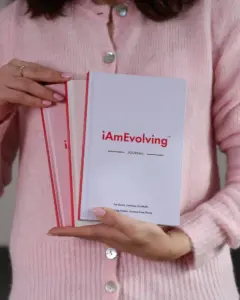
Start your daily practice of gratitude, goals, and growth.
Get the Journal →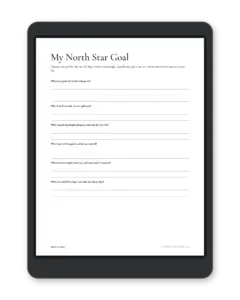
A free 30-day goal setting journal PDF with daily prompts, action steps, and reflection space. Printable, minimal, and designed to keep you focused on…
ExploreFrequently Asked Questions
What is a back to school reset?
How do I get my teenager to actually journal?
How long should a teen journal each day?
What should a teen write about in a school journal?
Can journaling help with school stress and anxiety?