Journaling Through Divorce: A Daily Practice for Healing

Journaling through divorce is one of the steadiest ways to carry yourself through the most disorienting season of your adult life. When a marriage ends, the days lose their shape. Mornings feel heavier, afternoons stretch, evenings ambush you. Writing for ten minutes each day gives you back a small frame: a way to name what happened, see where you stand, and hear your own voice underneath the noise of everyone else’s opinions.
This post is for anyone in the early or middle stages of separation. Whether the paperwork is signed, in motion, or still emotional, you don’t need to be a writer to do this. You need a notebook, a pen, and the willingness to show up for ten minutes when everything inside you wants to disappear. What follows is the daily practice I’d recommend to a close friend: four small parts that take the edge off and slowly, quietly, rebuild a self that feels like yours again. Many readers also find journaling through a breakup a helpful companion piece for the earlier stages of separation.
Why Journaling Through Divorce Works When Words Fall Short
Divorce scatters your thinking. One minute you feel relief, the next you feel ambushed by an old memory or a name on the calendar. Journaling through divorce works because it gives the brain a contained place to put all of that. Writing by hand for ten minutes a day has been shown to lower stress markers, slow rumination, and improve sleep — three things you need most right now. You aren’t journaling to fix anything. You’re journaling to slow the loop down enough that you can actually feel what’s happening.
It also works because divorce is rarely linear. Some days you wake up steady. Other days a song or a tax form pulls you back to the beginning. A journal keeps a record of that arc. When you reread an entry from six weeks ago and realize how far you’ve already moved, the journal becomes evidence — proof that you are not the same person you were when the worst day hit. That kind of evidence is hard to argue with, even on the bad mornings.
The First Pages: Writing Through the Initial Shock
The early days of a divorce don’t reward structure. You’re often in shock, switching between numbness and waves you can’t predict. For the first week or two, give yourself permission to write messy. Don’t reach for prompts. Don’t try to journal “correctly.” Open the page and say what is true at that moment, even if what is true is, “I don’t know how I’m going to get through this Tuesday.”
If you cannot find words at all, try one of these openings:
- Right now, my body feels…
- The hardest part of today was…
- I keep replaying…
- If I could tell one person the truth, I would tell them…
- I am not yet ready to…
Write until the timer goes off, then close the book. You do not need to reread it. The point of the first pages isn’t insight. The point is to take the pressure out of your chest and put it somewhere that can hold it. Over time, this practice supports a slow shift toward learning to release what doesn’t serve you without forcing it.
Building a Daily Anchor: A Four-Part Practice
Once the first wave passes, usually somewhere between week two and week six, you can introduce a small daily structure. The version I recommend to clients and readers has four parts: one goal, one gratitude, one habit, and one check-in. The whole thing takes ten minutes and is designed to be doable on a hard day, not just on a good one.
1. One Small Goal for the Day
Not a life goal. Not a five-year plan. One small thing that, if you did it today, would make you feel like you moved an inch forward. Send the email to your lawyer. Drink water before coffee. Take a walk after lunch. Write the goal down before you start your day. The act of finishing one small thing is how trust in yourself rebuilds, one quiet promise at a time.
2. One Honest Gratitude
Skip the forced gratitude. You’re not pretending the divorce is a gift. Find one small thing that was actually good in the last twenty-four hours: a hot shower, a text from a friend, the way the light came in at the window. Honest gratitude trains the brain to scan for something other than threat, which is the loop divorce loves to keep you stuck in.
3. One Habit That Steadies You
Pick one habit that holds your body together when your mind won’t cooperate. For most people it’s sleep, food, or movement. Write down what you did and what you skipped, without judgment. Habits aren’t about discipline right now — they’re about giving your nervous system something predictable to lean on while everything else changes.
4. One Honest Check-In
End with one or two sentences on where you actually are. Not where you should be. Just: how is the body, how is the heart, what is loud today. This is the part most people skip and the part that, six months in, you’ll be glad you kept. It’s also the practice that builds journaling for emotional clarity over time.
Get more like this, every week
Prompts for the Hardest Days
Some days, the four-part anchor will feel like too much. When you’re flattened by a hearing, an anniversary date, a chance encounter, or an old photo, switch to a single prompt. Pick one of these and write for as long as you can:
- What did I lose in this marriage, and what did I never actually have?
- What part of me am I getting back?
- What would I say to myself five years ago, the version of me who said yes?
- What am I afraid I’ll repeat, and what would it look like to break that pattern?
- What does safety feel like in my body when I imagine it?
- Who am I outside of this relationship?
- What is one thing I want my next chapter to refuse?
If you want a longer list to draw from across many seasons, the journaling prompts for healing collection has more material to sit with. Pick one prompt per day and resist the urge to answer all of them at once. Depth comes from staying with a single question, not from sprinting through a list.
When to Reread, When to Burn the Page
Not every entry is a keepsake. Some entries are meant to be read again later, and some are meant to be released the same day you wrote them. Both are valid. The general rule I use: if it’s a record of an honest day, keep it. If it’s a letter to your ex, a venting page, or a spiral that you would not want anyone, including future you, to read, you have permission to tear it out.
Some people keep two journals: one steady and reflective, one for raw release. Others use a single book and mark pages with a corner fold or a small dot when they want to revisit. Try both. You’ll know what serves you. The goal is not to build an archive of pain. The goal is to use writing as a tool that supports the slow work to rebuild confidence after setbacks, a process that takes more time than most people are willing to admit.
How Journaling Carries You Into Rebuilding
Somewhere between month three and month nine, most people notice a shift. The crying jags shorten. The anger softens into clarity. You start writing less about the marriage and more about the life in front of you. This is the quiet bridge that journaling builds. You don’t notice you’ve crossed it until you reread an old entry and barely recognize the voice on the page.
At this point, the practice can evolve. You might start mapping out values you want your next chapter to honor. You might start drafting plans for moves, careers, or boundaries you couldn’t have considered before. The same four-part structure still works; only the content is different. Goals get bigger. Gratitude broadens. Habits become rituals. Check-ins become reflections. The journal stays with you, but it stops being a survival tool and starts becoming a planning one.
Conclusion
Divorce will not be solved by writing in a notebook. Nothing solves divorce. But journaling through divorce is one of the few practices that meets you where you actually are, without asking you to feel better than you do. It lets the truth be the truth. It builds a record of who you are becoming. And it gives you ten minutes a day that belong only to you, in a season when so much of your life feels owned by lawyers, calendars, and other people’s reactions.
If you want a structure that holds all four parts (goals, gratitude, habits, and check-ins) in one place, the iamevolving journal is built around exactly this rhythm. Start with one page tonight. Tomorrow, write another. That’s the whole practice.
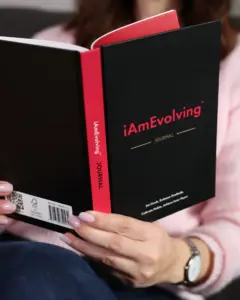
Start your daily practice of gratitude, goals, and growth.
Get the Journal →
A free 30-day goal setting journal PDF with daily prompts, action steps, and reflection space. Printable, minimal, and designed to keep you focused on…
ExploreFrequently Asked Questions
How long should I journal each day when going through a divorce?
What if I cry every time I open the journal?
Should I write to or about my ex in the journal?
Is journaling through divorce different from journaling through a breakup?
When will journaling start to actually help?