Self-Care Journal for Women: Prompts, Practices, and Picks

A self care journal for women is a dedicated space where you process the invisible weight you carry: the mental load of managing schedules, the emotional labor of holding everyone together, and the small ways you set yourself aside to keep things running. Research shows that expressive writing reduces cortisol levels and improves emotional regulation, making journaling one of the most accessible self-care practices available. When you write honestly about what you feel, need, and want, you begin reclaiming parts of yourself that daily responsibilities have slowly pushed to the margins.
Self-care journaling is not about performing wellness or filling pages with forced positivity. It is about creating a private, judgment-free ritual where you check in with yourself the way you check in with everyone else. Whether you have five minutes before the house wakes up or fifteen minutes before bed, a self care journal for women gives you a consistent anchor point: a place to notice patterns, release pressure, and reconnect with who you are beneath all the roles you play. If you are already familiar with the foundations of a journaling practice, this guide will help you shape it specifically around self-care.
Why Self-Care Journaling Matters for Women
Women carry a disproportionate share of emotional labor, not because they are naturally better at it, but because the world has trained them to absorb it without question. You remember the dentist appointments, notice when someone is upset at the dinner table, and carry the mental checklist that no one else sees. Over time, this invisible work creates a kind of chronic background stress that standard relaxation techniques barely touch.
Journaling reaches that layer. When you write about what is actually draining you, you make the invisible visible. You see the patterns: the resentment building around unequal responsibilities, the guilt that shows up when you try to rest, the way you minimize your own needs because someone else always seems to need more. Naming these things on paper is the first step toward changing them.
Self-care journaling also serves as an identity practice. Somewhere between career demands, caregiving, partnerships, and friendships, many women lose track of what they actually enjoy. Not what they are good at, not what they should want, but what genuinely lights them up. A daily journal practice designed for women creates a space to rediscover those parts of yourself.
And the research supports it. Studies published in the journal Psychosomatic Medicine found that writing about stressful experiences for just fifteen to twenty minutes a day over three to four days improved immune function and lowered blood pressure. For women managing chronic stress, those small windows of honest writing can create measurable shifts in both mental and physical health.
What Makes a Self Care Journal for Women Different
Not every journal is a self-care journal. A blank notebook is a wonderful tool, but it does not guide you toward the kind of reflection that actually restores you. The difference between a regular journal and a self-care journal comes down to intention and structure.
A self-care journal is designed to prompt you toward awareness: your energy, your emotions, your boundaries, and your needs. It asks questions that a blank page does not. It might invite you to check in with your body, notice what drained you today, or name one thing you did just for yourself. That intentional structure is what turns writing from a general activity into a genuine act of care.
Here is how self-care journals typically differ from standard journals:
- Guided prompts focused on emotional check-ins: rather than open-ended pages, self-care journals ask specific questions about mood, energy, and boundaries
- Sections for body awareness: tracking sleep, physical tension, and how your body feels helps you notice stress before it becomes a crisis
- Gratitude and joy-tracking: not toxic positivity, but genuine attention to what nourishes you
- Space for needs and boundaries: prompts that ask what you need to say no to, what you need more of, and where your limits are
- Ritual-friendly design: layouts that work for short daily sessions rather than demanding long-form essays
The best self-care journals meet you where you are. They do not require an hour of free time or perfect handwriting. They ask you to pause, notice, and respond honestly.
20 Self-Care Journaling Prompts for Women
When you sit down with your journal and your mind goes blank, prompts act as easy entry points. The following prompts are organized by theme so you can choose based on what you need most on any given day. You do not have to answer them in order; pick the one that pulls at you.
Emotional Check-In Prompts
- What emotion has been sitting with me most today, and when did I first notice it?
- Where in my body am I holding tension right now? What might that tension be trying to tell me?
- What is one thing I have been avoiding feeling, and what would happen if I let myself feel it fully?
- If my mood right now were weather, what would the forecast be?
- What did I need to hear today that no one said?
Boundaries and Energy Prompts
- What drained my energy this week, and is it something I can change or release?
- Where am I saying yes when I actually mean no?
- What would my day look like if I protected my energy the way I protect other people’s feelings?
- Who or what consistently leaves me feeling depleted, and what is one small boundary I could set?
- What would I do with an entire afternoon that belonged only to me?
Identity and Joy Prompts
- Apart from my roles (mother, partner, employee, friend), who am I?
- What is something I used to love doing that I have not done in a long time?
- When was the last time I laughed without thinking about anything else?
- What is one thing about myself that I genuinely appreciate, not for what it does for others, but for how it makes me feel?
- If I could describe the woman I am becoming, what would she be like?
Rest and Restoration Prompts
- What does rest actually look like for me, not just sleep, but real restoration?
- Am I resting enough, or am I just recovering enough to keep going?
- What guilt comes up when I try to do nothing, and where did that guilt originate?
- What is one small act of care I can give myself before the day ends?
- If self-care were not about productivity or earning rest, what would I choose to do right now?
These prompts work best when you answer them without editing yourself. Write the first thing that surfaces. If a prompt makes you uncomfortable, that discomfort is usually a sign you are getting close to something worth looking at. For more prompts focused on self-discovery through journaling, the rule is always the same: honest writing, without performance.
Get more like this, every week
How to Build a Self-Care Journaling Practice
Having prompts is helpful. Having a practice is what creates change. The difference between journaling once in a while and journaling as self-care is consistency, not perfection, but a rhythm you can return to even on difficult days.
Start With Five Minutes
You do not need an hour. Five minutes of honest writing will serve you better than thirty minutes of writing what you think you should feel. Set a timer if it helps. Open your journal, pick a prompt or just ask yourself “How am I really doing?” and write until the timer goes off. That is enough.
Attach It to an Existing Ritual
The easiest way to build a journaling habit is to anchor it to something you already do. Write while your morning coffee brews. Journal for a few minutes after brushing your teeth at night. Tuck your journal next to whatever daily habit feels most natural. The goal is to make it easy to reach for, not something that requires extra willpower.
Create a Sensory Anchor
Light a candle. Make tea. Sit in the same chair. These small sensory cues signal to your nervous system that this is your time. Over weeks and months, the ritual itself becomes calming. Your body starts to settle the moment you open the journal, before you have even written a word.
Let Go of Doing It Right
There is no correct way to journal for self-care. Some days you will write paragraphs. Other days you will write three words: “Today was hard.” Both count. The practice is in showing up, not in producing something beautiful. If you find yourself stuck, starting a self-care journal with minimal expectations is the fastest path to making it sustainable.
Review Without Judgment
Once a week or once a month, read back through your entries. Not to critique yourself, but to notice. You will start to see patterns: what triggers your stress, what restores your energy, which boundaries keep slipping. That awareness is the foundation of real self-care, because you stop guessing what you need and start knowing.
Common Mistakes Women Make When Starting a Self-Care Journal
Most women do not abandon journaling because they failed. They abandon it because of a few small habits that turn the practice into another obligation. Noticing these patterns early makes the difference between a journal you write in once and a journal that becomes a real anchor.
The most common mistake is treating it like a performance. You start with neat handwriting, full sentences, and the feeling that the entries should be meaningful. Within a week, the pressure makes you skip a day, and the skipped day becomes a reason to stop entirely. Honest writing is messy. Let it be.
Another mistake is writing only when things are hard. A self-care journal becomes a record of struggle rather than care. Try to write a few lines on ordinary days too. That is how you build a baseline and notice when something is genuinely shifting, not just when you are in crisis. The patterns covered in journaling for emotional clarity only emerge when you write across the full range of your days.
A third pattern is over-prompting. Asking yourself ten different questions in one sitting fragments your attention. Choose one prompt and let it unfold. The depth of a single honest answer is worth more than a dozen surface-level ones.
Finally, many women try to make journaling another productivity tool. They track every habit, every emotion, every goal in a structured grid. That can work for a while, but self-care asks for presence more than optimization. If your journal starts to feel like a spreadsheet, soften the structure. Let some pages be only words. Let some pages be blank.
What to Look for in a Self Care Journal for Women
If you are choosing a journal specifically for self-care, not every option will serve you equally. Some are beautifully designed but lack the structure that makes journaling therapeutic. Others are heavily guided but leave no room for your own thoughts. The right journal balances structure with freedom.
Here is what to consider:
Guided vs. Blank Pages
If you are new to journaling, guided prompts help you get past the “I do not know what to write” barrier. If you are experienced and want more freedom, look for journals that offer a mix: some structure with enough white space to follow your own thread. The best self-care journals give you both: a prompt to start and room to go wherever you need.
Emotional Depth vs. Surface-Level Prompts
Many journals marketed toward women rely on surface-level prompts like “List five things you are grateful for” or “What made you smile today?” Those have value, but self-care journaling needs to go deeper. Look for journals that ask about boundaries, emotional patterns, identity, and needs, not just positivity.
Daily Practice Integration
The most effective self-care journals are designed for daily use in short sessions. Look for layouts that work in five to fifteen minutes: morning check-ins, evening reflections, or both. A journal that demands an hour of your time each day will end up collecting dust. One that fits naturally into your morning or evening journaling routine becomes a lasting habit.
Quality and Feel
This matters more than people realize. A journal that feels good in your hands (the weight of the paper, the texture of the cover, the way it lies flat when open) makes you want to pick it up. Self-care is partly about pleasure, and the physical experience of your journal is part of the ritual.
How to Create Your Own Self-Care Journal at Home
If you would rather build your own journal than buy one, you can. Many women find that creating their own self-care journal makes the practice feel more personal. The structure you design becomes part of the care, because you are deciding what matters and what gets a page of its own.
You only need a few materials: a notebook you genuinely like the feel of, a pen that writes smoothly, and twenty quiet minutes to set it up. The format does not have to be elaborate. The goal is to give yourself permission to write inside a structure you trust.
Here is a simple framework you can adapt to your own life:
- Reserve the first ten pages for intentions. Write one paragraph about why you are starting, what you want this journal to hold, and one line about what success looks like for you.
- Divide each daily page into three small sections. A morning check-in (mood, energy, one thing you need today), an evening reflection (what drained me, what restored me), and one line of gratitude that is specific rather than generic.
- Set aside a weekly review page. Jot down patterns you noticed, boundaries that held, and one small adjustment for the week ahead.
- Keep two flexible pages at the back for emotional overflow. Difficult days, hard conversations, or anything you need to write through without a prompt.
That is the entire architecture. You can decorate it however you like, or you can leave it plain. What matters is that the sections invite honest reflection rather than performance. If you want a structure that someone else has already tested, the broader practice of journaling for women covers complementary formats you can borrow from.
A handmade self-care journal works because you built it around your own life. You know which questions you avoid, which areas you need to revisit, and what kind of space helps you feel safe enough to write the truth.
The iAmEvolving Journal: A Self-Care Tool That Goes Deeper
I designed the iAmEvolving Journal because I could not find one that held the full picture of what self-care actually requires. Most journals focus on one dimension: gratitude, or goals, or mood tracking. But real self-care involves your emotions, your habits, your mindset, your sense of identity, and the daily practices that hold everything together.
The iAmEvolving Journal combines guided prompts for emotional check-ins, gratitude reflection, habit tracking, goal setting, and affirmations into a single daily practice. Each page is designed to take ten to fifteen minutes. That is enough to go deep, short enough to stay consistent. It does not tell you how to feel or push forced positivity. Instead, it asks honest questions and gives you room to answer them in your own words.
What makes it particularly effective for women practicing self-care is the integration. Instead of bouncing between five different journals or apps, you keep everything together. Your emotions, your daily habits, your goals, and your moments of gratitude all live in the same place, which means you start to see how they connect. You notice that on days when you skip rest, your patience shrinks. You see that weeks when you write affirmations are weeks when you hold boundaries more easily. That connected awareness is what turns journaling from an activity into genuine self-care.
Gentle Rituals to Pair With Your Self-Care Journal
Journaling works well on its own, but pairing it with small rituals amplifies the effect. These are simple additions that deepen the practice, and none of them require extra time.
- Morning body scan before writing. Before you pick up your pen, close your eyes for thirty seconds and notice where you feel tension, heaviness, or ease. Let that awareness guide what you write about.
- Three deep breaths to close. After your last sentence, take three slow breaths. This helps your nervous system absorb what you just processed instead of rushing into the next task.
- A weekly review ritual. Every Sunday, read through your entries from the week. Highlight anything that surprises you. Write one sentence about what you want to carry into the next week and one thing you want to release.
- A monthly self-care inventory. At the end of each month, ask yourself: What did I do for myself this month that actually helped? What did I skip that I need to bring back? What boundary held, and which one crumbled?
- Write a letter to yourself. Once a month, write to yourself the way you would write to your closest friend who is struggling. This practice builds self-compassion more effectively than almost anything else you can do with a pen and paper.
These rituals work because they slow you down. Self-care means creating pockets of presence in your day where you are the priority, without adding more to your list. Your journal is the tool. The ritual is what makes it feel sacred.
Self-Care Journaling vs. Other Wellness Tools
Self-care journaling pairs well with other practices, but it is not interchangeable with them. Knowing the difference helps you choose the right tool for what you actually need on a given day.
Meditation calms the nervous system through stillness. Journaling calms it through expression. If you sit down anxious and your mind is racing, meditation often hits a wall because the noise is too loud. Writing offers a release valve. After fifteen minutes on the page, meditation becomes much more accessible.
Therapy works on the deeper roots of patterns: childhood experiences, attachment styles, trauma, and the parts of you that need professional support to heal. A self-care journal works as a companion to therapy, not a substitute for it. Many therapists actually recommend journaling between sessions, because what you notice on the page often become the starting point for your next conversation.
Habit tracking and goal-setting tools focus on outcomes and behavior change. A self-care journal focuses on the inner conditions that make behavior change sustainable. You can track exercise for months without addressing why you keep collapsing into burnout. Journaling helps you see the why. If you are recovering from chronic depletion, the practices in journaling prompts for burnout recovery work alongside this kind of self-care reflection.
Used together, these tools cover different layers of well-being. Used alone, journaling still does a remarkable amount of the work, because the act of honest writing reaches a part of you that nothing else quite touches.
Conclusion
A self care journal for women is not a luxury or an indulgence. It is one of the most practical tools you can use to stay connected to yourself in a world that constantly asks you to put everyone else first. The prompts give you a starting point. The practice gives you consistency. And the right journal gives you a structure that holds it all together.
You do not need to overhaul your life to start. You need five minutes, a pen, and the willingness to be honest on the page. Start with one prompt from this guide tonight. Notice how it feels to put your own thoughts first, even briefly. That small act, choosing yourself for a few quiet minutes, is where real self-care begins.
If you are new to this practice and want an easy starting point, the 7-Day Inner Reset walks you through a week of guided self-care prompts designed for women carrying too much. For an ongoing practice, the connection between journaling and mental health is well-documented, and the iAmEvolving Journal was built to make that connection part of your daily rhythm: no extra steps, no complicated systems, just honest reflection that compounds over time.
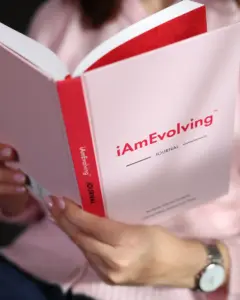
Start your daily practice of gratitude, goals, and growth.
Get the Journal →
A free 30-day gratitude journal designed for a simple daily practice. Calm, minimal, and printable to help you slow down and reflect.
ExploreFrequently Asked Questions
What should I write in a self-care journal?
How often should women journal for self-care?
What is the difference between a self-care journal and a regular journal?
Can journaling really help with stress and emotional burnout?
Is a guided journal better than a blank journal for self-care?