The 5-Minute Morning Journal for Women: Start Your Day Grounded

The 5-minute morning journal for women is the quietest productivity tool I know, and it’s the one most women skip because it sounds too small to matter. Five minutes of writing, before the phone, before the inbox, before the questions from the kids. That window is where the difference between a reactive day and a chosen day actually lives. Most morning routines fail because they ask too much. This one works because it asks for almost nothing.
This is a guide to building a 5-minute morning journal practice that survives real life. Not a perfect 60-minute ritual you’ll do twice and abandon. A short, repeatable practice designed for women who are already carrying a lot, who don’t need another should on the list, and who want one tool that compounds quietly across weeks. If you’ve been wanting a journaling practice for women that fits into your actual schedule, start here.
Why Five Minutes Is Enough (And More Is Usually Worse)
The science on this is unambiguous. Short, consistent journaling outperforms long, irregular journaling on every measure that matters: mood regulation, cortisol response, decision quality, follow-through on intentions. The reason isn’t mystical. A five-minute practice is sustainable on the hard mornings, and the hard mornings are exactly when you need it most. The 45-minute morning routine that influencers sell looks beautiful, but it’s the first thing to fall off your plate when your toddler wakes up sick or a deadline shifts.
Women, especially, benefit from this minimalism. The mental load most women already carry, the constant background calculations about everyone else’s needs, leaves very little spare capacity in the morning. A 5-minute morning journal for women has to fit inside that narrow window between waking up and the world starting to ask for things. Anything longer and the practice starts competing with the very life you’re trying to protect.
The 5-Minute Format That Actually Works
The format is three sections, written in this order, no editing. Set a timer if it helps. The goal is honesty, not poetry.
- Two minutes: how I actually feel. Not how you should feel. Not how you’ll feel after coffee. Right now, in your body. Tired, anxious, hopeful, overwhelmed, fine. Naming it lowers its volume. Skipping this step is the most common reason morning journals stop working.
- Two minutes: one thing that would make today feel mine. Not the most important thing on your to-do list. One small thing that, if you did it, would mean today was yours and not just a series of responses to other people. A 15-minute walk. Writing one paragraph. Calling your sister.
- One minute: one thing I’m grateful for, specifically. Specifically is the word. Not “my family.” The way your daughter laughed at something on the radio yesterday. Specificity is what makes gratitude journaling for women actually shift mood, not the act of writing the word “grateful.”
That’s it. Five minutes, three sections. The first section regulates your nervous system, the second protects your sense of agency, the third primes attention toward what’s already working. Together they reshape the whole day, but only because they fit inside a five-minute window every single morning.
When to Do It (And the One Mistake Most Women Make)
The non-negotiable: before your phone. Before the inbox, the notifications, the first scroll. The five-minute morning journal works because it gives you a few sentences with your own thoughts before the world starts auditioning to be your thoughts. Once the phone is in your hand, the brain shifts into reactive mode and the practice becomes performative instead of clarifying.
Practically, the time looks different for everyone. For a mother of small children, it’s the five minutes between waking up and getting up, while still under the covers. For a working professional, it’s at the kitchen counter with the first cup of tea. For a night-shift nurse, it’s right after coming home, before sleep. The when is flexible. The before-phone rule is not. This is the same principle that makes any morning journaling routine stick or fail.
Get the 5-minute morning journal worksheet
What to Write When the Page Feels Empty
Some mornings nothing comes. That’s normal, and it’s not a sign the practice isn’t working. The blank-page mornings are usually the ones where your mind is protecting something that hasn’t quite surfaced yet. Three prompts get you unstuck without forcing anything.
- “What am I avoiding feeling today?” Write whatever comes, even if it’s “I don’t know.” Sometimes the avoidance itself becomes the entry.
- “If today went well, what would be different by 9pm?” A specific, small marker. Not “I’d be happy.” Something concrete you can point to tonight.
- “What did yesterday try to teach me?” Useful on the harder mornings. There’s almost always a signal in the previous day if you make a quiet space for it.
These prompts aren’t meant to replace the three-section format. They’re a way back in when the standard structure feels closed. Rotate them gently. Don’t grade yourself.
Choosing a Journal That Supports the Practice
The journal itself matters more than people admit. A 5-minute morning journal practice fails more often because the journal is wrong than because the woman is. The features that actually help: a binding that lays flat (so you’re not holding pages open at 6am), a paper weight your favourite pen doesn’t bleed through, and a size you’ll keep on the bedside table without resenting it. Lined or unlined is preference. Dotted pages tend to work well because they’re structured enough to feel safe and open enough not to feel restrictive.
What to avoid: any journal with so much pre-printed structure that it feels like homework. The five-minute practice works precisely because it’s flexible. If the page is already telling you what to write in 17 little boxes, you’re back in performance mode. The best journals for women tend to balance structure with breathing room, but the right journal is the one you’ll actually open at 6am.
What Changes After Three Weeks
Three weeks is the threshold where most women notice the shift, and the shift is rarely the one they expected. It’s not usually “I feel calmer in the morning.” It’s more like, “I notice when I’m reacting instead of responding,” or “I can name what I want before I lose it in everyone else’s needs.” The five-minute journal becomes a small fence around your interior life. The fence is what changes everything else.
Sleep tends to improve too, especially if the evening was previously the only quiet time and the only journaling slot. Moving the practice to morning frees the evening for actual rest. The mornings, in turn, start feeling less like an emergency and more like a beginning. None of this requires more time. It requires the right five minutes.
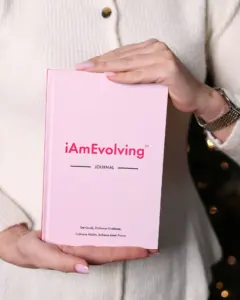
Start your daily practice of gratitude, goals, and growth.
Get the Journal →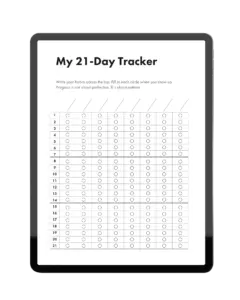
A free 21-day habit tracker PDF with daily check-ins, guided reflection prompts, and mindset reminders. Clean, minimal, and printable.
ExploreFrequently Asked Questions
How long does a 5-minute morning journal for women actually take?
What if I miss a morning?
Can I do this on my phone or a notes app?
What’s the difference between a 5-minute morning journal and a gratitude journal?
Is morning really better than evening for journaling?