Journaling During Career Change: Finding Clarity in the Unknown

Journaling for career change is one of the most grounding practices you can build when your professional identity feels uncertain. Whether you are leaving a role that no longer fits, stepping into something unfamiliar, or sitting in that uncomfortable space between the two, writing brings clarity when your thoughts keep circling. Research on expressive writing shows that people who journal through major life transitions report up to 25% lower anxiety levels and make more confident decisions about their next steps.
A career shift touches more than your resume. It reaches into how you see yourself, what you believe you are capable of, and the private fears you carry about starting over. Journaling creates a space to process all of that without rushing toward answers. It lets you slow down, examine what matters, and move forward from a place of intention rather than panic.
Why Career Change Triggers an Identity Shift
Most people spend eight or more hours a day at work. Over time, your job becomes more than a paycheck. It shapes your routine, your social circle, and your sense of purpose. When that changes, even voluntarily, there is a gap. You may feel untethered, unsure of who you are outside of the title you held.
This is normal, and it is also exactly where journaling helps most. Writing allows you to separate what you did from who you are. It gives you a place to name the feelings you might not say out loud: relief mixed with guilt, excitement tangled with self-doubt, grief for a chapter closing even when you chose to close it.
When you put those feelings on paper, they lose some of their weight. You can see them clearly instead of carrying them as a vague heaviness in your chest. And from that clarity, better decisions follow. Career transitions are one of the most practical applications of journaling for mental health, especially if you have struggled with journaling for overthinking in the past.
How Journaling for Career Change Builds Clarity
Clarity builds slowly, through small, honest moments of reflection. Journaling gives you a daily practice where you can check in with yourself, notice patterns, and track what is shifting inside you as your external circumstances change.
There are several ways journaling supports career transitions specifically:
- It separates facts from fears. Writing helps you distinguish between real obstacles and imagined worst-case scenarios. When your worries are on paper, you can evaluate them honestly.
- It reveals patterns. Over a few weeks of entries, you start to see what excites you, what drains you, and what you keep returning to. These patterns point toward alignment.
- It preserves your thinking. Decisions made during transitions can feel scattered. A journal gives you a record of your reasoning so you can revisit and refine your direction over time.
- It builds self-trust. Every entry is proof that you are paying attention to your own life. That consistency compounds into confidence.
If you are new to reflective writing, exploring different journaling techniques for clarity can help you find a method that feels natural during this transition. Pair them with journaling for emotional clarity to handle the mixed feelings that surface between roles.
Can Journaling Really Help You Find Clarity in a Transition?
Yes. When you are mid-transition, your mind tends to loop through the same worries without resolving any of them. Journaling interrupts that loop by moving the noise out of your head and onto the page, where you can actually examine it. Clarity in a career change usually shows up as a series of smaller realizations: what you no longer want, what you keep gravitating toward, and which fears are real versus rehearsed. Writing makes those realizations visible and repeatable instead of letting them dissolve back into anxiety.
The key is to ask questions that move you forward rather than in circles. If you only have a few minutes a day, start with prompts that surface what is true right now rather than what you think you should do next. If you are brand new to the practice, a short primer on how to start journaling for beginners removes the friction of the blank page so you can focus on the questions that matter.
- What part of my current situation am I most relieved to be leaving behind?
- When did I last feel genuinely engaged at work, and what was I actually doing?
- What am I afraid people will think if I change directions, and is that fear mine or borrowed?
- What would clarity actually look like for me three months from now?
If self-doubt keeps crowding out your answers, pairing these questions with the work of turning self-doubt into self-belief helps you write from a steadier place. And if your transition follows a hard ending, a patient approach to rebuilding confidence after setbacks gives you a way to process the loss without letting it define your next move. The goal is not to force a decision by Friday. It is to keep showing up to the page until the fog thins on its own.
Using Goal-Setting Pages During a Career Transition
One of the biggest challenges during a career change is knowing what to aim for when the path ahead is unclear. Traditional goal-setting can feel forced in these moments. You may not have a specific job title in mind or a five-year plan ready to go. That is okay.
Instead of setting outcome-based goals, use your journal to set intention-based goals. These focus on how you want to feel, what values you want to honor, and what small steps you can take today without needing the whole picture.
Try these goal-setting prompts during your career transition:
- What kind of work would make me feel proud at the end of the day?
- What three values do I want my next role to honor?
- What is one small step I can take this week toward clarity?
- If fear were not a factor, what would I try?
- What skills do I want to carry forward, and what do I want to leave behind?
These prompts work well in a structured journal like the iAmEvolving Journal, where goal-setting pages guide you to write intentions that connect to your deeper values rather than just external achievements. When you are ready to move from intention to action, you can begin to turn big goals into daily actions one step at a time.
Get more like this, every week
Gratitude Practice When Your Career Feels Uncertain
Gratitude might feel difficult when you are in between roles or questioning your direction. It can seem forced to write “I am grateful for…” when your bank account is shrinking or your confidence is low. But this is precisely when gratitude matters most.
The practice is not about pretending everything is fine. It is about noticing what is still solid while the ground shifts. During my own seasons of professional uncertainty, writing three small things I appreciated each morning changed my relationship with the transition. It moved me from “everything is falling apart” to “some things are falling away, and some things are holding steady.”
Gratitude prompts for career uncertainty:
- What skill or experience from my previous work am I genuinely thankful for?
- Who has supported me during this transition, and how?
- What is one thing about today that went better than expected?
- What freedom does this in-between space give me that I did not have before?
These prompts ask for honest acknowledgment, nothing more. And when practiced daily, they shift your inner narrative from scarcity to possibility.
Building New Professional Habits Through Journaling
Career transitions are natural reset points for your daily habits. The routines that served you in your previous role may not fit your current reality. Journaling helps you design new ones intentionally rather than falling into habits shaped by stress or avoidance.
Start by tracking what you do each day for one week. Write it down without judgment. At the end of the week, review your entries and ask:
- Which habits moved me closer to the person I want to become?
- Which habits were reactions to fear or boredom?
- What one habit could I add that would support my career search or skill-building?
A habit tracker page in your journal makes this visible. You might track things like applying to one role per day, spending 30 minutes learning a new skill, reaching out to one person in your network, or maintaining a morning journaling practice. These small, trackable actions build momentum even when the bigger picture remains unclear.
Staying Grounded When the Transition Takes Longer Than Expected
Not every career change happens quickly. Some take months. Some involve false starts, rejected applications, or a period of financial pressure that tests your patience. If you are leaving a role that pushed you into emotional burnout at work, the longer timeline can feel especially heavy. During these stretches, journaling is mostly about holding steady.
Write about what you are feeling without trying to fix it. Let your journal hold the frustration, the doubt, and the fatigue. On the same page, write what you are still committed to. This practice of holding both, the hard and the hopeful, builds emotional resilience that carries you through.
The transition is not wasted time. It is the space where you figure out what actually matters to you, not just what pays the bills.
If you notice that your inner critic gets louder during the wait, use your journal to reframe negative thoughts by writing the thought down, examining the evidence for and against it, and replacing it with something more accurate and compassionate.
Consider also using journaling prompts for self-discovery during this time. They help you reconnect with your core interests and values when the external world is not giving you the feedback you need.
Signs Your Career Change Journaling Practice Is Working
One of the harder parts of journaling through a career transition is that you cannot see the progress on a chart. Clarity tends to show up as small shifts in how you think, decide, and respond. If you have been writing for a few weeks and wonder whether it is making a difference, look for these quieter signals.
- You react less and reflect more. Job-search frustrations, awkward interviews, or family questions about your plans no longer hijack your whole day. You can name what you feel and choose your response.
- Your inner critic gets quieter. The harsh voice that compared you to peers or replayed your last role does not vanish, but it loses its grip. You catch the thought, write it down, and move on.
- You notice patterns in what energizes you. Reading older entries, you see the projects, conversations, and skills that keep showing up as bright spots. Those repetitions are clues about your next direction.
- Your decisions feel more grounded. When an opportunity arrives, you do not panic-accept or panic-decline. You sit with it, write through it, and act from a more centered place.
- You sleep better on hard days. Putting your worries on paper before bed releases their hold. You wake up with more energy for the actual work of transitioning.
- You stop needing the perfect plan. You make peace with not knowing the full path. Each entry reminds you that small steps, taken consistently, are enough.
If only one or two of these signs feel familiar right now, that is fine. Each one builds on the last. The point is to notice that something is shifting. The page is doing its work, even on days when the words come slowly.
Conclusion
A career change is one of life’s most disorienting transitions, and also one of its most clarifying. Journaling for career change gives you a daily anchor when everything else feels uncertain. It helps you process the identity shift, set clear intentions, practice gratitude in hard seasons, build habits that serve your future self, and stay grounded when the timeline stretches longer than you planned.
You can start writing before you have the answers. All it takes is a few minutes and the willingness to be honest on the page. The iAmEvolving Journal is designed for exactly this kind of work: structured enough to guide you, open enough to meet you where you are. Start today, and let your next chapter begin with clarity.
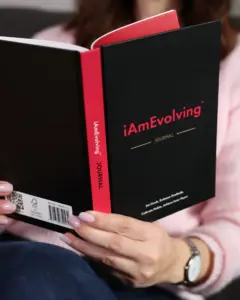
Start your daily practice of gratitude, goals, and growth.
Get the Journal →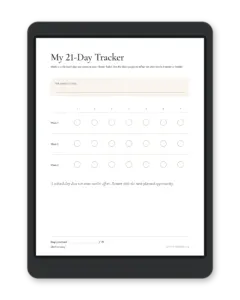
A free 21-day habit tracker PDF with daily check-ins, guided reflection prompts, and mindset reminders. Clean, minimal, and printable.
ExploreFrequently Asked Questions
How does journaling help during a career change?
What should I write in my journal when I am between jobs?
How often should I journal during a career transition?
Can journaling replace career coaching or therapy during a job change?