Journaling When You’re Burned Out at Work but Can’t Quit

Being burned out at work is hard enough. Being burned out at work when you cannot afford to quit is a different problem entirely. Journaling is a daily writing practice that helps here. It lets you offload stress, protect your energy, and think clearly while you are still inside the job. It will not fix a job that is draining you. What it gives you is something burnout quietly steals: a few honest minutes that belong to you. On the page you can name what is happening and choose how to respond, instead of only reacting. You may not be able to change the situation overnight. Changing how you carry it, day to day, is where your power actually lives.
This is for the person who is exhausted but still has bills to pay. A mortgage. A family. A plan that needs more runway before walking away makes any sense. You may not be able to quit this month, this quarter, or even this year. What you can do is stop letting the job take every last reserve you have. What follows is a five-minute daily practice you can start tonight. There are prompts for the hardest days, and a way to build an exit plan quietly on paper. If you are new to writing things down, start with this simple guide to journaling and come back here.
Why Burnout Hits Hardest When You Can’t Walk Away
Burnout is not the same as a hard week. The World Health Organization describes it as chronic workplace stress that has not been managed. It shows up as exhaustion, cynicism, and a creeping sense that nothing you do matters. When you have the freedom to leave, burnout is painful but bounded. When you are financially or practically trapped, it becomes a different animal. Every Sunday night carries dread. Every small task feels enormous. The part of your brain that should be planning your future is too tired. It can only get you through the day.
The trap is also psychological. When you believe you have no way out, your mind stops looking for one. You start to confuse a bad job with a permanent identity. The exhaustion convinces you that this is simply who you are now. Journaling interrupts that story. Putting the situation into words creates a small but real distance between you and the stress. From that distance, you can see what is actually within your control. That distance is the first thing burnout takes. It is the first thing writing gives back.
What Journaling Actually Does When You’re Burned Out at Work
Expressive writing has been studied for decades, and the findings are consistent. Spending fifteen minutes writing about a stressful experience measurably lowers anxiety. It also improves how people cope over the following weeks. The mechanism is simple. When stress stays locked in your head, it loops. Writing forces those looping thoughts into a single, linear sentence. And a thought you can read is a thought you can question. This is the same reason journaling reduces stress even when nothing about your circumstances has changed.
For burnout specifically, journaling does three things. First, it separates the facts of your job from the feelings about it. That helps you tell a genuinely toxic situation apart from a temporary rough patch. Second, it tracks your energy over time. You start to notice patterns. The meetings that wreck you. The days you recover. The small wins you would otherwise overlook. Third, it protects a sliver of your inner life from work entirely. A job can take your time, your focus, and your weekends. A private page that belongs only to you becomes an act of quiet resistance.
A Five-Minute Daily Practice to Protect Your Energy
You do not need an hour or a beautiful notebook. You need five honest minutes, ideally at the same time each day, so it becomes automatic. Here is a simple structure built on the iAmEvolving framework of daily goals, gratitude, and reflection. It is adapted for someone running on empty:
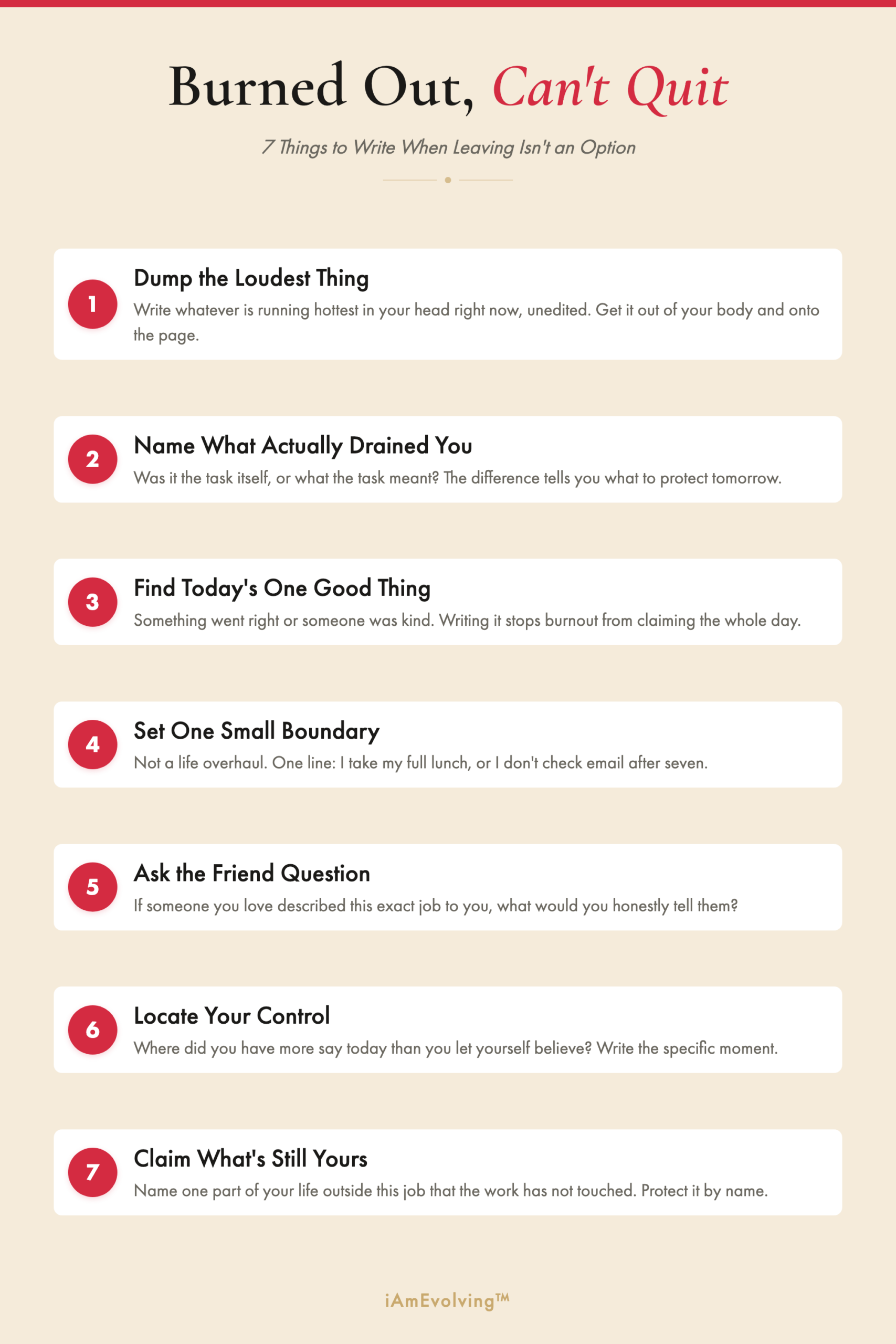
- Dump the noise (one minute). Write whatever is loudest in your head right now, unedited. The frustration, the dread, the thing your manager said. Get it out of your body and onto the page.
- Name one thing that held (one minute). Even on the worst day, something went right or someone was kind. Writing it down keeps burnout from convincing you that everything is awful.
- Set one boundary for today (one minute). Not a life overhaul. One small line: I will take my full lunch, or I will not check email after seven.
- Choose one energy-protecting action (two minutes). Decide on a single thing that refuels you today, however small. Write down when you will do it.
The point is repetition, not perfection. Five minutes a day for two weeks will tell you more than any single dramatic entry. If sticking with it feels hard, that is normal, and it is solvable. The mechanics of building a journaling habit matter more than motivation, which burnout has already drained.
Get more like this, every week
Prompts for the Days You Feel Stuck
Some days the blank page is too much. A prompt does the work of starting for you. Keep a few of these where you can reach them, and answer only the one that pulls at you:
- What part of today drained me most, and was it the task or the meaning behind it?
- If a friend described my exact job to me, what would I tell them?
- What am I tolerating right now that I would not advise anyone I love to tolerate?
- Where did I have more control today than I let myself believe?
- What would “enough” look like at work, and how far am I from it?
- What is one thing about my life outside this job that is still mine?
Prompts like these surface the truth faster than free writing. They aim at a specific corner of the experience. When you want a structured set built for exhaustion, try this collection of burnout journal prompts. It walks you through a gentle recovery sequence. You can repeat it whenever the heaviness returns.
Journaling Your Way Toward an Exit Plan, Even If It’s Years Away
Staying is not the same as giving up. Some of the most important career moves are made slowly, on purpose. They are made by people who refused to quit in a panic. Your journal is where that plan gets built, one entry at a time. It happens long before anyone else needs to know about it. Burnout makes the future feel impossible. But a plan written in small pieces is how the impossible becomes a checklist.
Once a week, use your journal to answer three planning questions. What did I learn this week that makes me more employable? How much closer am I to the financial cushion I need to leave safely? What is one tiny step toward the next thing, even a fifteen-minute one? Over months, these entries become evidence that you are moving. That evidence is the antidote to the helplessness at the center of emotional burnout at work. You are not stuck. You are saving up your exit, and you have the pages to prove it.
Keep your planning entries separate from your daily venting. A different page or a line down the margin is enough. The venting is where you discharge the day so it does not follow you home. The planning is where you build the future with a clearer head. Mixing them tends to drown the plan in the emotion. The whole point of staying on purpose is to keep despair and strategy from blurring together.
Setting Boundaries on Paper Before You Set Them Out Loud
Most boundaries fail because we try to enforce them in the moment, under pressure, with no script. Journaling lets you rehearse. In a job I could not yet leave, I started writing the boundary the night before. The exact sentence I would say. The request I would decline. The hour I would log off. Reading it back in my own handwriting made it feel decided rather than risky. And a decided boundary is far easier to hold than one you invent on the spot.
Try writing your boundaries as plain, present-tense statements. I protect my evenings. I do not apologize for taking my full break. I answer urgent things, not anxious things. You are not writing affirmations to feel good. You are drafting the operating rules that keep burnout from taking the last of you. The page is a safe place to practice saying no until the no feels like yours.
Conclusion
You may not be able to quit yet, and that is allowed. What you can refuse is to hand over every last reserve to a job that takes it without thanks. A few honest minutes on the page each day will not change your workload. It will change how much of you the workload gets to keep. Start with the five-minute practice tonight. Use a prompt when the page feels too big. Let your journal hold both the hard truth and the slow plan. When you are ready to rebuild, here is a gentle path to rebuild your energy after burnout. You are still here, you are still paying attention, and that is enough to begin.
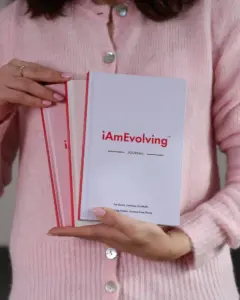
Start your daily practice of gratitude, goals, and growth.
Get the Journal →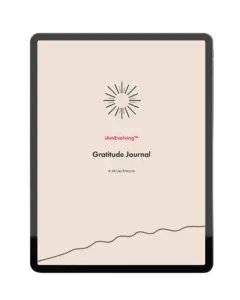
A free 30-day gratitude journal designed for a simple daily practice. Calm, minimal, and printable to help you slow down and reflect.
ExploreFrequently Asked Questions
Can journaling really help with burnout if I can’t change my job?
How long should I journal each day when I’m already exhausted?
What should I write about when I’m burned out at work?
Will journaling make me more likely to quit my job impulsively?
How is burnout different from just being stressed at work?
How soon will I notice a difference from journaling?