Journaling for Empty Nesters: Finding Yourself Again

The first month, you’ll cook for one more person than lives in the house. You’ll catch yourself listening for a car door at eleven at night. Journaling for empty nesters won’t fill that extra chair, but it gives you somewhere to put what you feel about it. When a child leaves home, practical responsibilities change overnight, but your identity rarely catches up that quickly. A page is where you notice the grief, name the space that’s opened, and start deciding what you want this next chapter to hold.
An empty nest isn’t a sign that your most meaningful years are behind you. It’s a change in relationship, routine, and purpose. Journaling won’t erase the ache or tell you who to become. What it can do is help you hear your own voice again, separate love from over-responsibility, and take small steps toward a life that includes your child without revolving entirely around their daily needs.
Why Journaling Helps Empty Nesters Find Their Footing
Most parents expect to feel one thing and find they’re feeling six. Pride and sadness. Relief and guilt. Worry about your child, and a quiet thrill at having a Saturday that belongs to you. Those feelings look contradictory written down, but they aren’t. You can miss your child and enjoy a quieter morning. You can be proud of their independence and still grieve the end of ordinary routines. Writing lets the whole picture exist without forcing one emotion to cancel another.
It also slows down the identity questions that arrive after years of caregiving. What do I want now? Which parts of my schedule ever belonged to me? What did I postpone? Which relationships, interests, or goals deserve more room? Those questions aren’t selfish. They’re part of learning how to stay close while the relationship grows up.
The house got quieter. That doesn’t mean your life did.
A journal practice isn’t a daily performance. Five honest minutes is enough. You’re building one reliable place where your thoughts become visible, your nervous system settles, and the next small choice gets easier to see.
If you’re earlier in this than you expected, and what you feel is closer to grief than to a fresh start, read about empty nest syndrome first and come back when you’re ready to write. And if you’re returning to journaling after years away, the complete journaling guide covers the basics without any pressure to be good at it.
Journaling for Empty Nesters: Start With What Actually Changed
Before you set a single goal, give yourself permission to describe what happened. A lot of people rush toward reinvention because sitting with loss feels unproductive. But grief you skip past tends to follow you into the next chapter anyway. Start with the ordinary details you miss, the responsibilities you no longer carry, and the parts of this that have surprised you.
- What changed in my day? Meals, noise, errands, evenings, weekends, and the moments you instinctively reach for your phone.
- Which part of our old routine do I miss most, and what did that routine give me emotionally?
- What am I proud of? Name the ways your child has grown and the ways you helped that happen.
- What feels genuinely difficult? Be specific: loneliness, worry, conflict, money, the loss of a rhythm that organized your week.
- What feels lighter? Relief isn’t evidence of a lack of love. It usually means a demanding season has ended.
- Where am I carrying worry that belongs to my child to solve?
- What part of myself went quiet while I was raising a family?
- What would make this week feel a little more like my own life again?
Don’t edit the emotional tone as you write. You don’t have to make this sound positive before you understand it. If a page holds both “I’m happy for them” and “I miss having them here,” leave both sentences there. Honest beats polished every time.
That last question is deliberately small. You might answer with a walk, a class, a phone call, a meal with a friend, or one protected hour for something you set down years ago. Small actions build evidence that your life isn’t waiting for permission to continue.
Rebuild Your Identity Without Abandoning Your Family
Identity after your children leave isn’t a blank page. You bring skills, memories, relationships, values, and preferences with you. The work isn’t inventing a new person. It’s recovering the parts of yourself you put on hold.
Separate Your Roles From Your Values
“Parent” is a role. Care, courage, loyalty, curiosity, patience, and creativity are values, and values can live in a lot of different roles. Make two columns in your journal. On the left, a responsibility that has ended. On the right, the value it let you practice. Then ask one question: where could that value live now?
Filled in, it looks something like this:
- Driving to practice four nights a week. The value was showing up for people. It lives now in a standing Thursday walk with a friend going through a divorce.
- Managing everyone’s schedule. The value was competence. It lives now in the certification course you kept putting off.
- Cooking for five. The value was care expressed through effort. It lives now in Sunday dinners for whoever’s around, including the neighbour who eats alone.
- Knowing every detail of someone’s week. The value was closeness. It lives now in one real conversation instead of ten logistical ones.
None of those are grand, and that’s the point. You’re not discarding the years you gave your family. You’re carrying what they meant into a wider life.
Notice the Stories That Create Guilt
Guilt usually shows up disguised as responsibility. “If I focus on myself, I’m being selfish.” Write that sentence down and ask whether it’s a fact, a fear, or an old rule you inherited from someone else. Then try a more honest version: “Caring about my own life is what keeps me a whole person in my relationships.” If that second sentence feels like a stretch today, reconnecting with yourself is a slower on-ramp.
Get more like this, every week
Build a Routine That Fits the Quiet
A new routine should hold you up, not become another project to manage. Start with three anchors: one thing in the morning, one point of contact during the day, one reflection at night. Keep each one short enough that you’d still do it on a bad day.
- Morning page: One feeling, one priority, one thing you’re looking forward to. Three lines.
- Connection point: A call, a message, a shared meal, a class, a walk. Something that keeps your world relational.
- Evening review: What gave you energy, what drained you, one choice you want to repeat tomorrow.
If that sounds like a lot to hold on loose paper, it is. That’s roughly the shape the iAmEvolving Journal was built around: goals, gratitude, habits, and a nightly reflection in one place, so the practice survives the weeks when you don’t feel like being disciplined about it.
When you’re ready to add a goal, pick one that belongs to this season instead of using goals to outrun the transition. Rebuilding a friendship. Getting your health back. Finishing a course. Building a more intentional relationship with your adult child. The meaningful goals guide helps you tell the difference between a goal that comes from your values and one that’s just filling uncomfortable space. Give yourself room to change your mind. The goal you pick in month one may not be the one you still want in month six.
Use Gratitude Without Denying the Grief
Gratitude helps in an empty-nest season, but not if you use it to shut sadness up. A balanced practice doesn’t say “I should be happy, so I can’t miss them.” It says “This hurts, and there are still moments of goodness I can take in.”
Try a three-line evening entry: one thing you miss, one thing you appreciate, one thing you’re learning. That format makes room for love, loss, and growth on the same page. Over a few months you may notice the entries shift on their own, from recovering the old household to building a relationship with the life that’s actually here.
On the days when the quiet gets loud, pair the writing with something physical. Slow breathing, a walk, a stretch, making tea. It helps your body understand that a feeling is present without treating it as an emergency. Finding stillness in a busy world is a good companion practice when your thoughts keep circling the same track.
A Four-Week Arc for the First Quiet Months
You don’t need to do any of this perfectly. Treat the month as an experiment in listening to yourself.
- Week one: name the change. Write about what you miss, what has gotten easier, and what you’re afraid to admit.
- Week two: reclaim your values. Pick five that matter now and one small behaviour that expresses each one.
- Week three: strengthen connection. Notice which relationships actually nourish you, then make one real invitation.
- Week four: choose one direction. Select a single personal goal and define the smallest repeatable action that moves it.
- The last two days: review. Read back through the month and note what gave you energy, what felt forced, and what you want to keep.
Your Next Chapter Can Hold More Than One Truth
Journaling for empty nesters isn’t about convincing yourself everything is fine. It’s a way to stay close to the truth while the truth keeps changing. You can love your child deeply, miss the old rhythm, and still want more room for your own life. You can feel completely uncertain and begin anyway.
Start tonight. One page. What you miss, what you’re proud of, what you want to make possible next. Then pick one small thing that belongs to you and do it this week. A new chapter almost never arrives as a dramatic transformation. Usually it starts with a quiet decision you make again the next day, and the day after that, until your life starts to feel like yours.
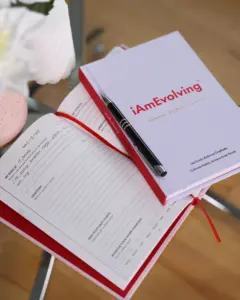
Start your daily practice of gratitude, goals, and growth.
Get the Journal →
A free 21-day habit tracker PDF with daily check-ins, guided reflection prompts, and mindset reminders. Clean, minimal, and printable.
ExploreFrequently Asked Questions
Is it normal to feel sad when a child leaves home?
What should empty nesters write about?
How often should I journal during an empty-nest transition?
How do I rebuild my identity after my children leave?
Can journaling replace professional support?