Daily Affirmation Rituals: Build a Practice That Transforms Your Mindset

Affirmations spoken once rarely change anything. It’s the daily repetition — the ritual of returning to intentional self-talk morning after morning, evening after evening — that rewires your brain and shifts your self-concept. Daily affirmation rituals transform scattered positive thoughts into a structured practice with measurable impact on how you think, feel, and show up in your life.
Building a ritual means more than remembering to say nice things to yourself. It means creating sacred time for the practice, anchoring it to existing habits, and approaching it with consistency that compounds over weeks and months. When affirmations become ritual, they stop being something you do and start being part of who you are.
Why Daily Affirmation Rituals Matter
Your subconscious mind learns through repetition. A single affirmation, no matter how powerful, gets drowned out by the thousands of automatic thoughts you have each day — many of which are negative, self-critical, or fear-based. Daily rituals create a counterweight, a consistent voice that speaks truth against the noise.
Neuroscience supports this approach. Regular affirmation practice activates the brain’s reward centers and strengthens neural pathways associated with positive self-perception. But these changes require sustained input. Just as you wouldn’t expect one workout to build lasting fitness, one affirmation session won’t reshape your mindset.
The ritual aspect matters too. When you perform affirmations at the same time, in the same way, your brain begins anticipating the practice. This anticipation primes your nervous system for receptivity. The ritual becomes a signal — a transition from autopilot to intentional presence. Understanding the power of I AM affirmations helps you approach your ritual with greater conviction.
Morning Affirmation Rituals
Morning is prime time for affirmations. Your mind is fresh, relatively unburdened by the day’s stresses, and more receptive to new input. What you tell yourself in the first hour of waking influences how you interpret everything that follows.
The mirror practice. Stand before a mirror, make eye contact with yourself, and speak your affirmations aloud. This feels uncomfortable at first — which is exactly why it works. You’re confronting yourself directly, making declarations to your own face. Start with three core affirmations and build from there.
The journal method. Write your affirmations by hand as part of your morning journaling routine. The physical act of writing engages different neural pathways than speaking. Many people write the same affirmation three to ten times, letting the repetition deepen the message.
The breath anchor. Pair each affirmation with a breath cycle. Inhale deeply, then speak or think the affirmation on the exhale. This connects your words to your body’s calming rhythm and helps the message land somatically, not just cognitively.
The intention set. Choose one affirmation as your theme for the day. Write it on a sticky note, set it as a phone reminder, or simply commit it to memory. Return to this single statement whenever you need grounding throughout the day.
For comprehensive morning affirmation guidance, explore I AM affirmations for morning motivation.
Evening Affirmation Rituals
Evening affirmations serve a different purpose than morning ones. While morning practice sets intentions, evening practice processes the day, releases tension, and prepares your subconscious for restorative sleep.
The release ritual. Before bed, speak affirmations focused on letting go: “I release everything that happened today. Tomorrow is a fresh start.” This helps your mind stop processing the day’s events and transition toward rest.
The gratitude bridge. Connect your affirmations to gratitude. After listing what you’re thankful for, add identity statements: “I am someone who notices beauty. I am grateful for my life.” This links positive emotion to self-concept. Pair this with an evening gratitude ritual for deeper impact.
The wind-down sequence. Create a consistent pre-sleep routine that includes affirmations. Perhaps it’s five minutes of mindful breathing, followed by your affirmations, followed by lights out. The sequence becomes a signal to your nervous system that sleep is coming.
The sleep invitation. Use affirmations that invite rest: “I am ready for deep, restorative sleep. My body knows how to heal while I rest.” These statements program your subconscious for quality sleep and influence how you wake feeling.
Get more like this, every week
Creating Your Personal Affirmation Ritual
The most effective ritual is one you’ll actually do. Here’s how to design a practice that fits your life:
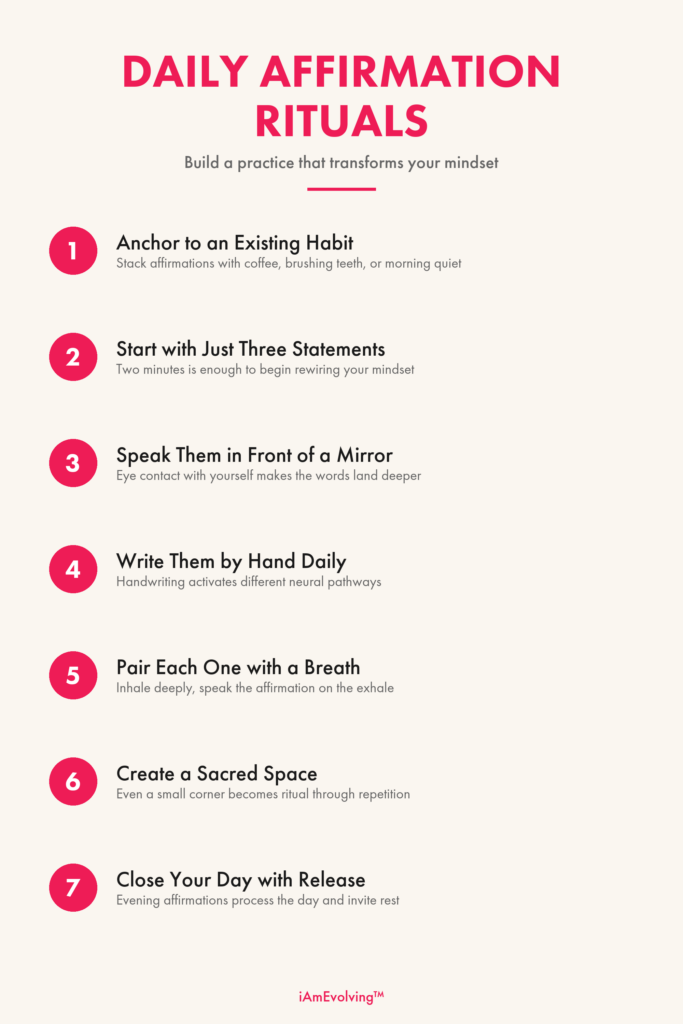
1. Anchor to existing habits. Attach your affirmation practice to something you already do consistently. After brushing your teeth. While your coffee brews. Before you check your phone. Habit stacking makes new behaviors easier to maintain.
2. Start smaller than you think necessary. Three affirmations, once a day, for two minutes. That’s enough to begin. You can always expand later. Starting too ambitiously often leads to abandoning the practice entirely.
3. Choose a consistent time. Morning works best for most people, but consistency matters more than timing. If you’re not a morning person, an evening ritual or midday practice can be equally effective.
4. Create a dedicated space. Even a small corner — a chair by a window, a spot on your bed — can become sacred through repeated use. Your brain will associate that space with the practice, making it easier to drop into the right state.
5. Use physical cues. A specific journal, a particular candle, a meditation cushion — these objects become part of the ritual. Their presence signals to your brain that it’s time for intentional practice.
A Sample Daily Affirmation Ritual
Here’s a complete ritual you can adapt to your needs:
Morning (5-7 minutes)
- Sit comfortably in your dedicated space
- Take three deep breaths to center yourself
- Read or recite your core affirmations (3-5 statements)
- Write your daily intention affirmation in your journal
- Close with one breath, carrying the energy into your day
Midday (1-2 minutes)
- Pause wherever you are
- Take one centering breath
- Silently repeat your daily intention affirmation
- Notice any shift in your state
- Return to your activities
Evening (5-7 minutes)
- Sit in your space or lie in bed
- Reflect briefly on the day without judgment
- Speak release affirmations (“I let go of today”)
- Speak rest affirmations (“I am ready for peaceful sleep”)
- Close with three slow breaths
Affirmations for Different Times of Day
Different moments call for different messages. Here are affirmations suited to various parts of your daily ritual:
Morning Affirmations
- I am ready to meet this day with presence and purpose.
- I am capable of handling whatever comes my way.
- I am grateful for this new beginning.
- I am choosing thoughts that serve my highest good.
- I am becoming more of who I truly am.
Midday Reset Affirmations
- I am calm in the middle of my day.
- I am focused on what matters most.
- I am allowed to pause and breathe.
- I am doing enough. I am enough.
- I am choosing peace over pressure.
Evening Affirmations
- I am releasing this day with gratitude.
- I am proud of myself for showing up.
- I am letting go of what I cannot change.
- I am safe, held, and ready to rest.
- I am trusting that tomorrow will unfold as it should.
Maintaining Consistency When Life Gets Busy
Every ritual faces the test of real life. Travel, illness, busy seasons, and simple forgetfulness can disrupt even well-established practices. Here’s how to maintain momentum:
Have a minimum viable practice. When you can’t do your full ritual, do the smallest version that still counts. One affirmation, spoken once. This keeps the habit alive even when circumstances make more impossible.
Don’t break the chain. Track your practice visually — a calendar with X marks, a habit app, a simple list. Seeing your streak builds motivation to continue. Missing one day is a stumble; missing two becomes a pattern.
Forgive yourself immediately. When you do miss a day, return the next morning without self-criticism. Guilt about missing practice becomes an obstacle to resuming practice. Let it go and begin again.
Adjust for seasons. Your ritual may need to shift with life changes. A new job, a new baby, a move — these all require adaptation. The core practice remains; the timing and format may evolve.
For support in building lasting practices, explore how to build habits that stick.
Deepening Your Practice Over Time
As your ritual matures, consider these ways to deepen its impact:
Rotate affirmations thoughtfully. Keep 2-3 core identity affirmations consistent for months. Add 1-2 rotating ones that address current challenges or goals. This balance provides stability while maintaining relevance.
Notice what shifts. Periodically reflect on how your relationship to your affirmations has changed. Do statements that once felt like stretches now feel true? That’s progress. Time to reach for new growth edges.
Add embodiment. Move beyond words. Place your hand on your heart while affirming. Stand tall and take up space. Let your body participate in the declaration.
Combine with visualization. As you speak each affirmation, see yourself living it. Feel the emotion of embodying that identity. This multi-sensory approach accelerates integration.

Begin Your Daily Affirmation Ritual Today
The best time to start was years ago. The second best time is today. Choose three affirmations that speak to who you want to become. Decide when you’ll practice — morning is usually easiest. Set a reminder if needed. Then show up tomorrow and begin.
Your first sessions may feel awkward, forced, or even silly. That’s normal. The practice earns its power through repetition, not perfection. What matters is that you return, day after day, speaking truth to yourself until your life begins to match your words.
You are building more than a habit. You are building a new relationship with yourself — one intentional declaration at a time.
Start your daily practice of gratitude, goals, and growth.
Get the Journal →A gentle 7-day reset to help you slow down, feel steadier, and reconnect — in just 5–10 minutes a day.
Start the ResetA simple introduction to daily journaling — gratitude, goals, and habits made easy.
Learn the MethodFAQ: Daily Affirmation Rituals
How long should a daily affirmation ritual take?
Is it better to do affirmations in the morning or evening?
How many affirmations should I include in my ritual?
What if I miss a day of my affirmation ritual?