Emotional Burnout at Work: How to Recover

Emotional burnout at work is a state of exhaustion that goes beyond tiredness — it shows up as fatigue, cynicism, and disconnection from work that once felt meaningful. It rarely arrives dramatically; it builds quietly over time.
Emotional burnout at work isn’t only an individual experience; it’s an organizational pattern. When reflection disappears and urgency takes over, emotional energy drains faster than it can be replenished. Preventing burnout is not about managing time — it’s about managing energy, attention, and compassion with awareness.
Understanding Emotional Burnout at Work
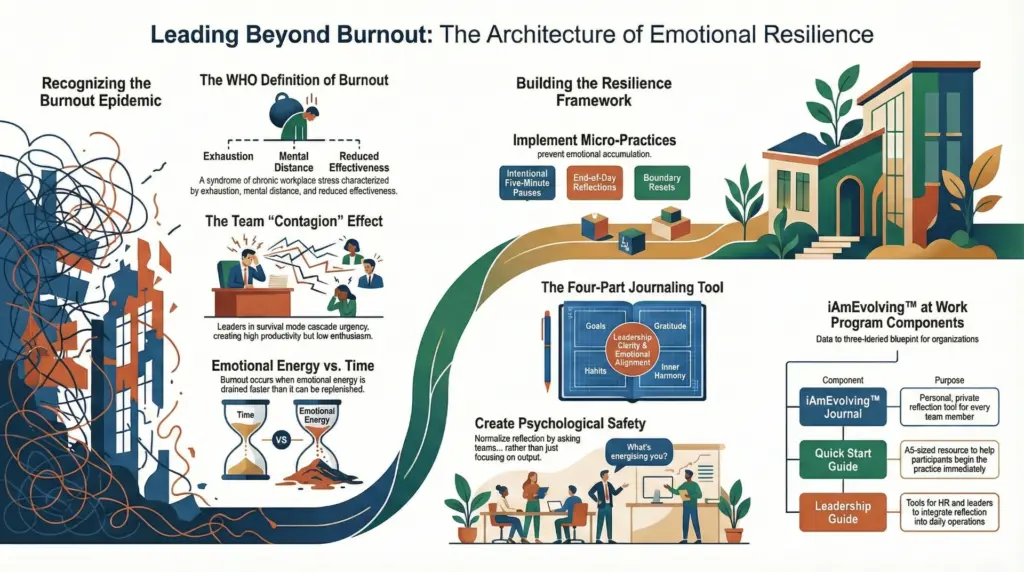
The World Health Organization defines burnout as a syndrome resulting from chronic workplace stress that has not been successfully managed. It’s characterized by exhaustion, mental distance, and reduced effectiveness. Emotional burnout adds another layer — the loss of empathy, patience, and internal motivation. For leaders, that’s dangerous territory: you may still perform, but you stop feeling connected to what matters most.
According to the World Health Organization, protecting mental health at work depends on creating psychologically safe environments that value balance and emotional recovery as much as results. That begins with leadership awareness.
How Emotional Burnout Spreads in Teams
Emotional burnout is contagious. Teams absorb their leaders’ energy — both grounded and reactive. When a leader operates in survival mode, urgency becomes the default emotional tone. When a leader models calm recovery, space opens for thoughtful collaboration. Emotional states, like culture, cascade.
Common signs of team‑level burnout include:
- Meetings filled with tension but little creativity.
- High productivity with low enthusiasm.
- Emotional reactivity replacing thoughtful dialogue.
- A sense that “we’re always behind,” even when goals are met.
Leaders can’t eliminate pressure — but they can regulate energy. Awareness of one’s emotional state, and of the group’s collective tone, is the first step toward preventing burnout before it becomes systemic.
The Energy Equation of Leadership
Every conversation, decision, and meeting requires emotional energy. When that energy goes out faster than it’s restored, burnout begins. Leaders often assume they must stay available and emotionally strong at all times. The truth is, sustainable leadership depends on cycles of engagement and recovery — showing up fully, then stepping back to recharge.
Ask yourself: “What restores my energy?” It may be silence, nature, writing, or connection. Knowing your own sources of renewal is not indulgence — it’s responsibility. You can’t model balance you don’t practice.
Get more like this, every week
Micro‑Practices for Preventing Emotional Burnout
Here are simple, repeatable practices you can integrate into your leadership rhythm to maintain emotional resilience:
- One intentional pause daily: Schedule a five‑minute meeting with yourself — no screens, no tasks. Use it to breathe, reflect, and notice how you feel before your next interaction.
- End‑of‑day reflection: Ask, “Where did I feel most connected today?” and “What felt heavy?” Awareness prevents accumulation.
- Boundary reset: Choose one signal that tells your team the day is ending — closing the laptop, walking outside, or sending a wrap‑up note.
- Emotion labeling: Before difficult conversations, name what you’re feeling. Calm doesn’t mean emotionless — it means conscious.
- Team gratitude ritual: Begin or end meetings by acknowledging small wins. Recognition releases tension and rebuilds collective morale.
Journaling as a Leadership Practice
Journaling is not only for personal growth — it’s a leadership tool for emotional clarity. When thoughts and emotions stay unspoken, they become invisible weights. Writing brings them to the surface, where they can be understood and released. In the iAmEvolving Journal, leaders can process both strategy and emotion — documenting not just what they’re doing, but how they’re leading.
Use these four sections to stay emotionally aligned:
- Goals: Define intentions for how you want to lead, not just what you want to achieve.
- Gratitude: Record appreciation for moments of connection — they protect against emotional fatigue.
- Habits: Track the small behaviors that maintain your balance, like mindful breaks or focused listening.
- Inner Harmony: Reflect on your emotional tone for the week. Awareness precedes recalibration.
Building Emotionally Resilient Teams
Preventing burnout is a collective practice. Teams thrive when leaders normalize reflection and recovery instead of constant urgency. Encourage conversations that explore energy, not just output. Simple questions like “What’s energizing you this week?” or “What’s feeling heavy?” open space for honesty.
Leaders who build emotionally resilient cultures share three traits:
- They create psychological safety — mistakes are learning moments, not emotional hazards.
- They respect recovery rhythms — not every hour must be optimized.
- They practice transparent reflection — modeling what it looks like to pause, reset, and return with clarity.
For a practical framework on sustainable personal habits that reinforce team balance, see Building Habits for Personal Growth.
Aligning Inner Harmony with Team Performance
Emotional awareness and high performance are not opposites; they’re interdependent. A team that reflects together performs with greater trust and creativity. Use short reflective exercises at the end of team meetings — one word check‑ins, gratitude rounds, or short journaling prompts. Over time, these habits anchor emotional awareness into daily workflow.
To deepen your understanding of how awareness shapes regulation, revisit Understanding Inner Harmony. It explores the link between emotional awareness and clear, grounded action — a skill every leader can develop.
Bring Emotional Resilience to Your Organization
iAmEvolving™ at Work helps teams and leaders build reflection into daily operations — privately, practically, and powerfully.
- 1 × iAmEvolving™ Journal per team member
- 1 × A5 Quick Start Guide
- 1 × Leadership Welcome Card
- Leaders receive a Full Leadership Guide (PDF or print)
A journaling program for teams that supports clarity, gratitude, and growth.
Learn MorePricing for teams with bulk or direct-to-employee delivery options.
Request QuoteLearn how to bring reflection‑based resilience to your organization at iAmEvolving™ at Work.
Below is a visual summary of how leaders can build emotional resilience using mindful reflection, journaling, and team awareness practices:
Conclusion — Calm Leadership Creates Sustainable Success
Preventing emotional burnout at work is not about avoiding pressure — it’s about leading through it with awareness. Calm is not the absence of urgency; it’s the presence of emotional clarity. When leaders prioritize reflection and energy renewal, they create space for teams to do the same.
Leadership is not sustained by constant drive but by intentional recovery. Every pause is an act of strategy. Every reflection is an investment in culture. And every moment of calm leadership ripples outward — restoring not only your energy, but the collective resilience of your team.
FAQ
What is emotional burnout at work?
How can leaders prevent emotional burnout in their teams?
How does journaling help reduce emotional burnout at work?