Gratitude vs Positivity: Understanding the Real Difference

Gratitude and positivity are often used as if they mean the same thing. Motivational posts blend them together, self-help books treat them interchangeably, and well-meaning advice frequently confuses one for the other. But gratitude vs positivity is an important distinction. They come from different places, they ask different things of you, and they produce very different results in your mental and emotional life. Understanding the difference matters because one of them can become harmful when used carelessly, while the other remains grounded no matter how hard life gets.
If you have ever felt pressured to “stay positive” during a genuinely painful experience, you already sense this distinction even if you could not name it. That pressure usually comes from the positivity side. Gratitude asks something different. It does not require you to feel good. It only asks you to notice what is real. And that honesty is what makes gratitude a sustainable daily practice while forced positivity often leads to emotional exhaustion.
Gratitude vs Positivity: The Core Difference
Positivity is a mindset orientation. It encourages you to focus on the bright side, look for silver linings, and maintain an optimistic outlook. At its best, positivity helps you approach challenges with confidence. At its worst, it dismisses real suffering by insisting that everything happens for a reason or that you should just think happy thoughts.
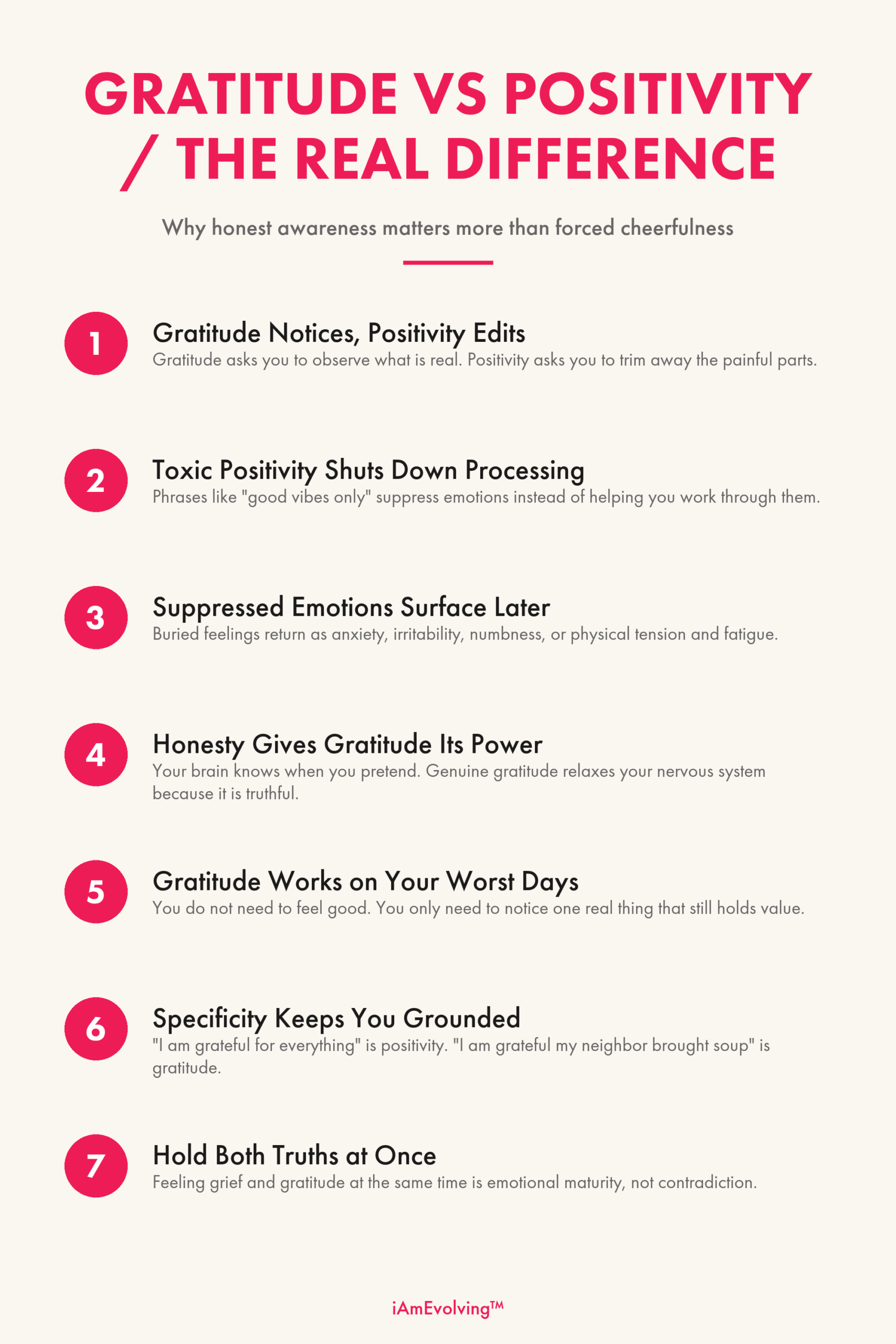
Gratitude is a noticing practice. It does not ask you to interpret events positively. It asks you to observe what is present and acknowledge what has value. You can be grateful for a friend’s support while feeling devastated by a loss. You can appreciate a warm meal while your finances feel uncertain. Gratitude holds space for complexity. Positivity often flattens it.
The key distinction is honesty. Positivity sometimes requires you to edit your experience, to trim away the painful parts and focus only on the good. Gratitude asks you to be fully honest about your experience and then, within that honesty, to notice what still holds value. One requires denial. The other requires awareness.
Why Toxic Positivity Causes Harm
The term toxic positivity has gained attention in recent years, and for good reason. Toxic positivity is the pressure to maintain a cheerful attitude regardless of what you are actually feeling. It shows up in phrases like “good vibes only,” “everything happens for a reason,” and “just look on the bright side.” These phrases sound supportive, but they often shut down genuine emotional processing.
When someone tells you to stay positive while you are grieving, struggling, or overwhelmed, the hidden message is that your real feelings are not welcome. This causes you to suppress emotions rather than process them. Over time, emotional suppression leads to increased anxiety, depression, and a growing disconnection from your own inner life. You learn to perform happiness rather than experience it.
Research from the University of California, Berkeley found that people who accept their negative emotions rather than judging them or trying to replace them with positive ones actually experience better long-term mental health. Acceptance does not mean wallowing. It means acknowledging what you feel before deciding how to respond. This is exactly what gratitude supports and what toxic positivity undermines.
Gratitude never asks you to replace a feeling. It asks you to expand your awareness so that you are holding your full experience rather than editing it. You can feel grief and gratitude at the same time. You can feel frustration and appreciation in the same breath. This dual awareness is a sign of emotional maturity, not contradiction.
How Gratitude Stays Honest When Positivity Cannot
Imagine you lost your job unexpectedly. A positivity approach might tell you to see it as an opportunity, trust that something better is coming, or remind yourself that you are lucky to have your health. These reframes might eventually be true, but in the raw moment of loss, they feel dismissive. They skip the part where you are scared, angry, or sad.
A gratitude approach looks different. It might sound like this: “Today was hard. I feel uncertain about what comes next. I also noticed that my partner sat with me for an hour this evening without trying to fix anything. I am grateful for that.” You have not denied the difficulty. You have not reframed the loss as a hidden gift. You have simply noticed one real thing that still had value. That is sustainable. That is honest.
This honesty is what gives gratitude its psychological power. Research shows that gratitude reduces cortisol and supports emotional regulation precisely because it does not require you to lie to yourself. Your brain knows when you are pretending. When you force a positive thought that contradicts your actual experience, your nervous system stays activated because the threat has not been acknowledged. When you practice genuine gratitude, your nervous system relaxes because you are being truthful.
Get more like this, every week
When Positivity Is Helpful and When It Falls Short
Positivity is not inherently bad. In many situations, choosing to focus on what is going well helps you maintain momentum and resilience. When you are facing a manageable challenge, an optimistic outlook gives you energy. When you are starting a new project, believing in the possibility of success helps you take the first step. Positivity works well when the difficulty is moderate and your emotional baseline is stable.
Positivity falls short when the difficulty is severe, when you are processing loss, trauma, or deep emotional pain. In those moments, forcing yourself to look on the bright side does not resolve the underlying emotion. It buries it. And buried emotions do not disappear. They surface later as anxiety, irritability, numbness, or physical symptoms like tension and fatigue.
Gratitude, by contrast, works across the full spectrum of human experience. It is gentle enough for your worst days and rich enough for your best ones. When life is good, gratitude deepens your enjoyment. When life is painful, gratitude gives you an anchor without asking you to pretend the storm is not real.
Building a Gratitude Practice That Avoids the Positivity Trap
If you want to practice gratitude without falling into toxic positivity, the following principles will keep you grounded:
- Never use gratitude to dismiss your feelings. If you are sad, be sad. Then, when you are ready, notice one thing you still appreciate. The gratitude comes after acknowledgment, not instead of it.
- Be specific rather than general. “I am grateful for everything” is a positivity statement. “I am grateful that my neighbor brought soup when I was sick” is a gratitude statement. Specificity keeps you honest.
- Allow complexity. A gratitude journal entry might include both struggle and appreciation. “Today was exhausting, and I am grateful I still made time to sit in the sun for five minutes.” Both truths can exist together.
- Do not compare your gratitude to others. Someone else’s hardship does not invalidate your right to feel what you feel. Gratitude is personal, not competitive.
- Let some days be hard. If you sit down to write your gratitude and nothing comes, that is information, not failure. Rest. Try again tomorrow. The practice is flexible enough to hold your worst days too.
How the iAmEvolving Journal Supports Honest Gratitude
The iAmEvolving Journal was built on the understanding that real growth requires honesty. Its daily gratitude section does not ask you to list things that are going well as if nothing is wrong. It asks you to pause, reflect, and notice what still has meaning in your life today. That subtle difference shapes the entire experience.
Alongside gratitude, the journal includes space for goal setting, habit tracking, and personal reflection. This integrated approach means you are never reducing your inner life to a single dimension. You are holding all of it, the goals and the doubts, the progress and the setbacks, the gratitude and the grief. That is what authentic personal growth looks like.
Gratitude is not about being positive. It is about being present. When you can sit with your full experience and still find one thing worth appreciating, you are practicing something deeper than optimism. You are practicing awareness. And that awareness is the foundation for everything else, lasting change, emotional resilience, and a life that feels genuinely yours.
Choosing Awareness Over Avoidance
The next time someone tells you to stay positive, notice what happens in your body. If the advice feels relieving, it is probably helpful. If it feels dismissive, it is probably bypassing something that needs your attention. In that second scenario, gratitude offers a better path. It does not ask you to avoid difficulty. It asks you to move through difficulty with your eyes open, noticing both what hurts and what heals.
That willingness to hold both is what separates surface-level wellness from genuine inner growth. Positivity can get you through a bad afternoon. Gratitude can get you through a hard year. Choose the practice that meets you where you actually are, not where you think you should be.
Start your daily practice of gratitude, goals, and growth.
Get the Journal →A gentle 7-day reset to help you slow down, feel steadier, and reconnect — in just 5–10 minutes a day.
Start the ResetA simple introduction to daily journaling — gratitude, goals, and habits made easy.
Learn the MethodFAQ: Gratitude vs Positivity
Is gratitude the same as positive thinking?
What is toxic positivity?
Can you be grateful and still feel negative emotions?
How can I practice gratitude without falling into toxic positivity?