How Gratitude Changes Your Brain: The Neuroplasticity Effect
Your brain is not a fixed machine. It is a living organ that reshapes itself based on what you think, feel, and do every single day. Neuroscientists call this neuroplasticity, the brain’s ability to form new neural connections throughout your entire life. And one of the most powerful ways to take advantage of this natural ability is through gratitude. Understanding how gratitude changes your brain takes this practice from a nice idea to a real strategy for building a calmer, more resilient mind.
If you have ever practiced gratitude and wondered whether it was actually doing anything beneath the surface, the answer from neuroscience is clear. Every time you focus on something you appreciate, you activate specific brain regions, release beneficial neurochemicals, and strengthen pathways that make it easier to feel positive emotions in the future. Over time, these small moments of appreciation literally reshape your brain’s architecture. The change is real, measurable, and lasting.
How Gratitude Changes Your Brain at the Neural Level
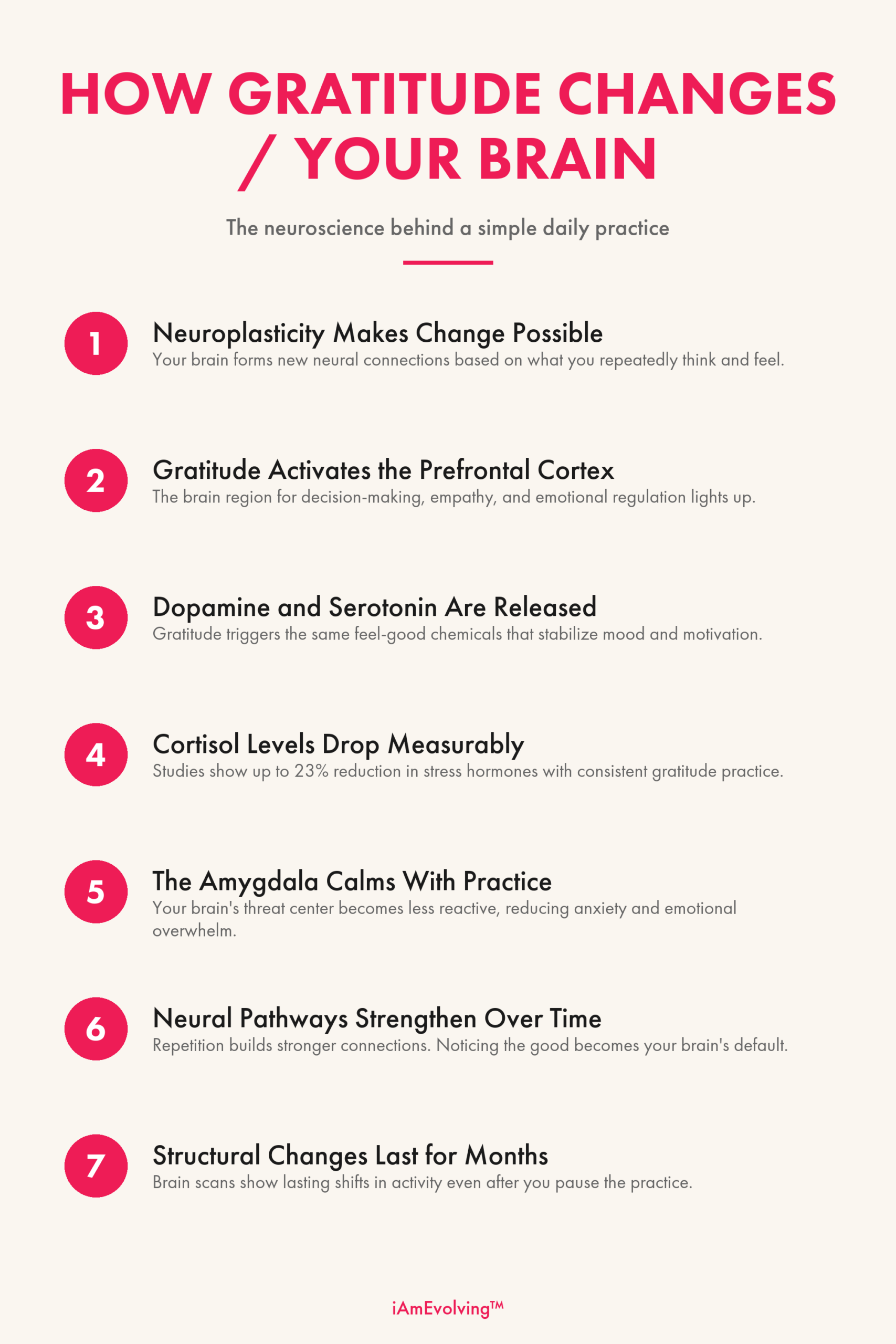
When you feel genuine gratitude, several key brain regions activate simultaneously. The medial prefrontal cortex, which handles self-referential thinking and decision-making, becomes more engaged. The anterior cingulate cortex, which governs emotional regulation and empathy, fires more intensely. And the ventral tegmental area, part of your brain’s reward system, releases dopamine into your neural circuits.
This combination is significant. You are simultaneously processing a positive experience, regulating your emotional state, and receiving a neurochemical reward. Your brain treats gratitude not as a passive thought but as an active, rewarding experience. And because your brain is designed to repeat behaviors that produce rewards, it begins building neural shortcuts that make gratitude easier and more automatic over time.
Brain imaging studies from the National Institutes of Health have confirmed this. When participants were asked to think about what they were grateful for, their hypothalamus showed increased activity. The hypothalamus controls fundamental body functions including sleep, eating, and stress response. Gratitude does not just change your thoughts. It communicates directly with the systems that regulate your physical health.
Neuroplasticity: Why Your Brain Can Change at Any Age
For most of the twentieth century, scientists believed that the adult brain was essentially fixed. You had the brain you had, and after a certain age, meaningful change was impossible. That view has been completely overturned. We now know that the brain continues forming new connections, pruning unused pathways, and adapting to new experiences throughout your entire life.
Neuroplasticity works on a simple principle. Whatever you practice repeatedly, your brain gets better at. If you spend years worrying, your brain builds strong worry circuits. If you spend years criticizing yourself, your brain strengthens those pathways. But the same principle works in the other direction. If you spend time each day noticing what you appreciate, your brain builds strong gratitude circuits. The pathways you use most become the pathways your brain defaults to.
This is why gratitude practice feels uncomfortable at first for many people. If your brain has spent years defaulting to anxiety or negativity, the gratitude pathways are weak. They have not been exercised. The first few days or weeks of practice feel forced because you are asking your brain to use circuits it has neglected. But with repetition, those circuits strengthen. What felt awkward becomes natural. What required effort becomes automatic.
The most important thing to understand about neuroplasticity and gratitude is that you are not stuck with the brain you have today. Your thoughts are not permanent. Your emotional patterns are not fixed. Every moment of genuine appreciation is a small act of rewiring, and those small acts compound over time into significant change.
The Negativity Bias and Why You Need Gratitude to Overcome It
Your brain has a built-in negativity bias. Psychologists estimate that negative experiences have roughly three to five times more impact on your mental state than equivalent positive ones. A single harsh comment can overshadow an entire day of kindness. One mistake at work can erase the memory of twenty things that went well.
This bias exists because of evolution. For your ancestors, noticing threats was a survival advantage. The person who ignored danger did not survive long enough to pass on their genes. But in modern life, this same bias creates chronic stress, rumination, and a distorted view of reality. Your brain is showing you a world that is more dangerous and disappointing than it actually is.
Gratitude is one of the most effective tools for counterbalancing this bias. When you deliberately notice and hold your attention on something positive for at least fifteen to thirty seconds, you give your brain enough time to encode that experience into long-term memory. Psychologist Rick Hanson calls this “taking in the good.” Without that deliberate pause, positive experiences slip through your awareness like water through a sieve while negative experiences stick like Velcro.
Over time, a daily gratitude practice builds a more balanced neural landscape. You do not lose your ability to detect problems. You gain the ability to detect solutions, beauty, and kindness with equal strength. Your brain becomes more honest about reality rather than more positive about it.
Get more like this, every week
What Brain Scans Reveal About Gratitude Practice
Some of the most compelling evidence for how gratitude changes your brain comes from neuroimaging studies. Researchers at Indiana University conducted a study where participants in counseling for anxiety and depression were assigned a gratitude letter-writing exercise. Three months later, participants underwent functional MRI scans while completing a gratitude task.
The results were remarkable. The group that had practiced gratitude writing showed significantly greater activation in the medial prefrontal cortex compared to those who had not written gratitude letters. These neural differences were visible three months after the writing exercise ended. The practice had created lasting structural changes in their brains.
Another finding was equally important. The gratitude writing group used fewer negative emotion words in their letters over time. Their brains had shifted not only in how they processed positive experiences but in how they framed difficult ones. They were naturally moving toward a more balanced perspective without being told to think positively.
These brain scan studies confirm what many people discover through personal experience. Gratitude changes something fundamental about how you see the world. It does not add a filter. It removes one, the filter that was causing you to overlook the good that was already there.
How Gratitude Journaling Strengthens Neural Pathways
Writing amplifies the neuroplastic effects of gratitude. When you think a grateful thought, one set of brain regions activates. When you write that thought down, additional regions engage, including those responsible for motor control, language processing, and visual memory. The more brain regions involved in an experience, the stronger the memory and the more robust the neural pathway.
This is why gratitude journaling produces better results than gratitude meditation or mental reflection alone. Writing forces you to be specific. You cannot write “I’m grateful for stuff” and feel satisfied. The pen demands detail. That detail activates memory, emotion, and sensory processing simultaneously, creating a rich neural experience that your brain encodes more deeply.
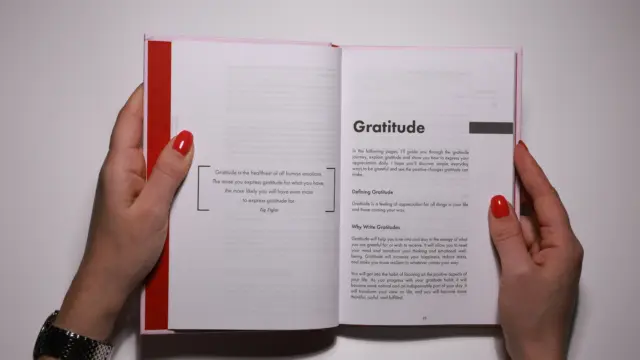
The iAmEvolving Journal was designed with this neuroscience in mind. Each day includes a dedicated space for gratitude that prompts you to be specific rather than vague. When you write about one particular moment you appreciated, one conversation that mattered, or one small thing that made you smile, you are doing more than recording your day. You are building neural architecture that will serve you for years.
Practical tips for maximizing the neuroplastic benefits of gratitude journaling:
- Write by hand when possible, as handwriting engages more brain regions than typing
- Be as specific as you can, including sensory details like what you saw, heard, or felt
- Pause after writing to re-experience the emotion for fifteen to thirty seconds
- Write at the same time each day to strengthen the habit loop in your brain
- Vary what you write about each day to prevent your brain from going on autopilot
The Compound Effect: Small Gratitude Moments Build Over Time
One of the most encouraging aspects of gratitude and neuroplasticity is the compound effect. Each individual moment of gratitude is small. A few seconds of appreciation, a sentence or two in your journal, a brief pause to notice something beautiful. None of these moments feels life-changing in isolation.
But neural pathways do not build overnight. They build through repetition. Every time you activate your gratitude circuits, the connection becomes slightly stronger, slightly faster, slightly more automatic. After a week, the change is invisible. After a month, you might notice you are sleeping slightly better. After three months, people around you might comment that you seem calmer. After a year, you are genuinely living in a different mental landscape.
This is exactly what the research predicts. The Indiana University brain scan study showed its biggest effects at three months. The Emmons gratitude journaling study showed significant changes at ten weeks. The timelines vary, but the pattern is consistent. Gratitude works through accumulation, not through sudden transformation.
Trust the small moments. They are doing more than you can see. Your brain is changing every time you choose appreciation over complaint, every time you pause to notice what went right instead of rehearsing what went wrong. You are not just having a nice thought. You are reshaping your brain.
Start Building Your Gratitude Brain Today
You do not need a perfect practice to benefit from neuroplasticity. You need a consistent one. Start with one specific thing you appreciate each day. Write it down. Hold the feeling for a few seconds before moving on. That is enough to begin the rewiring process.
If you want a structured way to build this habit, the iAmEvolving Journal gives you a daily framework that integrates gratitude with goal setting, habit tracking, and personal reflection. Gratitude is not treated as a separate exercise. It is woven into the fabric of your daily growth practice, which is exactly how your brain learns best, through context and connection.
Your brain is already changing every day based on what you pay attention to. The only question is whether that change is happening by default or by design. Gratitude practice gives you the design. Neuroplasticity does the rest.
Start your daily practice of gratitude, goals, and growth.
Get the Journal →A gentle 7-day reset to help you slow down, feel steadier, and reconnect — in just 5–10 minutes a day.
Start the ResetA simple introduction to daily journaling — gratitude, goals, and habits made easy.
Learn the MethodFAQ: Gratitude and Neuroplasticity
Can gratitude really change the physical structure of your brain?
How long does it take for gratitude to rewire your brain?
Is gratitude journaling better than just thinking grateful thoughts?
Does neuroplasticity from gratitude work at any age?