I AM Affirmations for Anxiety Relief

I AM affirmations for anxiety are calming statements like “I am safe” and “I am capable” that interrupt anxious thought spirals by giving your nervous system a message of peace. When anxiety tells you “I am in danger,” these affirmations offer a different truth.
These affirmations work at the identity level, which is exactly where anxiety does its damage. Anxiety tells you “I am in danger” or “I am not capable of handling this.” Affirmations counter with a different truth: “I am safe. I am capable. I am learning to be calm.” Over time, with consistent practice, these new messages can reshape how your nervous system responds to stress.
How I AM Affirmations Help with Anxiety
Anxiety is, at its core, a story your mind tells about danger. The danger may be real or imagined, present or future, but your body responds the same way — heart racing, breath shallow, muscles tensed for threat. Affirmations work by introducing a competing narrative, one that speaks to safety, capability, and calm.
When you repeat “I am safe,” you’re not denying real problems. You’re reminding your nervous system that this moment — right now — is not an emergency. This distinction matters. Anxiety often treats non-urgent situations as crises. Affirmations help restore proportion.
The “I am” construction is particularly powerful for anxiety because it addresses identity, not just feelings. “I feel anxious” keeps you identified with the anxiety. “I am learning to be calm” positions calmness as part of who you’re becoming. This subtle shift changes everything. Understanding what anxiety actually is can help you approach affirmations with greater clarity.
30 I AM Affirmations for Anxiety Relief
Choose the affirmations that resonate most with your experience. You might use different ones for different situations — some for general daily practice, others for acute moments of panic. There’s no wrong way to use these; let your intuition guide you.
Affirmations for Present-Moment Safety
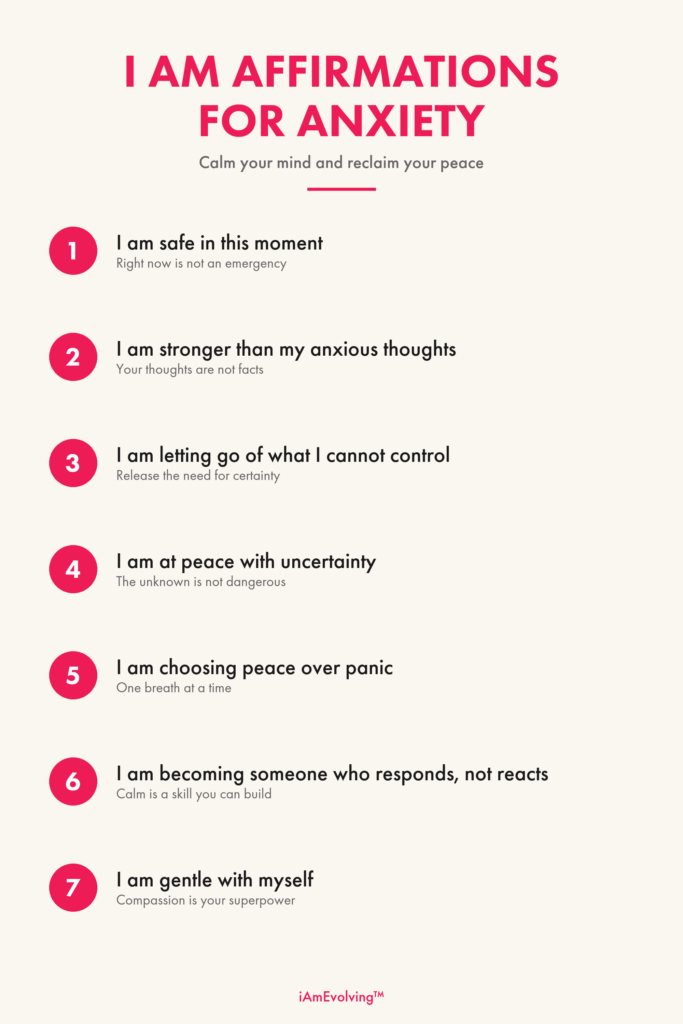
- I am safe in this moment.
- I am breathing, and that means I am okay.
- I am here, now, and right now is enough.
- I am grounded in my body and present in my life.
- I am surrounded by safety, even when fear tells me otherwise.
- I am learning to distinguish between danger and discomfort.
Affirmations for Capability and Strength
- I am capable of handling whatever comes my way.
- I am stronger than my anxious thoughts.
- I am resilient — I have survived difficult moments before.
- I am equipped with everything I need to face this day.
- I am learning to trust myself more each day.
- I am someone who finds solutions, even when scared.
Affirmations for Releasing Worry
- I am releasing thoughts that do not serve me.
- I am letting go of the need to control everything.
- I am trusting the process of life to unfold.
- I am free to release worries about the future.
- I am choosing peace over panic, one breath at a time.
- I am allowed to stop carrying burdens that aren’t mine.
For more support with releasing anxious thoughts, explore the art of letting go.
Affirmations for Calm and Peace
- I am calm, even when circumstances feel chaotic.
- I am at peace with uncertainty.
- I am learning to rest in the unknown.
- I am worthy of peace and mental stillness.
- I am cultivating inner calm that cannot be shaken.
- I am becoming someone who responds, not reacts.
Affirmations for Self-Compassion During Anxiety
- I am gentle with myself when anxiety arises.
- I am not broken — I am human and learning.
- I am worthy of compassion, especially from myself.
- I am doing my best, and that is enough.
- I am allowed to feel anxious without judging myself.
- I am patient with my healing process.
How to Practice Affirmations When Anxious
Using affirmations during active anxiety requires a slightly different approach than calm-state practice. Here’s how to make them work when your nervous system is activated:
Start with breath. Before speaking any affirmation, take three slow breaths. Inhale for four counts, hold for two, exhale for six. This activates your parasympathetic nervous system and creates space for the words to land. Anxious minds struggle to absorb affirmations — breath creates the opening.
Choose one affirmation. When anxiety is high, don’t overwhelm yourself with a list. Pick a single statement that feels most needed. Repeat it slowly, again and again, like a anchor holding you steady.
Engage your body. Place your hand on your chest or stomach as you speak. Feel your own touch. This grounds the affirmation in physical sensation, making it more than just words in your head.
Soften if needed. If “I am calm” feels like a lie when your heart is pounding, try “I am becoming calm” or “I am open to feeling calm.” These softer versions acknowledge your current state while pointing toward where you want to go.
Repeat until you feel a shift. This might take two minutes or twenty. Stay with your affirmation until you notice something change — a slightly slower heartbeat, a slightly deeper breath, a slight loosening of tension. That’s your signal it’s working.
Get more like this, every week
Building a Daily Anti-Anxiety Affirmation Practice
Affirmations work best when practiced regularly, not just during crisis. Daily practice builds the neural pathways that make calm more accessible when you need it most.
Morning foundation. Start each day with 3-5 affirmations focused on calm and capability. This sets your mental tone before daily stressors begin. Pair this with your morning journaling routine for deeper integration.
Midday reset. Set a reminder to pause in the middle of your day. Take one breath, speak one affirmation. This interrupts the accumulation of stress and reminds your nervous system that calm is always available.
Evening release. Before bed, use affirmations focused on letting go: “I release the worries of today. I am safe to rest.” This helps prevent nighttime anxiety and improves sleep quality.
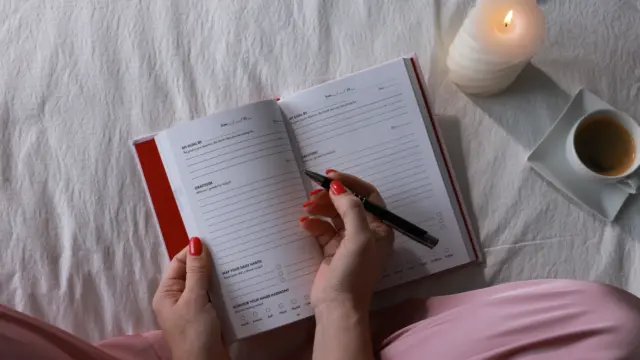
Written practice. Write your affirmations by hand in a journal. The physical act of writing engages different brain regions and deepens the imprint. Journaling prompts for anxiety can complement this practice beautifully.
Combining Affirmations with Other Anxiety Tools
Affirmations are most effective as part of a broader approach to anxiety management:
Breathing techniques. Mindful breathing and affirmations work synergistically. Breath calms the body; affirmations calm the mind. Practice them together for maximum effect.
Journaling. Writing about your anxiety — what triggered it, how it felt, how you responded — creates distance and understanding. Add affirmations at the end of journal entries as a way to close with intention.
Movement. Walking, stretching, or any gentle movement helps discharge anxious energy from the body. Repeat affirmations silently as you move for an integrated practice.
Grounding techniques. The 5-4-3-2-1 technique (naming things you can see, hear, touch, smell, taste) brings you into the present moment. Follow grounding with an affirmation to anchor the calm state you’ve created.
Professional support. Affirmations complement but do not replace therapy for clinical anxiety. If anxiety significantly impacts your daily functioning, consider working with a mental health professional who can provide additional tools and support.
What to Do When Affirmations Feel Impossible
Some days, anxiety feels so overwhelming that affirmations seem useless or even insulting. Your mind screams “I am not safe!” and any counter-message feels like denial. This is normal, and it doesn’t mean the practice has failed.
On these difficult days:
Acknowledge what’s true. Start where you are: “I am feeling anxious right now. That’s okay. I am still here.” This validates your experience instead of fighting it.
Use future-oriented softening. “I will feel calm again” or “This feeling will pass” may feel more accessible than present-tense calm you don’t yet feel.
Focus on action, not feeling. “I am taking one breath” or “I am putting my hand on my heart” describes what you’re doing, not what you’re feeling. Sometimes action-based affirmations are easier to believe.
Return to basics. “I am breathing. I am alive. I am here.” These fundamental truths can’t be argued with and provide a foundation when everything else feels unstable.
The Relationship Between Anxiety and Identity
Many people with chronic anxiety have internalized it as part of their identity: “I am an anxious person.” This belief, while understandable, keeps you stuck. If anxiety is who you are, how can you ever be free of it?
I AM affirmations offer an alternative identity. Instead of “I am anxious,” you practice “I am someone learning to be calm” or “I am becoming more peaceful.” These statements acknowledge your journey while pointing toward a different self-concept.
This shift is profound. You’re not pretending anxiety doesn’t exist. You’re refusing to let it define you. You’re claiming a larger identity that includes the capacity for calm, peace, and presence — even if you haven’t fully accessed those states yet.
The work of reframing negative thoughts supports this identity shift by helping you catch and redirect the mental patterns that fuel anxiety.
Start Today: Your Anti-Anxiety Affirmation Practice
Choose three affirmations from this list — ones that speak to your specific experience of anxiety. Write them down. Commit to practicing them twice daily for one week: morning and evening, for just two to three minutes each time.
Notice what happens. Not dramatic transformation overnight, but small shifts — a slightly calmer response to stress, a moment where you caught an anxious spiral earlier, a night where sleep came a little easier.
These small shifts compound. Day by day, affirmation by affirmation, you’re rewiring your brain to find calm more easily. You’re building new neural pathways that make peace more accessible than panic.
You are not your anxiety. You are someone capable of calm, worthy of peace, and already on the path to a quieter mind.
For the complete guide to identity-based affirmations, explore our I AM affirmations guide.
Start your daily practice of gratitude, goals, and growth.
Get the Journal →A gentle 7-day reset to help you slow down, feel steadier, and reconnect — in just 5–10 minutes a day.
Start the ResetA simple introduction to daily journaling — gratitude, goals, and habits made easy.
Learn the MethodFAQ: I AM Affirmations for Anxiety
Can affirmations really help with anxiety?
How often should I practice anxiety affirmations?
What if saying affirmations makes me feel worse?
Should I use affirmations instead of therapy for anxiety?