Why Gratitude Matters: The Psychology Behind Daily Practice
Gratitude is one of those words that gets used so often it can start to feel hollow. You hear it in self-help books, on motivational posters, in advice from well-meaning friends. But why gratitude matters goes far beyond a pleasant feeling or a polite habit. Research in psychology shows that gratitude physically changes how your brain processes the world. It reshapes your attention, your emotional baseline, and your ability to cope with difficulty. When you understand what gratitude actually does inside you, the practice stops feeling like a chore and starts feeling like a quiet act of self-restoration.
If you have been curious about building a gratitude practice but never understood the deeper reason behind it, this is where it starts. Gratitude is not about ignoring pain or forcing yourself to feel happy. It is about training your mind to notice what is already working, even on the hardest days. That single shift changes everything else.
What Gratitude Really Means in Psychology
In psychological research, gratitude is defined as recognizing that something good has happened to you and that an outside source is partly responsible. That outside source might be another person, nature, or even the simple fact that your body carried you through another day. Gratitude is not the same as saying everything is fine. It is the ability to hold both the good and the hard at the same time.
Dr. Robert Emmons, one of the leading researchers in gratitude science, describes it as a two-step process. First, you acknowledge that there is goodness in your life. Second, you recognize that some of that goodness comes from outside yourself. This definition matters because it separates gratitude from self-congratulation or denial. You are not pretending. You are paying attention with honesty.
When you start paying attention in this way, your brain begins to reorganize what it considers important. You notice small kindnesses. You register moments of beauty. You feel less alone. This is not a personality trait you are born with. It is a skill you build through practice, and the psychological evidence behind it is strong.
Why Gratitude Matters for Your Mental Health
One of the most well-documented effects of gratitude is its impact on mental health. Studies have shown that people who regularly practice gratitude report fewer symptoms of depression and anxiety. They sleep better. They feel more connected to others. They experience less resentment and more emotional stability.
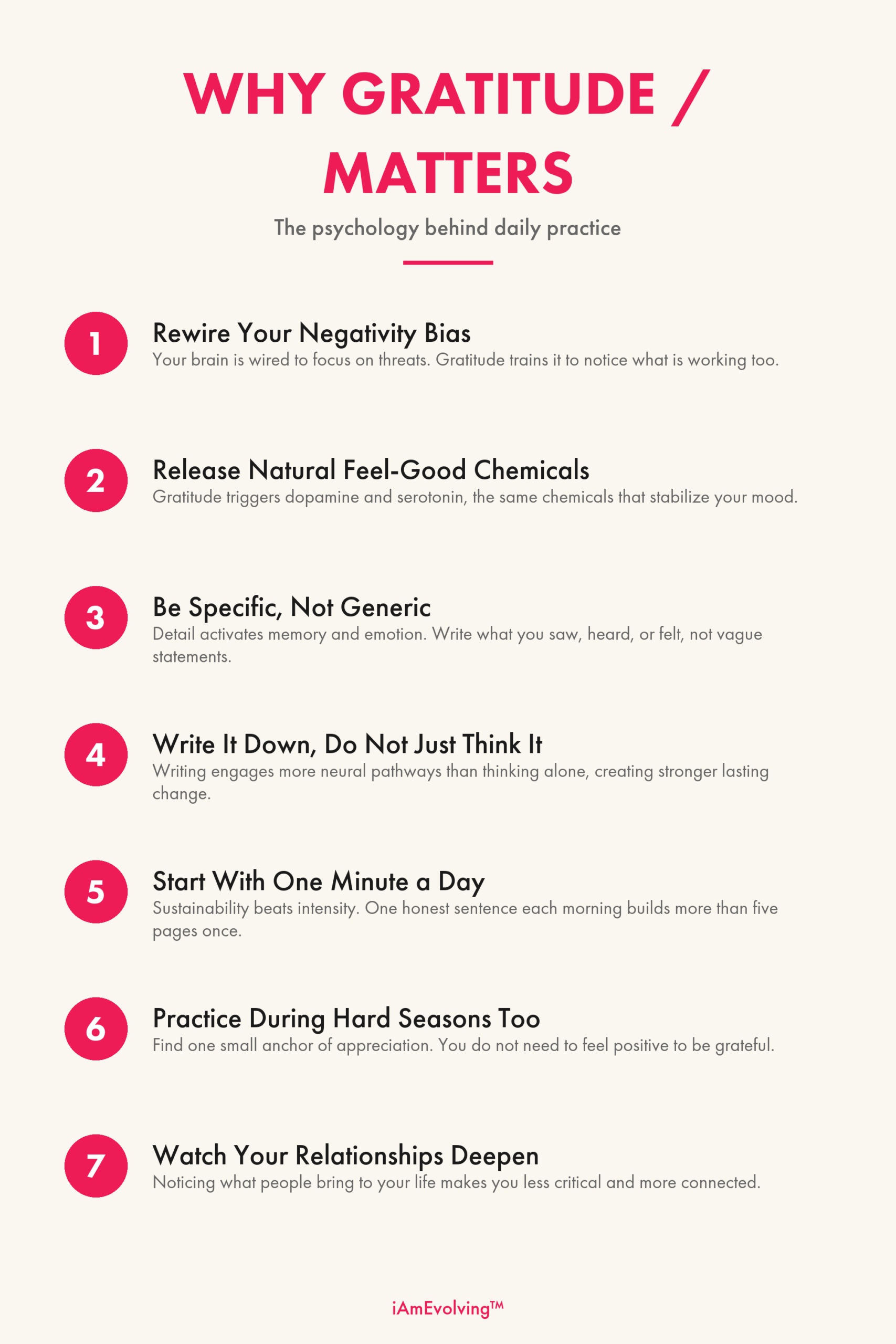
The reason is neurological. When you focus on what you appreciate, your brain releases dopamine and serotonin, the same chemicals responsible for feelings of well-being and calm. Over time, this becomes a habit loop. The more you practice, the more your brain defaults to noticing the good. It is not toxic positivity. It is deliberate attention training.
Research from the University of California, Davis found that participants who wrote in a daily gratitude journal for just ten weeks reported feeling 25 percent happier, more optimistic about the future, and more motivated to exercise. These were not people with easy lives. Many were dealing with real stress. Gratitude did not erase their problems. It changed their relationship to those problems.
If you struggle with rumination, the kind of thinking where your mind replays painful events over and over, gratitude gives your brain something else to hold. It is not a distraction. It is a redirect. You are choosing to spend mental energy on something that strengthens you instead of something that drains you.
The Daily Practice That Makes Gratitude Work
Knowing that gratitude matters is one thing. Practicing it daily is where the change actually happens. The most effective approach is simple and takes less than five minutes. You write down three things you are grateful for each day. Not generic things. Specific things. Not “I’m grateful for my family” every day, but “I’m grateful my daughter laughed at dinner tonight” or “I’m grateful the sun came through the window while I had my coffee.”
Specificity is what activates your brain. When you recall a detailed moment, you re-experience the emotion attached to it. That re-experiencing strengthens the neural pathway. Over time, your brain starts scanning for these moments automatically. You begin noticing more good because you have trained yourself to look for it.
Here are a few ways to build this into your daily life:
- Write three specific things you are grateful for every morning before checking your phone
- Use your evening journaling time to reflect on one moment from the day that felt meaningful
- Before a meal, pause for ten seconds and notice something good about where you are right now
- When something frustrating happens, ask yourself what you can still appreciate about the situation
- End your week with a short reflection on what went well, not just what needs fixing
The iAmEvolving Journal was designed with this kind of daily gratitude practice built in. Each page gives you space to acknowledge what is going well before you set your intentions for the day. That order matters. When you start from appreciation, your goals feel less desperate and more grounded.
Get more like this, every week
Gratitude Rewires Your Default Thinking
Your brain has a negativity bias. This is well-established in neuroscience. You are wired to pay more attention to threats, problems, and danger than to safety, beauty, and kindness. This was useful when survival depended on spotting predators. It is less useful when it means you spend your entire day focused on everything that is wrong.
Gratitude directly counteracts this bias. Every time you deliberately notice something good and hold your attention on it for a few seconds, you weaken the automatic pull toward negativity. You are not fighting your brain. You are retraining it. Neuroscientists call this experience-dependent neuroplasticity. Your repeated experiences literally change the structure of your brain.
This is why gratitude feels awkward at first. Your brain is not used to prioritizing positive input. It resists. It tells you the exercise is pointless or silly. That resistance is actually a sign that the rewiring is beginning. The discomfort means you are building a new pattern where an old one used to be.
Over weeks and months, the shift becomes noticeable. You catch yourself appreciating things without trying. You feel less reactive to minor frustrations. You sleep more easily because your mind is not churning through a list of worries. The change is quiet, but it is real.
How Gratitude Strengthens Relationships
Gratitude does not only change how you relate to yourself. It changes how you relate to others. When you practice noticing what people do for you, what they bring to your life, and what you appreciate about them, your relationships deepen. You become less critical. You express appreciation more naturally. People feel seen by you, and they respond in kind.
Research published in the journal Emotion found that expressing gratitude to a partner increased relationship satisfaction for both the person expressing and the person receiving. It created a positive feedback loop. One act of appreciation led to another. Over time, the entire dynamic between two people shifted toward warmth and generosity.
This applies beyond romantic relationships. Gratitude improves friendships, work relationships, and even your relationship with strangers. When you walk through the world looking for what is good in people, you interact differently. You are more patient. You give others the benefit of the doubt. You create an environment where connection can grow.
Gratitude During Difficult Seasons
One of the most common objections to gratitude practice is that it feels impossible when life is genuinely hard. When you are grieving, when your finances are strained, when your health is fragile, being told to be grateful can feel dismissive. This is a valid concern, and it deserves a honest answer.
Gratitude during difficulty is not about pretending the difficulty does not exist. It is about finding one small anchor that keeps you from being completely swept away. Maybe you cannot be grateful for your situation, but you can be grateful for the friend who called. Maybe the day was terrible, but the sunset was beautiful. That single point of appreciation does not fix everything. It gives your nervous system a moment of rest.
Psychologist Viktor Frankl, who survived the Holocaust, wrote about finding meaning even in the most extreme suffering. He did not call it gratitude, but the principle is the same. When you find one thing worth holding onto, you maintain your sense of agency. You remind yourself that the darkness is not all there is.
If you are going through a hard season, do not pressure yourself to fill a gratitude list. Start with one thing. One honest thing. That is enough. The practice meets you where you are.
Building a Gratitude Practice That Lasts
The biggest reason people stop practicing gratitude is that they try to do too much too fast and then burn out. They buy a beautiful journal, write five pages the first day, and quit by the second week. Sustainability beats intensity every time.
Start with one minute. Write one thing. Do it at the same time every day so it becomes automatic. Attach it to a habit you already have, like your morning coffee or your evening wind-down. The less effort it takes, the more likely you are to keep going.
Here are journaling prompts to keep your gratitude practice fresh:
- What is one thing that happened today that I did not expect but appreciated?
- Who made my life easier this week, and how?
- What part of my body am I thankful for today?
- What is a small comfort I usually take for granted?
- What challenge am I facing that is also teaching me something?
These prompts keep you thinking differently each day. They prevent the staleness that comes from writing the same things repeatedly. When gratitude feels alive and specific, it stays meaningful.
Gratitude as a Foundation for Personal Growth
Every pillar of personal growth, from goal setting to habit building to mindset work, becomes stronger when it sits on a foundation of gratitude. When you appreciate where you are, you pursue where you want to go with less anxiety and more clarity. You stop chasing goals from a place of lack and start moving toward them from a place of abundance.
This does not mean you stop striving. It means your striving becomes healthier. You set goals because you want to grow, not because you feel broken. You build habits because they serve your well-being, not because you are punishing yourself into change. Gratitude gives you a stable emotional base from which everything else can expand.
The iAmEvolving Journal integrates gratitude into every daily reflection for exactly this reason. It is not a gratitude journal. It is a personal evolution journal that uses gratitude as one of its core engines. When you write what you appreciate alongside your goals, habits, and reflections, you create a practice that is whole rather than fragmented.
Understanding why gratitude matters is the first step. The second step is practicing it, imperfectly and consistently, one day at a time. Your brain will resist at first. Keep going. The shift happens quietly, and then one morning you realize you are living differently. Not because your circumstances changed, but because you did.
Start your daily practice of gratitude, goals, and growth.
Get the Journal →A gentle 7-day reset to help you slow down, feel steadier, and reconnect — in just 5–10 minutes a day.
Start the ResetA simple introduction to daily journaling — gratitude, goals, and habits made easy.
Learn the MethodFAQ: Why Gratitude Matters
Why is gratitude important for mental health?
How long does it take for gratitude practice to work?
Can you practice gratitude when life is genuinely difficult?
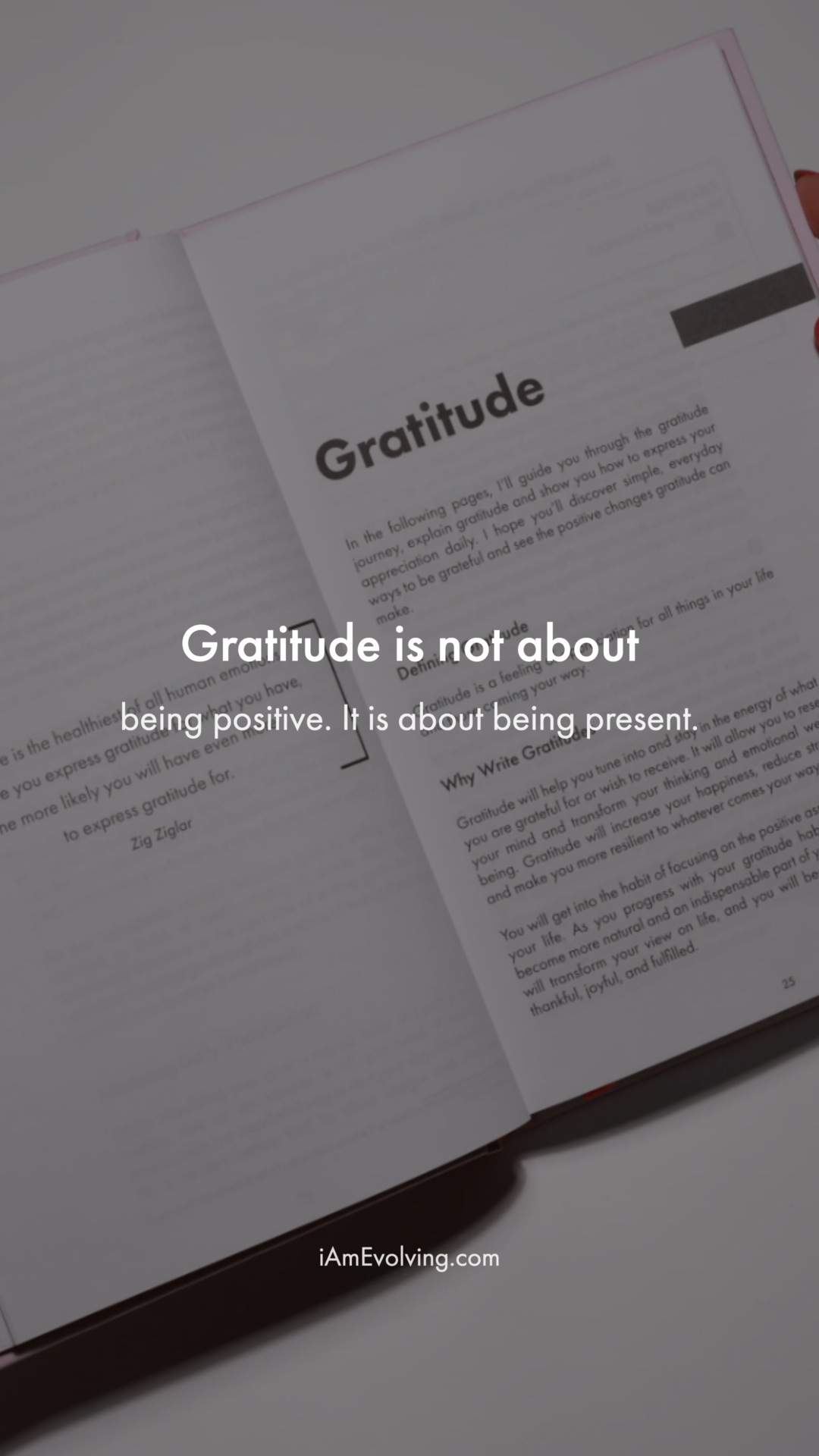
What is the difference between gratitude and positive thinking?