Evening Journaling Routine to Unwind

The end of the day is more than just a time to switch off — it’s the perfect opportunity to reflect, release mental clutter, and create emotional space for tomorrow. An evening journaling routine is one of the most powerful yet overlooked practices for personal clarity and peace of mind.
Instead of scrolling through your phone or replaying the day’s worries in your head, you can use journaling to unwind intentionally and set yourself up for a restful night.
If you want a complete guide to building a journaling practice that supports you from morning clarity to evening calm, explore my full guide on The Ultimate Journaling Guide. It will help you create a consistent rhythm that helps you unwind, reset your mind, and stay connected to yourself every day.
Why Evening Journaling Matters
Evening journaling gives you the space to process your thoughts before bed. By slowing down and writing things out, you:
- Clear lingering thoughts from your mind
- Reflect on the day’s wins and challenges
- Reduce stress and anxiety
- Improve sleep quality by mentally “closing the tabs”
- Strengthen self-awareness through consistent reflection
It’s a simple ritual that turns the end of your day into a moment of grounding.
What to Include in Your Evening Journaling Routine
There’s no single right way, but here’s a simple structure that works well for many people:
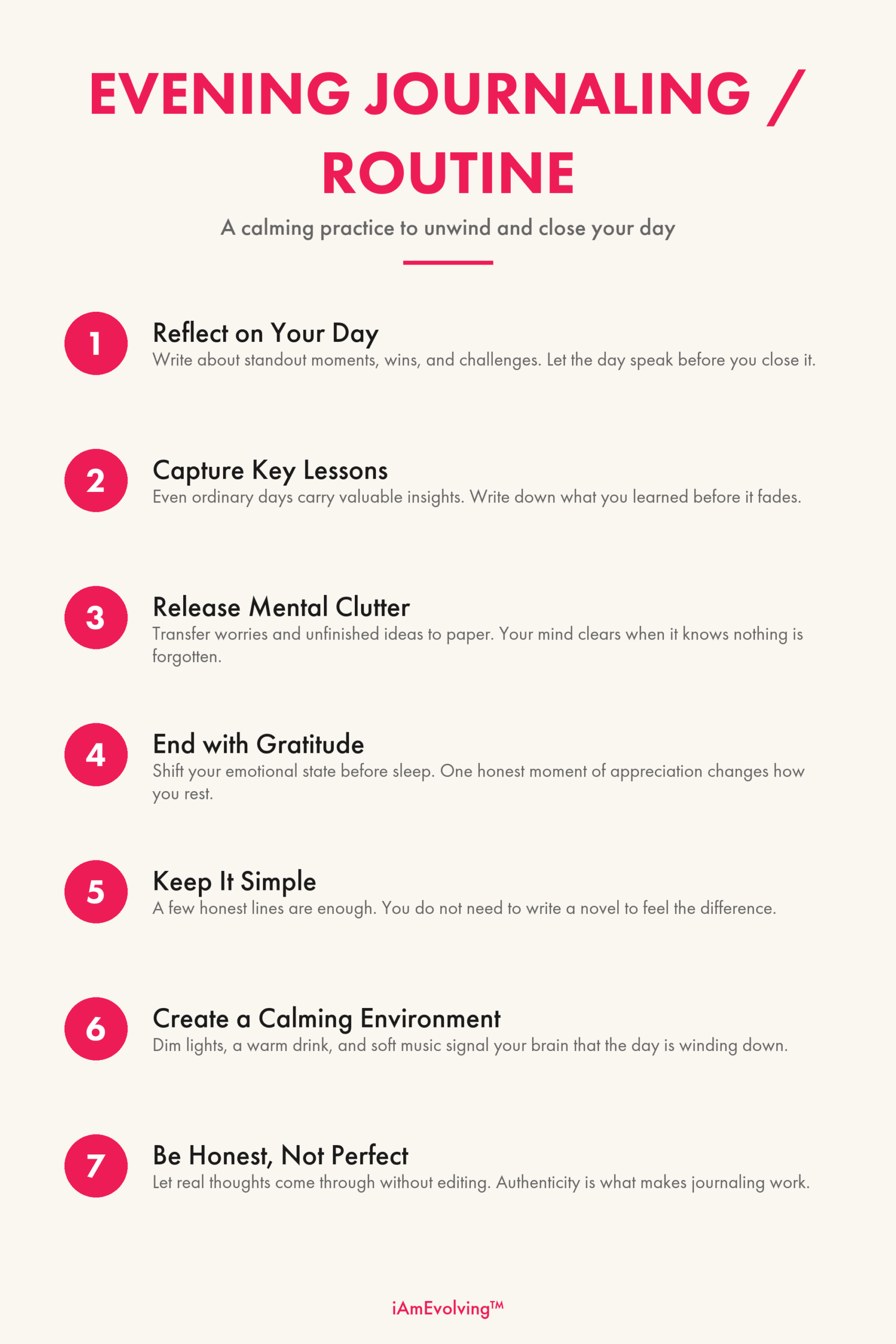
1. Reflect on the Day
Write about what happened — not every detail, but the moments that stood out. What went well? What felt challenging? Reflection gives you perspective.
You do not need to write a full narrative. A few bullet points or short sentences are enough. The goal is to acknowledge the day rather than carry it into your sleep. Some people find it helpful to start with “Today, I noticed…” or “The moment that stayed with me was…” — simple starters that move the pen without overthinking.
Pay attention to both the highlights and the hard moments. A balanced reflection is not about listing only what went well — it is about seeing the day honestly. When you write about a challenge without judgment, you process it. When you skip it, you carry it forward. Honesty on paper leads to lightness in your body.
If you find it hard to know where to start, try a simple prompt: “What am I still carrying from today?” That single question opens the door to everything — frustration you have not expressed, pride you have not acknowledged, or worry you have not named. Let the question do the work and follow your pen wherever it goes.
2. Note Key Lessons or Insights
Even ordinary days hold valuable lessons if you take time to notice them. A few sentences are enough.
Ask yourself: “What did I learn today that I want to remember?” It might be something practical — a better way to handle a difficult conversation — or something internal, like recognizing a pattern you want to change. Writing it down anchors the insight so it does not slip away overnight. Over weeks and months, these small entries become a personal record of growth that you can look back on whenever you need perspective.
3. Release Mental Clutter
Write down any lingering thoughts, worries, or unfinished ideas. This clears your mind and signals to your brain that it’s okay to rest.
4. End with Gratitude
Write down a few things you’re grateful for from the day. Ending with gratitude shifts your emotional state and helps you sleep with a calmer mind.
How Journaling Before Bed Improves Sleep
One of the most common reasons people start journaling at night is to sleep better — and the evidence supports them. A 2018 study published in the Journal of Experimental Psychology found that participants who spent five minutes writing a to-do list before bed fell asleep significantly faster than those who wrote about completed tasks. The act of offloading upcoming concerns onto paper reduced cognitive arousal enough to shorten sleep onset.
When you journal before bed, you give your brain permission to stop problem-solving. Without that release, your mind continues to loop through unresolved thoughts — replaying conversations, anticipating tomorrow’s challenges, or cataloguing things you forgot to do. Writing interrupts that cycle by externalizing the mental load.
The benefits extend beyond falling asleep faster. Night journaling also improves sleep quality by reducing the emotional intensity of lingering thoughts. When you process frustration, disappointment, or worry on paper, those feelings lose their grip. You wake up feeling lighter — not because the problems disappeared, but because your brain had the chance to file them away properly before rest. If you want to explore this connection further, my post on night journaling before sleep goes deeper into techniques designed specifically for better rest.
Nighttime journaling also reduces cortisol — the stress hormone that keeps your body in a state of alertness. When cortisol stays elevated at night, falling asleep becomes a fight against your own biology. Writing before bed helps discharge the emotional charge behind your thoughts, which in turn allows cortisol to drop naturally. This is why people who journal in the evening often report not just falling asleep faster, but waking up feeling more rested.
Another benefit worth mentioning: evening journaling strengthens your ability to recognize patterns over time. When you consistently reflect on your day, you start to notice recurring themes — what drains your energy, what restores it, which interactions leave you unsettled, and which ones fill you up. That self-awareness does not develop from thinking alone. It develops from writing things down and revisiting them.
If you struggle with racing thoughts at bedtime, try writing for just five minutes before you turn out the lights. Do not aim for completeness — aim for honesty. Even a short entry like “I feel tense about tomorrow’s meeting and I do not know why” gives your brain enough closure to begin winding down. The specificity matters less than the act of acknowledging what is present.
Some people find that adding a closing ritual helps. After your last line, close the journal, take one deep breath, and set it aside. That physical act of closing the cover becomes a signal — the day is officially done. Your brain learns to associate journal-closing with permission to rest, and over time, the transition from writing to sleeping becomes almost seamless.
Get more like this, every week
Tips to Make Evening Journaling a Consistent Habit
Starting an evening journaling routine is easy. Keeping it going is where most people struggle. The key is not willpower — it is design. Set up your environment so that writing feels like the path of least resistance, and the habit will build itself. Not sure when to fit it in? My guide on the best time to journal can help you find the window that works for your schedule.
- Set a reminder. Choose a specific time each evening to sit down and write.
- Keep it simple. A few lines can make a big difference — this doesn’t need to be a long entry.
- Create a calming environment. Dim lights, make tea, or play soft music to turn journaling into a relaxing ritual.
- Be honest, not perfect. This is your private space. Let your real thoughts come through.
- Put your phone away first. Scrolling before writing pulls your attention outward. Journaling works best when your mind turns inward.
- Use the same journal every night. Familiarity builds ritual. When your brain associates the physical journal with winding down, the habit becomes almost automatic.
The key to consistency with any evening journaling routine is removing friction. Keep your journal on your nightstand, not across the room. Use a pen you enjoy writing with. And lower the bar — even two sentences count. Bedtime journaling works best when it is woven into something you already do, like your skincare or reading routine. Habit stacking is one of the most reliable ways to make a new practice stick, and your evening wind-down is full of natural anchor points.

Why the iAmEvolving Journal Works Perfectly for Evenings
What makes the iAmEvolving Journal especially effective for nighttime journaling is the way it separates reflection from planning. Most journals combine both, which keeps your mind in problem-solving mode. The iAmEvolving Journal gives you an evening space that is entirely about processing and releasing — not preparing for tomorrow. That separation is what helps your mind shift from doing to resting.
Each evening section is designed for five to ten minutes of honest writing. There are prompts for reflection, space to note what you are grateful for, and a place to capture anything still weighing on your mind. The structure removes the “what do I write?” barrier — which is the number one reason people quit journaling. When the page guides you, all you have to do is show up.
The iAmEvolving Journal provides a structured space to reflect on your day, track habits, and express gratitude — making evening journaling effortless. Instead of facing a blank page, you’re guided through meaningful reflection that helps you end your day with clarity and calm.
Available here:
Start your daily practice of gratitude, goals, and growth.
Get the Journal →A gentle 7-day reset to help you slow down, feel steadier, and reconnect — in just 5–10 minutes a day.
Start the ResetA simple introduction to daily journaling — gratitude, goals, and habits made easy.
Learn the MethodAn evening journaling routine turns reflection into release — a moment to unwind, let go, and prepare your mind for rest. Each entry helps you close the day with clarity and peace. It does not matter whether you write three lines or three pages. What matters is that you show up, put pen to paper, and give your mind permission to stop carrying the day.
The people who benefit most from this practice are not the ones who write beautifully — they are the ones who write consistently. Start tonight. Keep it short. Let it grow naturally. And if you want to deepen the emotional release that comes from an evening practice, explore how an evening gratitude ritual can close your day on an even calmer note.
If you are looking for a companion practice, pairing your evening journal with a morning journaling routine creates a rhythm that bookends your day with intention and awareness. And for more daily writing rituals that bring balance and consistency, visit Journaling Routines & Daily Practice.
Frequently Asked Questions
How long should an evening journaling routine take?
Can I use the same journal for morning and evening routines?
What if I skip a day?
Is it better to write before or after bedtime?
Does nighttime journaling actually improve sleep?
What should I write in my journal before bed?