Gratitude and Mindfulness: How These Two Practices Work Together
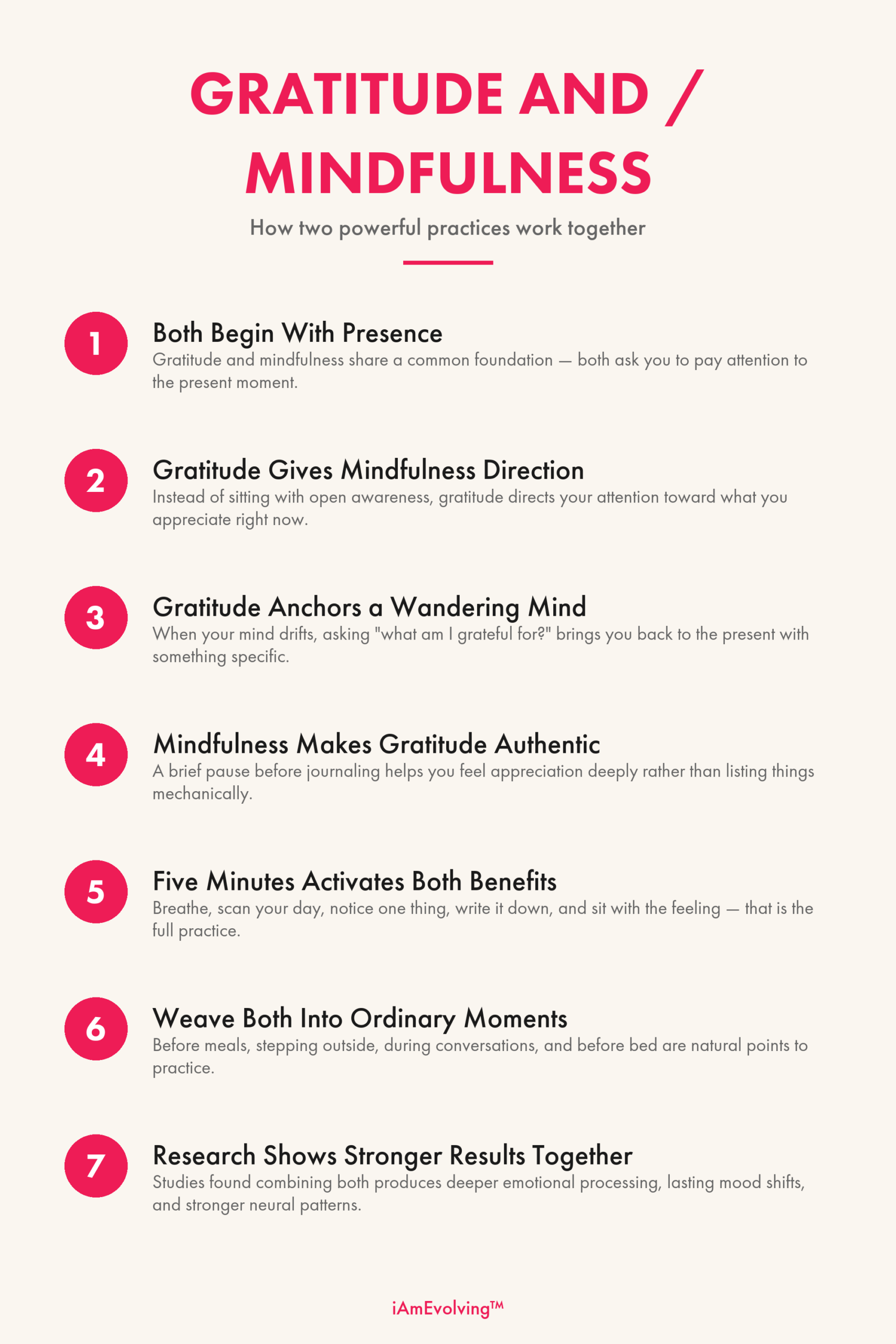
Gratitude and mindfulness are two of the most studied practices in modern psychology, and they share a common foundation. Both ask you to pay attention. Both ask you to be present. Both teach you to notice what is happening right now instead of getting lost in what happened yesterday or what might happen tomorrow. When you combine gratitude and mindfulness into a single daily practice, they amplify each other in ways that neither can achieve alone. Gratitude gives mindfulness something specific to rest on. Mindfulness gives gratitude the depth it needs to become more than a surface-level habit.
If you have tried either practice and found it difficult to sustain, combining them might be what you need. Mindfulness without gratitude can sometimes feel empty, like you are watching your thoughts without direction. Gratitude without mindfulness can become mechanical, like you are listing things you appreciate without actually feeling them. Together, they create a practice that is both focused and alive. And the research supports this. People who practice both report greater emotional resilience, better sleep, and a deeper sense of connection to their daily lives.
What Mindfulness Actually Means
Mindfulness is the practice of paying attention to the present moment without judgment. That last part is critical. It is not just about noticing what is happening. It is about noticing without immediately deciding whether what is happening is good or bad, right or wrong, comfortable or uncomfortable.
When you sit in mindfulness, you observe your thoughts, feelings, and sensations as they come and go. You do not try to change them. You do not push away the difficult ones or cling to the pleasant ones. You simply notice. This practice builds what psychologists call metacognition, the ability to observe your own thinking. Over time, metacognition creates space between a stimulus and your response. Instead of reacting automatically, you learn to pause, notice, and choose.
Mindfulness has been shown to reduce stress, improve focus, decrease emotional reactivity, and support better physical health. It is used in clinical settings for anxiety, depression, chronic pain, and addiction. The evidence base is extensive and growing. But mindfulness, practiced alone, can sometimes feel challenging because it does not give you a direction. You are present, but present with what?
Where Gratitude and Mindfulness Meet
Gratitude gives mindfulness a direction. Instead of simply being present and noticing whatever arises, you direct your attention toward what you appreciate. This does not mean you ignore difficulty. It means you intentionally include appreciation as part of what you notice.
Think of it like looking at a landscape. Mindfulness teaches you to see the whole landscape clearly, the mountains, the valleys, the clouds, and the sun. Gratitude asks you to linger on the parts that nourish you, without pretending the valleys are not there. You are not filtering your experience. You are choosing where to rest your attention within the full scope of what is real.
Research from the Greater Good Science Center at UC Berkeley found that participants who combined mindfulness meditation with gratitude exercises showed greater improvements in well-being than those who practiced either alone. The combination produced deeper emotional processing, more lasting mood improvements, and stronger neural patterns associated with positive affect. The two practices work on similar brain regions but activate them in complementary ways.
How Gratitude Deepens Your Mindfulness Practice
One of the most common struggles with mindfulness is that the mind wanders. You sit down to be present, and within thirty seconds you are planning dinner, replaying a conversation, or worrying about a deadline. This is normal. The brain is designed to wander. But it makes sustaining a mindfulness practice difficult, especially for beginners.
Gratitude provides an anchor. When your mind wanders during a mindful pause, you can bring it back by asking a simple question: what am I grateful for right now? This question redirects your attention to the present moment and gives it something specific to rest on. The warmth of your coffee. The sound of birds outside. The fact that your body is breathing without you having to think about it.
This anchoring effect makes mindfulness more accessible. You are not just sitting with the void of your thoughts. You are sitting with appreciation. And because appreciation feels good, your brain is more willing to stay present. The reward of gratitude keeps you engaged in the mindfulness practice longer than you might otherwise stay.
Over time, this combined practice teaches your brain to default to a state of mindful appreciation. You start noticing small moments of beauty and kindness throughout your day without deliberately trying. You become someone who is both present and grateful as a natural way of being, not as a forced exercise.
Get more like this, every week
How Mindfulness Makes Gratitude More Authentic
Just as gratitude strengthens mindfulness, mindfulness strengthens gratitude. Without mindfulness, gratitude can become a rote exercise. You write “I’m grateful for my family” in your journal each morning without actually feeling anything. The words are there, but the emotion is absent. This kind of mechanical gratitude does not produce the neurological or psychological benefits that the research describes.
Mindfulness brings depth to gratitude by slowing you down enough to actually feel what you are writing. When you pause before your gratitude practice, take a few deep breaths, and settle into the present moment, the appreciation that arises is genuine rather than performative. You connect with the experience behind the words.
Try this simple exercise. Before writing in your gratitude journal, close your eyes for thirty seconds. Take three slow breaths. Then ask yourself: what felt meaningful today? Let the answer come to you rather than forcing it. The gratitude that surfaces from this mindful pause will be specific, vivid, and emotionally resonant. Your brain encodes that kind of gratitude far more deeply than a hurried list written while scrolling your phone.
A Simple Daily Practice That Combines Both
You do not need to meditate for an hour or fill pages in a journal to combine gratitude and mindfulness. A five-minute daily practice is enough to activate the benefits of both. Here is a simple structure you can follow:
- Minute one: Sit quietly and take five slow, deep breaths. Do not try to think about anything. Just notice how your body feels in this moment.
- Minute two: Scan your day so far. Without judging anything, simply notice what happened. What did you see, hear, taste, or feel?
- Minute three: Ask yourself what you appreciated from those moments. Let one specific thing rise to the surface. Hold it in your awareness.
- Minute four: Write that one thing down. Be as specific as possible. Include sensory details if you can.
- Minute five: Close your eyes again. Let the feeling of appreciation settle in your body. Notice where you feel it. Stay with it for a few breaths before moving on with your day.
This practice takes five minutes and combines the full benefits of both mindfulness and gratitude. The mindfulness keeps you present and aware. The gratitude gives your attention a nourishing focus. Together, they create a daily ritual that calms your nervous system, sharpens your awareness, and builds emotional resilience over time.
Gratitude and Mindfulness Throughout Your Day
The combined practice does not have to be limited to a morning or evening ritual. You can weave gratitude and mindfulness into ordinary moments throughout your day. The key is brief, intentional pauses that bring you back to the present and direct your attention toward appreciation.
Here are some natural moments to practice:
- Before eating, pause for five seconds and notice the food in front of you. Appreciate where it came from and that it is nourishing your body.
- When you step outside, stop for a moment and feel the air on your skin. Notice the sky. Appreciate the fact that you can be here, in this moment.
- During a conversation, listen with your full attention. Afterward, notice something you appreciated about the exchange, a kind word, a shared laugh, the simple connection of being heard.
- Before bed, lie still for a moment and scan your day. Let one moment of gratitude surface naturally. Hold it gently as you fall asleep.
These micro-practices take seconds, not minutes. But they train your brain to operate in a state of mindful gratitude throughout the day rather than only during a dedicated practice session. Over time, this becomes your default way of moving through the world.
The iAmEvolving Approach: Gratitude and Mindfulness in One Journal
The iAmEvolving Journal was designed to bring gratitude and mindfulness together in a practical daily format. Each page begins with a moment of reflection, a natural mindfulness pause, before moving into gratitude, goal setting, and habit tracking. This structure mirrors the combined practice described above. You settle into the present, you appreciate what is here, and then you move forward with intention.
The journal does not treat gratitude and mindfulness as separate exercises. It integrates them into a single flow that feels natural rather than forced. When you open the journal each morning, you are not switching between practices. You are engaging in one cohesive ritual that touches every dimension of your inner life.
Gratitude and mindfulness are not competing practices. They are partners. One teaches you to be present. The other teaches you what to appreciate about being present. Together, they build a way of living that is calmer, clearer, and more deeply connected to what matters. Start with five minutes. Let them work together. The rest follows naturally.
Start your daily practice of gratitude, goals, and growth.
Get the Journal →A gentle 7-day reset to help you slow down, feel steadier, and reconnect — in just 5–10 minutes a day.
Start the ResetA simple introduction to daily journaling — gratitude, goals, and habits made easy.
Learn the MethodFAQ: Gratitude and Mindfulness
What is the connection between gratitude and mindfulness?
Can I practice gratitude and mindfulness at the same time?
How long should a combined gratitude and mindfulness practice take?
Is gratitude a form of mindfulness?