Monitoring and Mapping Emotions
Every emotion carries information. It tells a story about what you value, how you interpret life, and where your attention is directed. Most of us, however, experience emotions as waves that sweep us away — we react before we understand. The practice of monitoring and mapping emotions transforms that pattern. It helps you see your inner world clearly enough to respond consciously rather than automatically.
In the previous part of the Inner Harmony Journey, we explored how emotional balance begins within — by understanding that harmony is not the absence of emotion, but the ability to move through emotions with awareness. This next phase takes that understanding further. It’s about learning to observe what arises in real time and to chart your inner responses with gentle curiosity.
Why Mapping Emotions Matters
Your emotional state is like a compass. When you learn to read it, it points you toward alignment. When you ignore it, you drift without noticing. Monitoring emotions is not about control — it’s about connection. It allows you to notice patterns, triggers, and subtle shifts that often go unseen until they build into stress, conflict, or burnout.
Think of it as emotional cartography — drawing the map of your inner world so you can navigate it with clarity. Just as travelers use a compass to orient themselves, mapping helps you find direction in your feelings. Without that map, even positive emotions can turn into distraction or attachment, and difficult ones can spiral into overwhelm.
What you can observe, you can understand. What you understand, you can transform.
The Art of Emotional Observation
Before you can map emotions, you must first learn to observe them. Observation is the bridge between unconscious reaction and conscious response. It’s the moment you notice, “I’m feeling anxious,” rather than unconsciously acting from that anxiety. This awareness gives you a pause — a breath — and within that pause, choice begins.
As you begin to notice and map recurring emotional patterns, understanding what is anxiety can help you recognize when anticipation or unease is shaping your inner state.
1. Notice Physical Sensations
Emotions often appear as sensations before thoughts. Tightness in the chest, warmth in the face, restlessness in the body — these are early signals. When you become familiar with how emotions feel in your body, you can identify them sooner, reducing reactivity.
2. Name What You Feel
Labeling emotions accurately is powerful. Research shows that naming an emotion decreases its intensity by activating language centers in the brain. Instead of saying “I feel bad,” try “I feel disappointed,” or “I feel uncertain.” Precision turns confusion into understanding.
3. Trace the Trigger
Ask yourself, “What just happened before this emotion arose?” Triggers are not enemies — they are teachers revealing unmet needs or unhealed stories. By tracing them, you move from judging your feelings to learning from them.
4. Note the Pattern
Do certain emotions appear around similar situations? Patterns show you where awareness needs to deepen. For example, if frustration often surfaces around lack of control, it might signal a deeper need for trust or boundaries.
Building Your Emotional Map
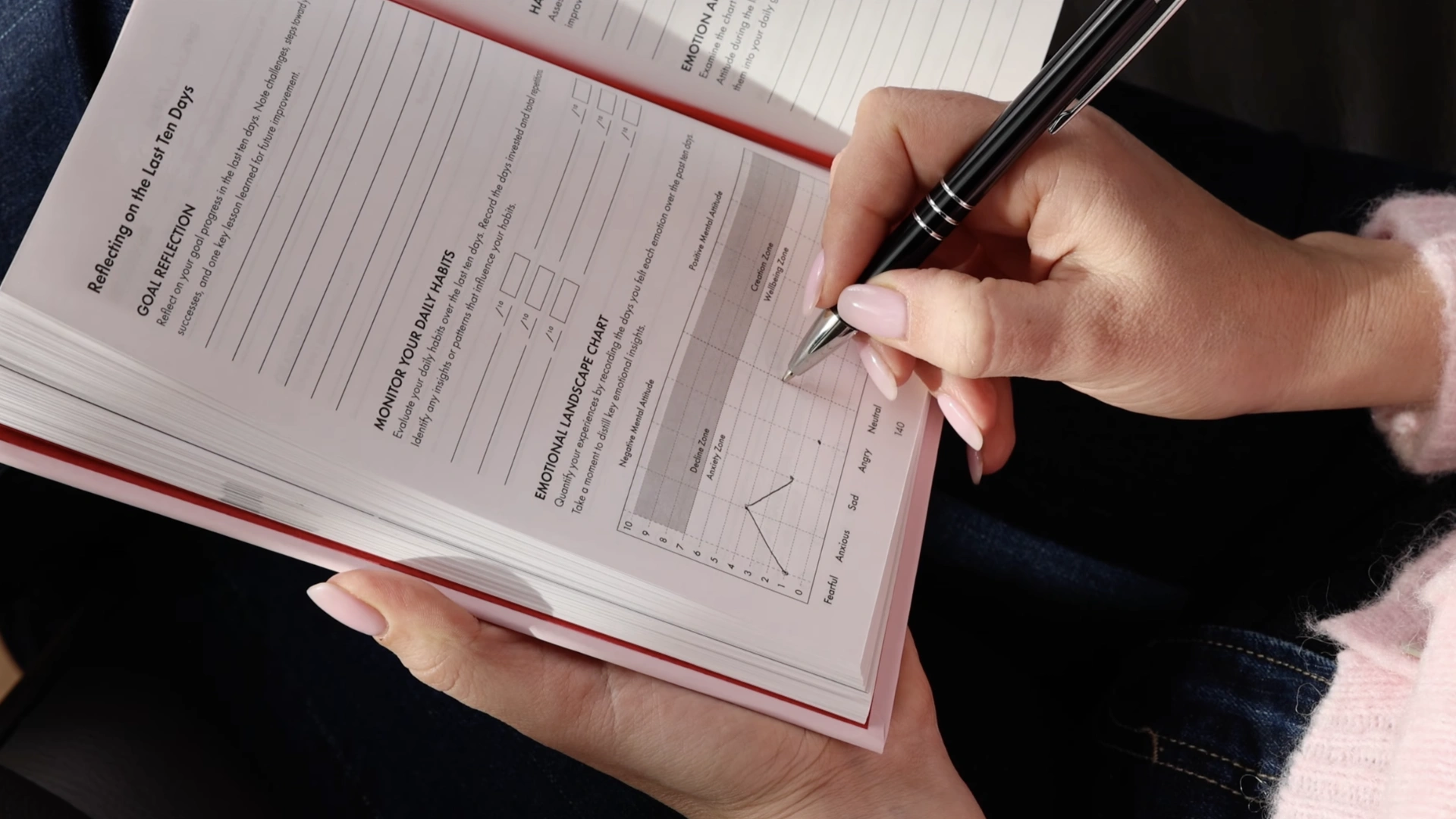
Mapping emotions means giving structure to what you notice. The iAmEvolving Journal includes a daily Inner Harmony section designed exactly for this: you score your emotional balance and note any dominant feelings. Over time, these entries reveal trends that help you understand your inner evolution.
Step 1: Define Your Emotional Spectrum
Begin by identifying 5–7 common emotions you experience each week — joy, calm, irritation, sadness, excitement, fear, peace. Write them down and observe where each one tends to appear. This creates your personal emotional landscape.
Step 2: Track Daily States
At the end of each day, take one minute to record your emotional state on a 1–10 scale of harmony. Ten means fully centered, one means completely scattered. Over weeks, this data becomes your personal alignment graph.
Step 3: Reflect on Peaks and Dips
Review your journal weekly. Look for clusters: What tends to lower your score? What restores it? Awareness of patterns leads to empowerment. You’ll start noticing, for instance, that social interactions recharge you — or that lack of rest always lowers your inner harmony.
Step 4: Translate Awareness into Action
Mapping is not an end; it’s a mirror. Once you see your patterns, you can respond differently. For example, if anxiety rises whenever you skip reflection time, you learn to protect that practice. Awareness becomes self-leadership.
Get more like this, every week
The Difference Between Observation and Overthinking
Some people worry that focusing on emotions might intensify them. The difference lies in your intention. Observation is about curiosity, not judgment. Overthinking analyzes; observation witnesses. When you notice an emotion without labeling it good or bad, you create space around it — and in that space, it naturally settles.
To balance this, practice brief grounding rituals such as mindful breathing. If you’d like a gentle starting point, read Embracing Calm: The Power of Mindful Breathing for simple techniques that help regulate emotions while you observe them.
Turning Emotional Data Into Insight
Every time you record or reflect on your emotions, you collect valuable data about your inner life. But numbers and notes only matter when interpreted with compassion. Here’s how to turn emotional data into understanding:
- Look for trends, not perfection. You’re not trying to stay at 10/10 harmony every day. You’re learning how and why you fluctuate.
- Identify the stabilizers. Which habits or mindsets consistently help you return to balance? Keep them visible — they are your anchors.
- Notice recurring lessons. Often, the same emotional theme reappears until integrated. Mapping helps you recognize when growth is happening beneath discomfort.
Journaling Prompts for Emotional Mapping
If you use the iAmEvolving Journal, pair your daily Inner Harmony rating with short reflections. Try these prompts to deepen your awareness:
- What emotion felt most present today, and what message might it hold?
- Which part of my day brought me closest to peace?
- What pattern am I beginning to notice in my emotional responses?
- What do I need to release or accept to feel more aligned?
- What small choice helped me return to balance today?
These short entries build emotional intelligence over time — gently, consistently, without self-criticism.
Emotional Mapping in Daily Life
Mapping isn’t limited to journaling; it extends into real moments. When tension rises during a conversation, pause internally and label what’s happening. Are you feeling dismissed, unsafe, unheard? This inner awareness changes your next action. Instead of reacting, you can communicate with clarity and empathy.
Similarly, when joy appears, take a moment to notice what created it. Recording positive states trains your brain to recognize alignment, not just dissonance. Over time, you begin to live more from the centered middle of your spectrum rather than its extremes.
Returning to Neutrality
Emotional mapping helps you reach a grounded neutrality — not numbness, but presence. You stop identifying with every emotional wave and instead witness the ebb and flow with calm. From this place, even difficult emotions become meaningful teachers rather than threats.
As you deepen this practice, revisit From Fear to Faith: Transforming Negative Emotions. It explores how awareness and compassion turn fear into inner strength — a natural continuation of this mapping process.
How the iAmEvolving Journal Supports Emotional Mapping
The iAmEvolving Journal was created to simplify the process of emotional self-awareness. Each daily page invites you to write your goals, gratitude, habits, and emotional balance — side by side. This structure mirrors the real connection between intention, action, and emotion. When you document your feelings next to your habits and goals, you start seeing how each affects the other.
Over time, this holistic view transforms your journal from a notebook into a mirror of your evolution. You no longer guess how you feel — you know, because you’ve been observing with kindness and consistency.
Start your daily practice of gratitude, goals, and growth.
Get the Journal →A gentle 7-day reset to help you slow down, feel steadier, and reconnect — in just 5–10 minutes a day.
Start the ResetA simple introduction to daily journaling — gratitude, goals, and habits made easy.
Learn the MethodIntegration: Awareness in Motion
Monitoring emotions is not a static skill — it’s an ongoing relationship with yourself. As you learn to map your feelings, you’ll begin to sense subtle shifts sooner. You’ll catch tension before it becomes frustration, fatigue before burnout, joy before it fades unnoticed.
This awareness doesn’t make life easier; it makes it more authentic. It brings you closer to your truth and teaches you how to navigate both light and shadow with grace. Emotional mapping, in the end, is the language of self-trust — a dialogue between your mind, heart, and body.
When you live in this dialogue, you embody the essence of Inner Harmony: movement, awareness, and a return to your natural state of balance.
Continue Your Journey
Once you’ve practiced mapping and monitoring your emotions, continue to the next part of your Inner Harmony journey — Regulating Emotions and State. There, you’ll learn how to turn emotional awareness into practical calm through gentle regulation techniques that bring balance back to your daily life.
Every emotion carries information. It tells a story about what you value, how you interpret life, and where your attention is directed. Most of us, however, experience emotions as waves that sweep us away — we react before we understand. The practice of monitoring and mapping emotions transforms that pattern. It helps you see your inner world clearly enough to respond consciously rather than automatically.
This guide is part of the Inner Harmony journey, where we explore how awareness, mapping, and reflection help you find stillness in a busy world. Here, you’ll learn to observe what arises in real time and chart your inner responses with gentle curiosity.
What does emotional mapping mean?
How often should I map my emotions?
What if I can’t identify what I’m feeling?
How can mapping emotions improve my daily life?
Do I need the iAmEvolving Journal to practice this?