Daily Habits for Motivation: 9 Practices That Keep You Moving Forward
Daily habits are the invisible architecture behind lasting motivation. Research consistently shows that people who build structured routines outperform those who rely on willpower alone — a study from the European Journal of Social Psychology found that it takes an average of 66 days for a new behavior to become automatic, but once it does, the need for motivation drops dramatically. The difference between people who stay consistent and people who burn out is rarely talent or desire. It is structure.
If you have ever felt motivated on Monday and completely drained by Wednesday, you are not broken. You are human. Motivation is an emotion, and emotions are temporary by nature. What carries you through the days when inspiration disappears is not a feeling — it is a set of daily habits so embedded in your routine that skipping them feels stranger than doing them. This is what a solid habits guide teaches: the goal is not to feel fired up every morning. The goal is to build a life where forward movement happens regardless of how you feel.
Why Motivation Alone Does Not Work
Motivation is a spark. It lights fast, burns bright, and disappears just as quickly. You feel it after a great podcast, a fresh start, or a moment of frustration that pushes you to change. But motivation is an emotional state — and emotional states are not something you can schedule or control.
The problem starts when you treat motivation as the foundation of change rather than the catalyst. When motivation is the engine, every low-energy day becomes a reason to pause. Every bad night of sleep becomes a permission slip to skip. You start waiting to feel ready before you act, and “ready” becomes a moving target that never quite arrives.
Understanding habits vs motivation changes the game entirely. Motivation gets you started. Habits keep you going. The people who consistently move their lives forward are not the ones with the most motivation — they are the ones who stopped depending on it. They built systems that work on ordinary days, not just peak days. And ordinary days are where real life happens.
9 Daily Habits That Build Lasting Motivation
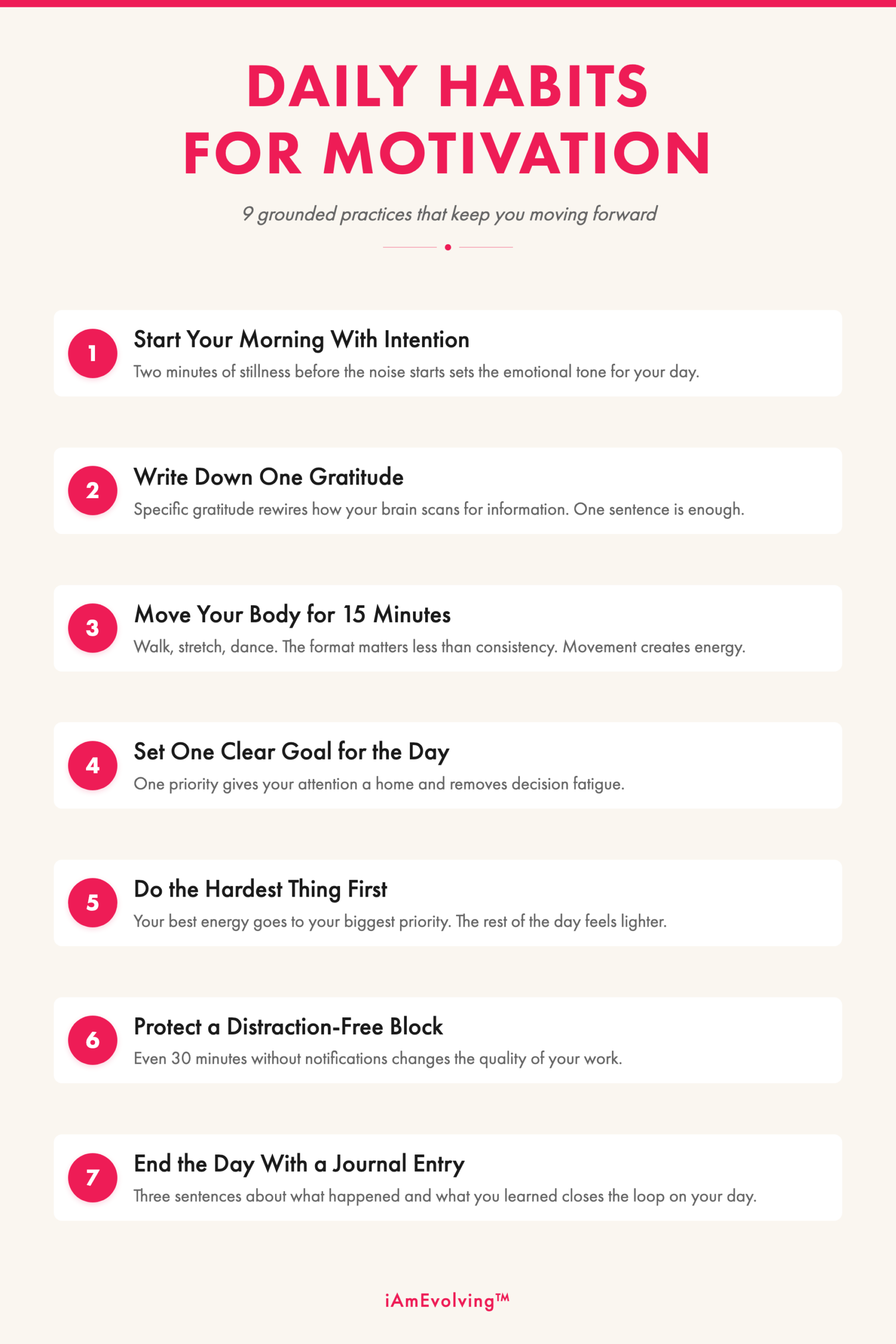
These nine practices are not complicated. None of them require special equipment, a perfect schedule, or a dramatic lifestyle overhaul. What they do require is repetition — doing them often enough that they stop being choices and start being reflexes. That is the point where daily habits become self-sustaining.
1. Start Your Morning With Intention, Not Your Phone
The first thing you give your attention to each morning sets the emotional tone for your entire day. When you reach for your phone before your feet hit the floor, you hand that tone over to notifications, news, and other people’s priorities. You begin the day reactive instead of intentional.
Try this instead: before you check anything, spend two minutes with yourself. Take a few slow breaths. Think about one thing you want to focus on today. Say it out loud if that helps. This small pause creates a buffer between sleep and the noise of the world — and that buffer is where clarity lives. Over time, this becomes the anchor habit that everything else connects to.
2. Write Down One Thing You Are Grateful For
Gratitude is not a personality trait — it is a skill you can build through practice. Writing down one thing you appreciate each day takes less than a minute, but it rewires how your brain scans for information. Instead of defaulting to what is wrong, you start noticing what is working.
The key is specificity. “I am grateful for my partner” is fine, but “I am grateful that my partner made coffee this morning without me asking” lands differently. Specific gratitude forces you to pay attention to your actual life, not an abstract idea of it. Over weeks, this shifts your baseline mood in a way that generic positivity never can.
3. Move Your Body for at Least 15 Minutes
You do not need a gym membership or a marathon training plan. You need 15 minutes of movement that raises your heart rate and gets you out of your head. Walk, stretch, do bodyweight exercises, dance in your kitchen — the format matters far less than the consistency.
Physical movement is one of the fastest ways to shift your mental state. It reduces cortisol, increases dopamine, and clears the fog that accumulates from sitting and staring at screens. When you make movement a non-negotiable daily habit, you stop waiting for the energy to exercise and start exercising to create the energy.
4. Set One Clear Goal for the Day
Not five goals. Not a sprawling to-do list. One clear, specific thing that, if you accomplished it and nothing else, would make the day feel productive. This could be finishing a work project, having a difficult conversation, or completing a 30-minute focused writing session.
When you define one priority, you give your attention a home. Decision fatigue drops because you already know what matters most. And when you complete that one thing, the sense of accomplishment creates genuine momentum — the kind of motivation that comes from action, not from waiting for a feeling.
5. Protect a Distraction-Free Block of Time
Motivation erodes when your attention is constantly fractured. Notifications, interruptions, and context-switching drain your mental energy before you have a chance to use it on anything meaningful. One of the most powerful daily habits you can build is protecting a block of focused time — even 30 minutes — where nothing interrupts your work.
Close the tabs. Silence the phone. Tell the people around you that this time is yours. What you do during this block matters less than the fact that you are doing it without distraction. Deep focus is a muscle, and like any muscle, it strengthens with use and weakens without it.
6. Do the Hardest Thing First
Your willpower and mental clarity are highest in the first few hours after you wake up. If you spend that energy on easy tasks, emails, and busywork, you will hit your most important work already depleted. The habit of doing the hardest thing first — sometimes called “eating the frog” — ensures that your best energy goes to your biggest priority.
This habit also eliminates procrastination-based anxiety. That low-level dread you carry around all day when you know something difficult is waiting for you? It disappears when you handle it early. The rest of the day feels lighter because the weight has already been lifted.
7. Reflect on What Went Well Before Bed
Most people end their day replaying what went wrong — the mistake at work, the conversation they wish they handled differently, the task they did not finish. This negativity bias is hardwired, but it is not helpful. It trains your brain to associate the end of each day with failure.
A brief evening reflection — even 60 seconds — where you mentally note two or three things that went well reverses this pattern. It does not mean ignoring problems. It means balancing your attention so your brain registers progress alongside setbacks. Over time, this builds a genuine sense that your life is moving forward, which is one of the deepest sources of lasting motivation.
8. Track Your Habits Visually
There is something uniquely satisfying about a visual streak. Whether you use a journal, a wall calendar, or a simple checklist, seeing a chain of completed days creates a psychological pull to keep the chain going. This is not a gimmick — it is how the brain responds to visible progress.
Tracking also provides honest data. When you can see that you completed your morning routine 25 out of 30 days, that is powerful evidence that you are more consistent than you think. And when you see a gap, it is an opportunity to notice what threw you off without judgment. The iAmEvolving Journal includes dedicated habit tracking sections for exactly this reason — visual accountability paired with written reflection creates a system that reinforces itself.
9. End the Day With a Brief Journal Entry
Writing closes the loop on your day. It moves thoughts out of your head and onto paper, which reduces the mental load you carry into sleep. A brief journal entry — three to five sentences about what happened, how you felt, and what you learned — is enough to create closure.
This is not about writing perfectly or even writing a lot. It is about the practice of pausing to notice your own experience before the day ends. Over weeks and months, these entries become a record of your growth — tangible proof that you are evolving, even on the days when it does not feel like it.
How to Make Daily Habits Stick
Knowing which habits to build is the easy part. Making them stick is where most people struggle. The good news is that habit formation follows predictable patterns, and once you understand those patterns, the process becomes far less mysterious.
The most effective strategy is anchoring new habits to existing routines — a technique called habit stacking. Instead of trying to remember a new behavior from scratch, you attach it to something you already do automatically. “After I pour my morning coffee, I write one gratitude sentence.” The existing habit becomes the trigger for the new one, removing the need for willpower or reminders.
Start smaller than you think you need to. If you want to journal every night, begin with one sentence. If you want to exercise daily, begin with five minutes. The goal in the first two weeks is not results — it is repetition. You are building the neural pathway, not training for a competition. Once the habit feels automatic, you can increase the intensity. But if you start too big, you create resistance, and resistance kills habits faster than anything else.
If you want a deeper framework for this process, learn how to build habits that stick. The principles are simple, but they work because they respect how your brain actually forms new behaviors rather than forcing change through sheer willpower.
Get more like this, every week
What Happens When You Stay Consistent
The first week of a new habit feels like effort. The first month feels like discipline. But somewhere around the 60 to 90-day mark, something shifts. The habits stop feeling like things you have to do and start feeling like things you simply do. That transition — from effort to identity — is where the real transformation happens.
When you journal every night for three months, you stop being someone who is trying to journal. You become someone who journals. When you move your body every day for a season, you stop negotiating with yourself about exercise. You are just a person who moves daily. This identity shift is the compound effect of small actions repeated over time, and it is far more powerful than any burst of motivation.
Building strong morning habits is one of the fastest ways to experience this shift, because mornings set the direction for everything that follows. But the principle applies to any time of day: consistency creates identity, and identity creates effortless action. That is the real endgame of daily habits — not checking boxes, but becoming the person who no longer needs to check them.
How to Build a Daily Habit Routine
Choose 2 to 3 Habits That Matter Most
Anchor Each Habit to an Existing Routine
Shrink Each Habit to Its Smallest Version
Track Your Habits Daily in a Journal
Reflect Weekly and Adjust
Conclusion
Daily habits are not about perfection. They are about showing up often enough that the behavior becomes part of who you are. You do not need to overhaul your life in a single morning. You need two or three small practices, repeated with enough consistency that they stop requiring a decision.
Start with one habit from this list. Anchor it to something you already do. Keep it small enough that you can do it even on your worst day. And if you are looking for a structured way to track your progress and reflect on your growth, the iAmEvolving Journal was built for exactly this kind of daily practice.
Start your daily practice of gratitude, goals, and growth.
Get the Journal →A gentle 7-day reset to help you slow down, feel steadier, and reconnect — in just 5–10 minutes a day.
Start the ResetA simple introduction to daily journaling — gratitude, goals, and habits made easy.
Learn the MethodFAQ: Daily Habits for Motivation
What are the best daily habits for motivation?
How long does it take to build a daily habit?
What should I do when I miss a day?
How do daily habits help with long-term goals?