Habits Foundations: Understanding How Change Really Happens

Habits foundations are the core principles that explain how behaviors form, why they persist, and what it takes to change them deliberately. Understanding these foundations before you try to build new habits or break old ones is the difference between sustainable change and the frustrating cycle of starting strong and quitting within weeks. The science of habit formation is well-established: your brain automates repeated behaviors into neural pathways that fire with minimal conscious effort. This automation is what makes habits powerful. It is also what makes them difficult to change once they are established.
This page covers the essential building blocks of habit science: how your brain forms habits, why most habit-change efforts fail, the role of small daily actions, and how awareness through journaling accelerates the process. Each section introduces the topic and links to a deeper resource. For the broader framework that these foundations support, visit the complete habits guide.
How Habits Are Formed in the Brain
Every habit follows the same neurological loop: cue, routine, reward. A cue triggers the behavior, the routine is the behavior itself, and the reward is what your brain gets from completing it. Over time, this loop becomes so automatic that the cue alone triggers the routine without any conscious decision. This is why you can drive home from work without remembering the turns, or reach for your phone the moment you feel bored without deciding to do so.
The basal ganglia, a structure deep in your brain, is responsible for storing these automated patterns. Once a behavior has been repeated enough times in a consistent context, the basal ganglia takes over from your prefrontal cortex, freeing conscious attention for other tasks. Research from University College London found that forming a new automatic behavior takes an average of 66 days, with a range from 18 to 254 days depending on complexity.
Understanding this process is liberating because it means habits are not about character or willpower. They are about repetition in a stable context. Anyone can build any habit if they understand the loop and practice it consistently long enough for automation to take over. How habits are formed covers the neuroscience in full detail, including how to design your own habit loops intentionally.
One of the most important insights from habit science is that the reward does not need to be large. Small rewards, a sense of completion, a checkmark in your tracker, even the physical satisfaction of closing your journal, are enough to reinforce the loop. Your brain does not distinguish between a small dopamine hit and a large one when it comes to building automation. It only cares about the consistency of the cycle. This is why habit tracking works so well: the act of marking a habit complete provides an immediate micro-reward that strengthens the loop every single day.
Why Most Habit Changes Fail
Most people approach habit change by relying on motivation and willpower. Both are unreliable. Motivation fluctuates with mood, energy, and circumstances. Willpower depletes throughout the day as you make decisions and resist impulses. Building a habit on motivation is like building a house on sand: it holds up in good weather and collapses the moment conditions change.
The real reasons habits fail are structural, not personal. You try to change too many habits at once. You set the bar too high and create friction that overwhelms your willpower. You lack a clear cue that triggers the new behavior. You do not have a reward that reinforces the loop. Or you rely on motivation to do what only a system can sustain.
Habits vs motivation explores this distinction in depth and explains why building systems produces lasting results while chasing motivation produces temporary bursts followed by collapse. The solution is not more willpower. It is better design.
Environment design is one of the most underused tools in habit formation. If you want to journal every morning, put your journal and pen on the kitchen table next to where you drink your coffee. If you want to exercise after work, lay out your workout clothes before you leave the house. If you want to read before bed, put a book on your pillow and charge your phone in another room. These small environmental changes reduce the friction for good habits and increase the friction for bad ones, making the desired behavior the path of least resistance rather than an act of willpower.
Another common failure point is trying to eliminate a bad habit without replacing it. Your brain cannot simply delete an automated loop. It can only overwrite it with a new one. When you remove a habit without providing a substitute, the old cue still fires and the old craving still activates, pulling you back to the behavior you were trying to stop. Breaking old patterns and starting fresh covers how to replace unwanted habits with constructive alternatives.
The Power of Small Daily Actions
The most effective habits are the smallest ones. Research on behavior change consistently shows that reducing the size of a new habit increases the likelihood of consistency. “Meditate for two minutes” sticks better than “meditate for thirty minutes.” “Write one sentence in your journal” sticks better than “write three pages.” The small version builds the neural pathway. Once the pathway exists, expanding the behavior is easy. Building it from scratch is the hard part.
The power of daily habits explains how small actions compound over time to produce significant life changes. A two-minute habit performed daily for a year produces more transformation than an ambitious routine performed intensely for two weeks and then abandoned. The math is simple: consistency multiplied by time always beats intensity multiplied by burnout.
Small habits also build self-trust. Every time you follow through on a commitment to yourself, no matter how small, you strengthen the belief that you are someone who keeps promises. That self-trust is the foundation for larger commitments later. People who successfully build complex morning routines almost always started with one tiny habit and added from there.
The compound effect of small habits is also where identity change happens. When you meditate for two minutes every day for three months, you do not just build a meditation habit. You become someone who meditates. That identity shift is the real prize, because identity-driven behavior is self-sustaining. You no longer need willpower to do what you believe you are. The daily habit provides the evidence, and the evidence reshapes the belief.
Get more like this, every week
Tracking Habits: Making the Invisible Visible
You cannot improve what you do not measure. Habit tracking is the practice of recording whether you completed your daily habits, creating a visual record that reveals your real consistency rate. Most people overestimate how consistent they are. Tracking eliminates this self-deception and gives you honest data to work with.
The habit tracking journal method provides a structured framework for daily tracking that balances simplicity with depth. The key is to track three to five habits maximum. More than five creates overwhelm and leads to abandoned trackers. Fewer than three may not give you enough data to spot patterns.
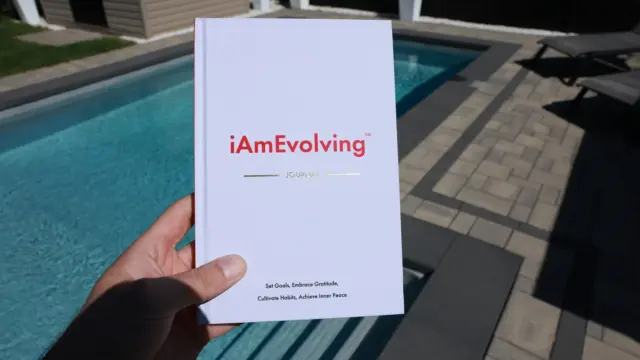
For reviews of dedicated tracking tools, best habit tracker journals compares the top options by format, design, and how well each supports long-term consistency. The iAmEvolving Journal includes a built-in daily habit tracking section that integrates tracking with goal setting, gratitude, and reflection, so you do not need a separate tool.
How Awareness Through Journaling Accelerates Habit Change
Journaling accelerates habit formation because it engages your prefrontal cortex in a process that normally runs on autopilot. When you write about your habits, you move from unconscious repetition to conscious observation. You notice which habits stick easily and which ones you resist. You see which days are strongest and which circumstances cause you to skip. This awareness is the raw material for intelligent adjustment.
The most effective habit journaling practice is simple: each evening, write which habits you completed, which you missed, and what you notice about the pattern. Do not judge. Just observe. Over two weeks, the data will show you exactly where your system needs adjustment, whether it is the cue, the routine, the reward, or the environment.
A digital detox day is one example of using awareness to design a specific habit intervention. By removing digital stimulation for one day, you create space to notice the automatic behaviors that technology has created and decide which ones you want to keep. The entrepreneur’s journal applies these same awareness principles to business habits, showing how daily writing drives better professional decisions and more consistent execution.
The combination of habit tracking and reflective journaling creates a feedback loop that no other tool can replicate. Tracking shows you what you did. Journaling shows you why you did it, what prevented you from doing it, and what conditions need to change for consistency to improve. Together, they turn habit formation from a guessing game into a data-driven practice where every week provides clearer insight than the last.
Habit Stacking: Linking New Habits to Existing Ones
Habit stacking works because it uses existing automation. Your brain has already wired in routines that happen without conscious thought. When you anchor a new behavior to one of those existing routines, the established habit becomes the cue for the new one. You do not need to remember to do the new habit. The old habit reminds you automatically.
The formula is simple: after I [existing habit], I will [new habit]. After I pour my morning coffee, I will write three sentences in my journal. After I brush my teeth at night, I will do two minutes of deep breathing. After I sit down at my desk, I will write my three most important tasks for the day. The existing behavior provides the cue. The new behavior provides the routine. The reward, whether it is the satisfaction of completion or a checkmark in your tracker, closes the loop.
What makes habit stacking so effective for new behaviors is that it eliminates the most common point of failure: forgetting. Most habit attempts collapse not because the person did not want to follow through, but because they never thought to do it at the right moment. Stacking solves this problem by tying the new habit to a moment that is already guaranteed to happen. If you brush your teeth every morning, you can be certain you will be in the bathroom at a specific time, with the cue already firing. Adding two minutes of stretching to that moment makes follow-through almost automatic.
Choose your anchor habit carefully. The strongest anchors are routines that happen at consistent times, in consistent locations, with low cognitive demand. Morning coffee, brushing teeth, and sitting down at your desk all qualify. Eating lunch, checking your phone, or feeling stressed do not, because the timing, location, and conditions vary too much to provide a reliable cue. For a deeper framework on stacking and other consistency-building techniques, habits for consistency walks through the full set of strategies. If you want a structured plan that combines stacking with progressive habit building, the 30-day habit building challenge gives you a day-by-day path. And for the broader question of what makes new habits actually stick instead of fading after week three, how to build habits that stick covers the long-term retention principles.
What to Do When You Miss a Day
Missing a day is not the problem. Believing that one missed day has ruined your progress is the problem. A single lapse does almost nothing to the neural pathway you are building. What damages a habit is the story you tell yourself afterward, the all-or-nothing thinking that turns one skipped morning into a week of skipped mornings and then a quiet decision that you were never the kind of person who could keep this up.
The rule that protects almost every long-term habit is simple: never miss twice. Missing once is an accident. Missing twice is the beginning of a new pattern. When you skip a day, your only job is to show up the next day, even if you do the smallest possible version of the habit. Two minutes of journaling. One page of reading. A single set of pushups. The goal on a recovery day is not performance. It is to keep the pathway alive and prove to yourself that a lapse is recoverable.
It also helps to look at the miss without judgment and ask what actually caused it. Was the cue missing because your routine changed? Was the habit too big for a hard day? Did an unexpected demand crowd it out? Most missed days are not failures of character. They are signals that something in the system needs adjusting. Tracking makes these patterns visible, and over time you learn which conditions threaten your consistency. What happens when you track habits for 90 days shows how that data builds a clear picture of your real patterns rather than your imagined ones.
Consistency is not a perfect streak. It is a high rate of return over months, with the occasional miss absorbed without drama. People who build lasting habits are not the ones who never slip. They are the ones who slip and return without making it mean anything about who they are. For more on building that kind of resilient consistency, habits for consistency covers the full set of strategies, and habits for self-discipline explains how to strengthen follow-through on the days motivation is nowhere to be found.
Conclusion
Habits are not about willpower, motivation, or personality. They are about understanding how your brain automates behavior and working with that process instead of against it. These foundations, understanding the habit loop, starting small, replacing rather than eliminating, tracking honestly, and using journaling for awareness, are the principles that make every other habit strategy work.
The iAmEvolving Journal was built around these foundations. Its daily habit tracking section gives you a simple, consistent way to monitor your behaviors without overcomplicating the process. Combined with goal setting, gratitude, and inner harmony reflection, it creates a complete growth system where habits are one integrated piece rather than an isolated effort.
Start with one habit. Make it small enough that it feels almost too easy. Track it daily. Reflect weekly. That is the foundation. Everything else builds from there.

Start your daily practice of gratitude, goals, and growth.
Get the Journal →
A free 21-day habit tracker PDF with daily check-ins, guided reflection prompts, and mindset reminders. Clean, minimal, and printable.
ExploreFrequently Asked Questions
How long does it take to form a new habit?
Why do I keep failing at building new habits?
How many habits should I track at once?
What is the best way to break a bad habit?