Summer Routine Reset: How to Rebuild Your Habits When Your Schedule Shifts
A summer routine reset is the deliberate practice of rebuilding your daily habits around the looser, less predictable structure that summer brings, instead of fighting to keep your old schedule alive. When school lets out, work slows down, travel picks up, and the long evenings blur one day into the next, the routines that carried you through winter often quietly fall apart. That is not a personal failure. It is a predictable response to a season that removes the external scaffolding your habits were leaning on.
This guide is for anyone who feels their momentum slipping as the calendar opens up, whether you are a parent suddenly home with kids, a professional on a lighter workload, or someone who simply finds the heat and the late sunsets pulling them off track. You will learn why summer breaks habits in the first place, how to keep the few routines that actually matter, and a simple way to rebuild the rest without forcing yourself back into a rigid winter schedule that no longer fits.
Why Your Schedule Falls Apart in Summer
Most habits are held in place by cues you barely notice: the alarm before work, the commute, the kids’ bedtime, the gym class at six. Summer quietly removes many of those cues at once. The mornings start earlier and feel less urgent, the workday loosens, and the evening that used to signal wind-down now stretches with daylight until nine or ten. When the cue disappears, the habit it triggered tends to go with it, even if your intention to do it is unchanged.
The second force is novelty. Travel, guests, longer social calendars, and spontaneous plans are some of the best parts of the season, and they also pull you out of the repetition that habits depend on. A routine needs roughly the same time, place, and trigger most days to stay automatic. Three weeks of irregular mornings is usually enough to make even a strong habit feel effortful again. Understanding this is the heart of any successful summer routine reset, because it shifts the question from “why am I so undisciplined” to “which cues did I lose, and how do I rebuild them.”
Recognizing this pattern early matters. If you wait until September to notice that your daily habits have eroded, you have lost an entire season of small progress. A reset done in June or July protects the consistency you worked hard to build during the rest of the year.
Keep the Anchor Habits That Hold Everything Together
Before you rebuild anything, protect the two or three habits that keep the rest of your life steady. These are your anchor habits: the small routines that, when they hold, make everything else easier to recover. For most people they are some version of consistent sleep and wake times, a few minutes of movement, and a short daily check-in with yourself through reflection or journaling. You do not need to defend your whole winter routine through summer. You need to defend the anchors.
An anchor habit is worth protecting because it carries the others. If your wake time stays roughly stable, your morning practices have something to attach to. If your evening wind-down survives, your sleep stays intact, and almost everything downstream improves. This is the same principle behind building aligned habits: a few routines that match who you are will outlast a long list of rules that depend on perfect conditions.
- Sleep window: Keep your wake time within an hour of normal, even after late nights, so your body keeps one stable cue.
- Daily movement: Shrink it if you must, but keep it daily; a ten-minute walk preserves the habit better than a skipped hour-long workout.
- One reflective moment: A few written lines each day keeps you aware of how the season is actually going, not just how it feels.
Get more like this, every week
How to Rebuild Your Habits Around a Summer Schedule
Rebuilding works best when you stop trying to restore the old schedule and instead design a lighter version that fits the season you are actually in. The goal of a summer routine reset is not to be as productive as you are in winter. It is to stay connected to your habits in a form loose enough to survive travel, heat, and changing plans. A smaller routine you keep beats a perfect one you abandon by July.
- List what actually broke. Write down the three to five routines that slipped. Naming them turns a vague sense of drift into a short, fixable list.
- Attach each one to a summer cue. Tie the habit to something that still happens daily, like morning coffee, the first walk outside, or sunset, instead of the cue you lost.
- Shrink the habit to a version you can do tired. Cut each routine to its smallest meaningful form so a bad day still counts as a kept promise.
- Rebuild one habit at a time. Add the next routine only once the previous one feels automatic again, usually after about a week of repetition.
- Plan for the gaps in advance. Decide now what the habit looks like on a travel day, so disruption becomes a smaller version rather than a full stop.
This staged approach is far more reliable than a single dramatic restart. The most common reason summer resets fail is that people try to fix everything in one Monday, run on motivation for a few days, and collapse under the first heatwave or trip. Rebuilding one cue at a time is how you create habits for consistency that hold even when your days look nothing alike.
Use Flexible Routines Instead of Rigid Time Blocks
Rigid time blocks are the first thing summer destroys, because they assume your days are interchangeable. A 6:00 a.m. workout and a 9:00 p.m. wind-down work beautifully in a structured winter week and fall apart the moment a road trip or a late barbecue rearranges your hours. The fix is not more discipline. It is a more forgiving format: anchor your habits to events and parts of the day rather than to the clock.
Instead of “journal at 7:00 a.m.,” try “journal with my first coffee.” Instead of “walk at 6:00 p.m.,” try “walk after dinner, whenever dinner happens.” Event-based cues bend with your day without breaking the habit, which is exactly what a chaotic schedule needs. When the structure of your year falls apart, flexible routines are what let you keep moving instead of waiting for normal to return.
There is a quiet freedom in this shift. Once your habits are tied to moments rather than minutes, a slow morning or a spontaneous afternoon stops feeling like a threat to your progress. You are no longer asking your summer to behave like your winter. You are simply carrying a few steady practices through whatever shape the day happens to take, and that adaptability is what keeps the habit alive long after the rigid version would have broken.
The same flexibility applies to your evenings, which summer disrupts most of all. A gentle, adaptable close to the day protects your sleep and your sense of completion even when bedtime drifts late. If your nights have unraveled, rebuilding a simple set of evening routines for emotional reset is often the single highest-leverage move you can make this season.
Let Go of the Guilt and Reset Without Shame
When I have watched my own summers come apart, the hardest part was never the broken habit itself. It was the running commentary of guilt that came with it, the quiet sense that slipping meant I had failed at something I should have been able to control. That guilt is heavier than the missed walk or the skipped journal entry, and it makes restarting harder, because shame and momentum cannot occupy the same morning. Based on the iAmEvolving framework, a reset begins by separating what happened from what it means about you.
A summer routine reset is not a punishment for falling off. It is simply the next chapter of a practice that was always meant to bend with your life. Letting go of an old, perfect version of your schedule is what frees you to build one that actually fits. If you tend to carry old patterns and self-criticism from one season into the next, it is worth learning to break old patterns and start fresh so that this reset is a genuine new beginning rather than a repeat of last summer.
Treat each return to your routine as neutral information, not a verdict. You missed three days, so you start again on the fourth. That is the entire skill. The people who stay consistent across years are not the ones who never slip; they are the ones who have made restarting boring, quick, and free of drama.
Plan Your Summer Routine Reset on Paper
A reset that lives only in your head rarely survives a busy week. Writing it down turns good intentions into a plan you can actually follow, and it gives you a place to notice what is working before the whole season slips by. Spend ten quiet minutes at the start of summer mapping the version of your routine that fits the months ahead, then revisit it whenever your days shift again. This small act of planning is what separates a reset that holds from one more hopeful Monday.
The mapping itself is simple. On one page, write the three anchor habits you refuse to drop, the single cue each one will hang on, and the smallest version you will accept on a hard day. On a second page, list the routines you are letting go of until autumn, so you can release them on purpose instead of feeling them slip away. Seeing both lists side by side removes most of the guilt, because it reframes the season as a deliberate choice rather than a slow collapse. If you want a fuller framework for designing routines that last, the broader habits guide walks through how cues, repetition, and identity work together.
Try these reflection prompts to shape your own reset. Which two or three habits, if I kept only those, would make this summer feel steady? What daily cue still happens no matter where I am? What does each habit look like on my busiest travel day? Answering these on paper, even briefly, gives your reset a structure that survives heat, guests, and changing plans far better than memory alone.
Conclusion
Summer will keep loosening your structure every year, and that is not a problem to solve so much as a rhythm to work with. The goal of a summer routine reset is not to force your winter self back into a season that no longer fits, but to protect a few anchor habits, rebuild the rest one cue at a time, and let your routines bend without breaking. A smaller practice you actually keep will carry you further than a perfect one you abandon by July.
If your habits have slipped this season, you have not lost anything that a calm, unhurried restart cannot recover. Pick one anchor habit, attach it to something that still happens every day, and begin there tomorrow. You are allowed to rebuild slowly, and you are allowed to start again as many times as the season asks you to.

Start your daily practice of gratitude, goals, and growth.
Get the Journal →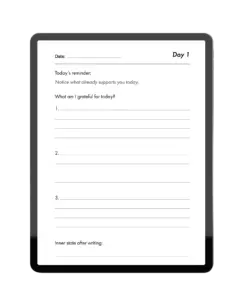
A free 30-day gratitude journal designed for a simple daily practice. Calm, minimal, and printable to help you slow down and reflect.
ExploreFrequently Asked Questions
What is a summer routine reset?
Why do my habits always fall apart in summer?
How do I rebuild a routine when my schedule keeps changing?
How long does it take to reset a routine?
Should I keep all my habits through summer or let some go?