How to Do a Life Audit: A 60-Minute Reset for Every Area of Your Life

Learning how to do a life audit gives you a clear picture of what is working, what feels neglected, and where one thoughtful change could improve several parts of your life. A life audit is a structured review of the areas that shape your daily experience, followed by a short plan for bringing your time and choices closer to what matters most.
You do not need to reinvent yourself or judge every decision you have made. You need an honest snapshot. In about 60 minutes, you can review eight areas, notice the gaps between your values and your reality, and choose one practical focus for the next 30 days. Think of it as a checkpoint within your broader personal growth guide, not a final grade on how well you are living.
What Is a Life Audit?
A life audit is a deliberate review of your well-being, relationships, work, finances, environment, personal growth, enjoyment, and sense of direction. You rate your current experience in each area, write down the evidence behind each rating, and identify the changes that would create the greatest positive effect.
The value of the exercise is not the number you assign. The value is the conversation the number begins. A six in health might mean your body feels strong but your sleep is inconsistent. A seven in work might mean your job is stable but no longer challenging you. Two identical scores can tell very different stories.
A useful life audit separates three things that often get mixed together:
| Part of the audit | Question it answers | What you record |
|---|---|---|
| Current reality | What is true right now? | Facts, patterns, commitments, and results |
| Personal meaning | How do I feel about what is true? | Energy, satisfaction, tension, and desire |
| Next adjustment | What would make this area meaningfully better? | One change you can test within 30 days |
This distinction keeps the exercise grounded. It also deepens self awareness and identity, because you begin to see the difference between the life you are actually living and the story you have been telling yourself about it.
When a Life Audit Is Most Useful
You can do a life audit at any time, but it is especially useful when your days feel full and your direction feels unclear. That combination often means you are maintaining many commitments without checking whether they still belong together.
Consider doing the exercise when:
- You are busy but cannot name what your effort is building toward.
- A major transition has changed your priorities, energy, or responsibilities.
- You keep setting goals but lose interest before making meaningful progress.
- One part of life looks successful from the outside but feels empty or costly from the inside.
- You want a thoughtful reset at the start of a month, season, birthday, or new year.
A life audit is also helpful when nothing is obviously wrong. Reflection is not only for difficult seasons. Sometimes the best moment to correct your direction is before frustration becomes a crisis. Understanding life alignment meaning can help here: alignment is the agreement between what you say matters and how you actually spend your time, energy, and attention.
How to Do a Life Audit in 60 Minutes
Set aside one uninterrupted hour and use paper if possible. A notebook slows the process enough for you to notice your first honest response before you begin polishing it. Divide the hour into six simple steps.
- Prepare the page for five minutes. Write the date and list the eight audit areas: health, relationships, work, finances, environment, personal growth, joy, and direction.
- Score each area for ten minutes. Use a scale from 1 to 10, where 1 means the area is causing serious strain and 10 means it feels deeply supportive and aligned.
- Write the evidence for 20 minutes. Under every score, write two facts that explain it. Focus on repeated patterns rather than one unusually good or difficult day.
- Notice the connections for ten minutes. Circle the areas that influence one another. Poor sleep may affect work and relationships. Financial stress may limit joy. A cluttered environment may drain focus.
- Choose one leverage area for ten minutes. Do not automatically choose the lowest score. Choose the area where a realistic improvement could create the widest positive ripple.
- Define one next action for five minutes. Turn your insight into a behavior that can begin within 48 hours and continue for 30 days.
When I designed the iAmEvolving Journal, I built the daily practice around four signals: goals, gratitude, habits, and emotional wellness. Looking at those signals together matters because one score rarely explains a whole season. A goal can be right while the habits supporting it are weak. Your habits can be consistent while your emotional energy is quietly falling. The life audit uses the same principle at a wider scale.
Get more like this, every week
The Eight Areas of a Life Audit
The eight areas below are broad enough to reveal your main patterns without turning the audit into a day-long project. Use the questions as prompts, not as a test you must complete perfectly.
1. Health and Energy
Consider sleep, movement, nutrition, stress, medical care, and the energy available for ordinary days. Ask: Do I wake with enough energy for my responsibilities? Which choice consistently supports my body? What warning have I been minimizing?
2. Relationships and Connection
Review your closest relationships, family life, friendships, community, boundaries, and sense of belonging. Ask: Where do I feel known and supported? Which relationship needs more presence or a clearer boundary? Am I making room for connection or only fitting it around work?
3. Work and Contribution
Look beyond your job title. Consider challenge, meaning, workload, growth, recognition, and the contribution you want to make. Ask: Does my work use my strengths? What part gives me energy? What part creates strain that no longer feels worthwhile?
4. Finances and Security
Review income, spending, debt, saving, financial habits, and how often money occupies your thoughts. Ask: Do I know where my money is going? Which financial decision would reduce the most stress? Does my spending reflect what I say I value?
5. Home and Environment
Your surroundings influence how easily you rest, focus, and follow through. Consider your home, workspace, digital environment, and access to nature. Ask: Which space supports me? Which space repeatedly creates friction? What could I remove, repair, or simplify this week?
6. Personal Growth and Learning
Consider what you are learning, practicing, questioning, and becoming. Ask: Where am I growing through action rather than consumption? Which skill or inner pattern deserves attention now? Am I giving myself time to reflect on what experience is teaching me?
7. Joy, Rest, and Play
This area is easy to dismiss because it rarely feels urgent. Yet a life with no room for restoration eventually makes every responsibility heavier. Ask: What has made me feel alive recently? When did I last do something without trying to improve or monetize it? Does my calendar contain anything I genuinely anticipate?
8. Direction and Purpose
Direction is not a perfect five-year plan. It is a felt sense that your present choices are connected to a life you respect. Ask: What am I moving toward? Which commitment belongs to an older version of me? If nothing changed for two years, what would I regret not addressing?
The most useful score is not the lowest number. It is the number that helps you tell the truth about what needs your attention now.
How to Read Your Life Audit Results
Once all eight scores are visible, resist the urge to create eight new goals. That response turns clarity into pressure. Read the page for patterns instead.
First, mark any score that surprised you. Surprise often reveals an area you have been avoiding or taking for granted. Then underline repeated words. If “tired” appears under health, work, and relationships, energy may be the real issue. If “unclear” appears under work, growth, and direction, the next step may be reflection rather than more effort.
Next, identify your leverage area. It should meet three conditions:
- It matters now. Improving it would change how your days feel, not merely make your audit look balanced.
- It affects other areas. The change creates a positive ripple beyond one score.
- It is workable. You can influence it through a specific action within the next month.
Finally, write one sentence that names what the audit is telling you. For example: “My life does not need a bigger goal right now; it needs enough sleep and protected focus to support the goals I already have.” This sentence becomes the bridge between reflection and your daily growth practices.
Turn the Audit Into a 30-Day Reset
A life audit becomes useful when it changes one repeated choice. Choose a 30-day experiment tied to your leverage area. An experiment is gentler and more informative than a dramatic promise because it gives you a defined period to learn what works.
| Leverage area | Vague intention | Useful 30-day experiment |
|---|---|---|
| Health | Get healthier | Begin winding down at 10 p.m. five nights each week |
| Relationships | Be more present | Keep one phone-free meal with family each day |
| Work | Feel less scattered | Protect the first 45 minutes of each workday for one priority |
| Finances | Spend less | Review every purchase each Sunday for four weeks |
| Environment | Get organized | Clear one small problem area for ten minutes each evening |
| Joy | Have more fun | Schedule one activity each week that has no productive outcome |
Track the action with a simple mark, then write two sentences at the end of each week: what helped and what created friction. This rhythm is enough. If you want more structure, use a weekly reset routine to review the experiment without turning every day into a performance review.
At the end of 30 days, repeat only the score for your leverage area and the areas connected to it. Ask whether the action changed your experience. Keep it, adjust it, or choose a better experiment. This is reflection and continuous evolution in practice: observe, act, learn, and refine.
Common Life Audit Mistakes to Avoid
The exercise is simple, but a few habits can make it less useful.
- Scoring against someone else’s life. A ten means deeply supportive for you, not impressive to another person.
- Treating the score as a verdict. The number is a prompt for reflection, not proof that you have succeeded or failed.
- Using one bad week as the evidence. Rate the repeated pattern of the past one to three months.
- Trying to repair everything at once. One leverage area creates clearer evidence than eight simultaneous resolutions.
- Choosing an action that depends on motivation. Put the action on your calendar or connect it to an existing routine.
- Repeating the audit too often. A quarterly or seasonal review is usually enough. Give your experiment time to produce useful information.
If an area reveals serious health, financial, relationship, or emotional distress, a notebook may clarify the issue but cannot replace qualified support. Let the audit help you name the next appropriate step, including asking for professional help when needed.
Complete a Life Audit in 60 Minutes
List the Eight Life Areas
Score Each Area From 1 to 10
Add Evidence for Every Score
Circle the Connections
Choose One Leverage Area
Start One 30-Day Experiment
Your Life Needs a Clear Next Step, Not a Perfect Score
A life audit will not make every area feel complete. It gives you something more useful: an honest view of where you are and a clear way to respond. The goal is not eight tens. The goal is a life in which your choices increasingly support your values, energy, relationships, and direction.
Open a page, write the eight areas, and begin with the truth rather than the version that sounds best. Then choose one action small enough to repeat. The iAmEvolving Journal can help you carry that action forward through daily goals, gratitude, habit tracking, and emotional check-ins, so your audit becomes a lived change rather than a page you forget.

Start your daily practice of gratitude, goals, and growth.
Get the Journal →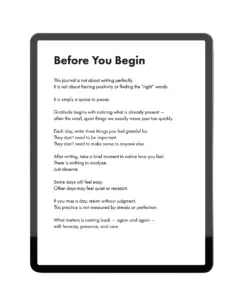
A free 30-day gratitude journal designed for a simple daily practice. Calm, minimal, and printable to help you slow down and reflect.
ExploreFrequently Asked Questions
What is a life audit?
How often should you do a life audit?
What areas should be included in a life audit?
How do you score a life audit?
What should you do after completing a life audit?