Self-Awareness and Identity: The Foundation of Personal Growth

Self-awareness and identity are the two forces that determine whether personal growth sticks or fades. Self-awareness is the ability to observe your own thoughts, emotions, and behavioral patterns without being controlled by them. Identity is the collection of beliefs you hold about who you are. When these two align, change becomes natural. When they conflict, you find yourself setting goals you never follow through on, making promises you keep breaking, and wondering why growth feels so difficult.
Research in developmental psychology has consistently shown that self-awareness is the strongest predictor of emotional intelligence, effective leadership, and sustained behavior change. Organizational psychologist Tasha Eurich’s research found that while roughly 95 percent of people believe they are self-aware, only 10 to 15 percent actually meet the criteria, which explains why insight so often fails to translate into lasting change. You build it through deliberate practice, the same way you build any other skill, whether or not it comes naturally to you. This post looks at how self-awareness and identity work together as the foundation for every real change in your life, and how to strengthen both through simple daily practices. For a broader framework, the personal growth guide maps out how this foundation connects to the larger process of personal evolution.
Why Self-Awareness Comes Before Every Other Change
Most people try to change their behavior without first understanding what drives it. They set goals, build routines, and push through willpower, but the underlying patterns remain invisible. This is why so many resolutions fail by February. The behavior you can see is always rooted in beliefs and emotional patterns you cannot see, until you learn to look.
Self-awareness is the practice of looking. It means noticing what you think when no one is watching, how you react under stress, what stories you tell yourself when things go wrong, and what you avoid when you feel uncomfortable. None of this requires special training. It requires honesty and a willingness to observe rather than judge.
Your brain constantly filters the world around you, deciding what deserves attention and what gets ignored. This filtering system, known as the Reticular Activating System, operates based on what you believe is important. When you become more self-aware, you start noticing how this filter shapes your reality. You see opportunities you previously missed. You catch negative thought loops before they spiral. You begin choosing your focus instead of letting your default programming choose for you.
How Identity Shapes What You Believe Is Possible
Your identity is not who you are. It is who you believe you are. That distinction matters enormously because your brain will consistently act in alignment with your self-image, even when that image is outdated or inaccurate.
If you believe you are someone who cannot stick to habits, you will unconsciously sabotage every habit you try to build. If you believe you are not the kind of person who speaks up in meetings, you will stay quiet even when you have the best idea in the room. These identity beliefs operate below conscious awareness, which is exactly why self-awareness is the prerequisite for changing them.
Identity is built from three sources: the stories you were told as a child, the experiences that left an emotional mark, and the choices you repeat daily. The first two are largely inherited. The third is where your power lies. Every time you make a choice that aligns with who you want to become rather than who you have been, you are rewriting your identity one decision at a time.
This is not wishful thinking. Behavioral psychology calls this “identity-based habit formation.” The idea is simple: lasting change comes from focusing on who you want to become, more than on what you want to achieve. A person who identifies as a runner does not need willpower to go for a run. The behavior flows from the belief.
Are Self-Awareness and Identity the Same Thing?
People often use these two words interchangeably, but they describe different things. Self-awareness is a skill: the live act of noticing what you think, feel, and do. Identity is content: the set of conclusions you have already reached about who you are. Awareness is the lens. Identity is the picture the lens keeps pointing at. You can sharpen the lens through practice, and you can change the picture through repeated choices, but the two are not the same mechanism.
The distinction matters because it is diagnostic. When you feel stuck, it helps to ask which one is the real problem. Sometimes you lack awareness, and the pattern driving you stays invisible no matter how hard you try, until you finally see it. Other times your awareness is sharp but your identity resists, so you know exactly what to do and still avoid it, because the action contradicts who you believe you are. The first problem is solved by observation. The second is solved by acting against the old belief until a new one forms. Naming which lever you are facing saves months of pushing on the wrong one.
In practice the two reinforce each other. Awareness gives you the raw material, and identity decides what you do with it. This is why personal growth starts with awareness rather than goal setting, since you cannot reshape a self-image you have never honestly examined. A set of journaling prompts for self-discovery can surface the beliefs you hold without realizing it, which is the first step toward deciding whether they still belong to the person you are becoming.
The Connection Between Self-Awareness and Confidence
Confidence grows from self-trust, even while some doubt is still there. And self-trust can only grow from self-awareness, because you cannot trust someone you do not know, including yourself.
When you pay attention to your own patterns, you learn what triggers your insecurity, what situations bring out your best thinking, and where your real strengths lie. This knowledge becomes the evidence that confidence is built on. You stop relying on external validation because you have an internal record of who you are and what you are capable of.
Self-doubt is one of the biggest obstacles in this process. It disguises itself as realism, telling you that your limitations are facts rather than stories. The practice of turning self-doubt into self-belief starts with recognizing that doubt is a pattern, not a truth. Once you see it as a pattern, you can work with it instead of being controlled by it.
Setbacks are where confidence gets tested. A failure, a rejection, or an unexpected change can crack the self-image you have been building. But setbacks are also where the deepest growth happens, if you have the awareness to learn from them rather than be defined by them. If you are going through a difficult period, understanding how to rebuild confidence after setbacks can help you find your footing again.
Get more like this, every week
How to Build Self-Awareness Through Daily Practice
Self-awareness grows through small, repeated acts of attention, much more than through a single moment of clarity. Here are four practices that strengthen it consistently:
Journal for 10 minutes daily. Write about what you felt, what triggered those feelings, and how you responded. Over time, patterns emerge that are invisible in the moment but obvious on paper. The process of self-discovery through journaling is one of the most effective ways to build self-awareness because it forces you to articulate what you are experiencing rather than just reacting to it.
Name your emotions precisely. “I feel bad” is not self-awareness. “I feel resentful because I agreed to something I did not want to do” is. The more specific your emotional vocabulary, the more clearly you can understand your own responses and the faster you can address what is driving them.
Notice your defaults under stress. Do you shut down, speed up, blame others, or retreat? Your stress response reveals your deepest patterns. You do not need to change it immediately. Just notice it. Awareness itself begins to create space between the trigger and your reaction.
Review your week every Sunday. Spend five minutes reading through your journal entries or just reflecting on the week. Ask yourself: What patterns showed up? What surprised me about my own reactions? What do I want to do differently next week? This weekly review compounds awareness over time in a way that daily reflection alone cannot.
If you would rather not assemble this practice yourself, a structured personal growth journal lays these four habits out as a daily page you fill in.
Action as Identity Reinforcement
Awareness without action is just observation. The final piece is closing the loop: using what you see about yourself to make different choices, and letting those choices reshape your identity.
Every action you take is a vote for the identity you are building. When you journal despite not feeling like it, you vote for the identity of someone who reflects. When you set a boundary despite discomfort, you vote for the identity of someone who respects their own needs. When you show up to a goal on a difficult day, you vote for the identity of someone who follows through.
These individual votes are small. But they compound. Over weeks and months, they add up to a new self-image backed by real evidence. You stop needing to convince yourself you can change because the proof is already in your behavior.
Growth is often quiet. It shows up in the choices you no longer make, the boundaries you now set, and the emotions you process instead of avoiding. If you are unsure whether you are making progress, the signs you are growing are often more visible than you think.
When Personal Growth and Identity Align
Growth feels effortless when the person you are becoming matches the person your brain already believes you are. The relationship between identity and self-awareness is reciprocal. Awareness shows you the identity you currently inhabit, and identity decides what your awareness is allowed to act on. When the two pull in opposite directions, every new habit feels like swimming upstream. This is why two people can read the same book, follow the same routine, and end up with completely different results. One is building from an identity that supports the change. The other is fighting an identity that resists it.
The phrase personal growth and identity describes this exact intersection. Growth is the direction you want to move. Identity is the current that either carries you there or pulls you back. When you align them, the small daily choices you make stop draining your willpower and start feeding it. You wake up wanting the thing that used to feel like a chore, because it has become an expression of who you are rather than a task on your list.
Alignment happens slowly, as you edit the beliefs that no longer fit. You notice an old story telling you who you are. You ask whether it still serves the person you are becoming. If the answer is no, you rewrite it through action, choosing a behavior that contradicts the old belief and reinforces the new one. Over time, the new identity becomes the default, and the old one fades into background memory.
This is the practical work behind building aligned habits. Each habit you choose is a vote, but the larger question is whether the habits collectively point toward a coherent self-image. If you are practicing patience in one area and tolerating chaos in another, your identity stays fragmented. Choose habits that compound in a single direction, and your identity begins to consolidate around the person you are becoming.
If you want a clearer picture of who that future self is, the concept of a higher self-concept offers a useful frame. You imagine the version of you who has already integrated the change, then act in the way that person would act today. The gap between current self and future self narrows with every consistent choice, until one day you realize the gap has closed.
Conclusion
Self-awareness and identity work as two sides of the same practice. Awareness shows you who you are right now. Identity is the story you are writing about who you are becoming. When you pay attention to both, growth stops being something you chase and becomes something you live.
The iAmEvolving Journal was designed to support this exact process. Its daily structure guides you through intention setting, gratitude, habit tracking, and emotional reflection. Each section strengthens a different dimension of self-awareness, and together they build the evidence your identity needs to evolve.
Start by noticing. Write what you see. Let the awareness shape your choices. The identity follows.
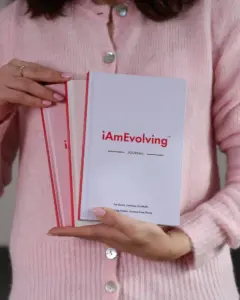
Start your daily practice of gratitude, goals, and growth.
Get the Journal →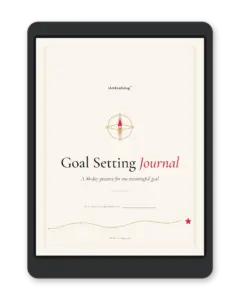
A free 30-day goal setting journal PDF with daily prompts, action steps, and reflection space. Printable, minimal, and designed to keep you focused on…
ExploreFrequently Asked Questions
What is self-awareness in personal growth?
How does identity affect personal growth?
How do I become more self-aware in daily life?
Can self-awareness help with confidence and self-doubt?