Why Personal Growth Starts with Awareness

Personal growth starts with awareness because you cannot change what you do not see. Awareness is the ability to observe your own thoughts, emotions, and behavioral patterns clearly enough to make deliberate choices about them. Without it, growth is accidental. With it, growth becomes intentional. Every lasting transformation in habits, relationships, confidence, and purpose begins with the moment you stop operating on autopilot and start paying attention to what is actually happening inside you.
Research in behavioral psychology consistently shows that self-awareness is the strongest predictor of emotional intelligence, effective decision-making, and sustained behavior change. A study by organizational psychologist Tasha Eurich found that while 95% of people believe they are self-aware, only about 10-15% actually are. That gap between perceived and actual self-awareness explains why so many people feel stuck despite genuine effort. The personal growth guide maps out the full journey, but awareness is where every meaningful step begins.
What Awareness Actually Means in Personal Growth
Awareness in personal growth is not the same as intelligence, self-criticism, or overthinking. It is the practice of observing without judgment. It means noticing that you are anxious without labeling yourself as an anxious person. It means recognizing a pattern of avoidance without deciding you are lazy. It means seeing your reactions as data, not verdicts.
There are two dimensions of awareness that matter for growth. Internal awareness is how clearly you see your own values, emotions, strengths, and blind spots. External awareness is how accurately you understand how others perceive you. Both are necessary, and most people are stronger in one than the other.
The practical starting point is simple: notice what you do when you are not thinking about what you are doing. Your default behaviors, the ones that happen without conscious choice, reveal your deepest patterns. Those patterns are where the real work of growth begins.
Why Awareness Must Come Before Action
Most people try to change their lives by changing their actions first. They set goals, build routines, and push through willpower. But without awareness, those actions are built on top of patterns they have not examined. This is why New Year’s resolutions fail, why habits collapse under stress, and why people repeat the same relationship dynamics with different partners.
Action without awareness is like renovating a house without inspecting the foundation. You can paint the walls and replace the furniture, but if the structure underneath is compromised, the problems will resurface.
Awareness changes this by giving you access to the underlying beliefs and emotional responses that drive your behavior. When you understand why you procrastinate, avoid conflict, or abandon goals after two weeks, you can address the root cause instead of treating the symptoms. Understanding your own patterns is the core of self-awareness and identity work, which forms the foundation for every other growth skill.
How Journaling Builds Awareness Faster Than Anything Else
Journaling is the most effective tool for building self-awareness because it forces you to translate internal experience into concrete language. Thoughts that loop invisibly in your mind become visible on paper. Patterns that take months to recognize in conversation reveal themselves in weeks of consistent writing.
When you journal, you are doing three things simultaneously. First, you are slowing your thinking down enough to actually observe it. Second, you are creating a record that you can review for patterns over time. Third, you are practicing the skill of honest self-examination in a private, judgment-free space.
Research by James Pennebaker at the University of Texas found that expressive writing about thoughts and feelings produces measurable improvements in mental health, immune function, and cognitive processing within days. The mechanism is awareness: the act of putting experience into words reorganizes how the brain stores and processes that experience.
If you are new to this practice, starting journaling for self-improvement provides a practical framework for your first weeks.
Get more like this, every week
Five Practices That Develop Awareness Daily
Awareness is not a one-time insight. It is a skill that strengthens with daily practice. Here are five methods that build it consistently:
Write your intentions each morning. Before the day starts, write down what you intend to focus on, how you want to show up, and one pattern you want to watch for. Writing down your intentions creates a reference point that makes it easier to notice when you drift from them.
Name your emotions with precision. Replace vague labels (“stressed,” “fine,” “off”) with specific descriptions (“resentful because I over-committed,” “anxious about tomorrow’s meeting,” “grateful for the quiet morning”). Precision in language produces precision in understanding.
Notice your stress response. The next time you feel pressure building, pause and observe. Do you shut down, speed up, snap at others, or retreat? Your default stress response is one of the most revealing patterns you can identify. Noticing it is the first step to choosing a different response.
Review your week every Sunday. Spend five minutes reading through your journal entries or reflecting on the week. Ask: What patterns showed up? What surprised me? What would I do differently? This weekly review compounds awareness over time in a way that daily reflection alone cannot.
Track your inner state. Rate your emotional state at three points during the day: morning, midday, and evening. Over a few weeks, you will see clear patterns connecting your environment, activities, and emotional responses. The inner harmony mapping practice provides a structured framework for this kind of emotional tracking.
How Self-Awareness Becomes Personal Growth
Self-awareness and personal growth are often discussed as separate skills, but they operate as a single feedback loop. Self-awareness gives you the information. Personal growth is what you do with that information over time. Without the loop, awareness becomes self-analysis that goes nowhere, and growth becomes effort that produces little durable change.
The loop has four stages, and each one reinforces the next. You notice a pattern. You name what is driving it. You experiment with a different response. You observe what happened and update your understanding. This is the actual mechanism of personal evolution, and it is why people who journal consistently grow faster than people who only consume self-improvement content. Reading produces ideas. The loop produces change.
Developing self-awareness as a learning process means treating yourself the way a scientist treats a subject of study. You collect data through observation and writing. You form a hypothesis about why a pattern exists. You test small changes in your behavior. You measure the results not against perfection but against your earlier baseline. Over months, the compound effect is significant: daily growth practices like this turn vague self-improvement goals into measurable forward motion.
One subtle truth is that growth often feels worse before it feels better. As awareness sharpens, you start to see patterns you used to ignore, mistakes you used to rationalize, and emotional habits that used to feel automatic. This phase can be disorienting. It is also a sign that the loop is working. Learning to sit with the discomfort of change, rather than retreat from it, is part of how the beauty of change reveals itself over time.
The relationship between self-awareness and personal growth is also why progress is rarely linear. You will move forward, regress, gain insight, lose it, and circle back to the same pattern at a deeper level. Each return is not failure. It is a chance to apply what you have learned to a context you could not see before. The loop deepens with every cycle, and the version of you on the other side of it is more responsive, more honest, and more capable of choosing your own direction.
Awareness Is the Beginning, Not the Destination
Awareness without action is just observation. The purpose of seeing your patterns clearly is to give you the power to choose differently. Once you notice that you avoid difficult conversations, you can practice having one. Once you see that you abandon goals after the initial excitement fades, you can build systems that sustain you through the flat middle.
The relationship between awareness and action is cyclical, not linear. You become aware, you act, you observe the results, and you become more aware. Each cycle deepens your understanding and strengthens your ability to grow with intention. Recognizing the signs that you are growing helps you stay motivated through cycles that feel slow or invisible.
Conclusion
Personal growth does not start with goals, habits, or motivation. It starts with awareness. The moment you begin paying attention to your own thoughts, emotions, and patterns, you gain the power to shape them deliberately rather than being shaped by them unconsciously.
The iAmEvolving Journal was built around this principle. Every daily spread begins with intention setting and ends with reflection, creating a consistent awareness practice that compounds over weeks and months. You do not need to understand everything about yourself today. You just need to start noticing.
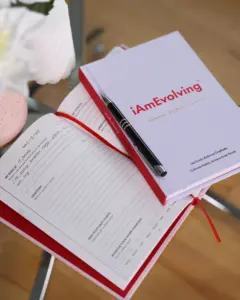
Start your daily practice of gratitude, goals, and growth.
Get the Journal →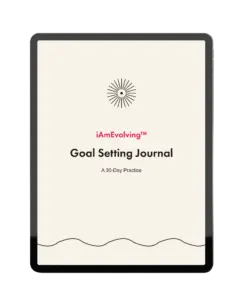
A free 30-day goal setting journal PDF with daily prompts, action steps, and reflection space. Printable, minimal, and designed to keep you focused on…
ExploreFrequently Asked Questions
Why is self-awareness important for personal growth?
How do you develop self-awareness?
What is the difference between awareness and overthinking?
Can journaling really improve self-awareness?