How to Do the Work on Yourself When No One Can Do It for You

Learning how to do the work on yourself starts with one plain truth: no one else can do it for you. Doing the work on yourself means taking honest, daily responsibility for your thoughts, reactions, and habits, instead of waiting for a person, a book, or a better season to change them for you. It is less dramatic than it sounds, and far more ordinary. Most of it happens in small moments nobody else ever sees.
I can’t do this work for my wife, for my son, or for my closest friends, and they can’t do it for me. We can encourage each other, share tools, and walk side by side, but each of us has to take our own steps. This guide shows you what doing the work actually looks like, where to begin, what tends to get in the way, and how to tell that it is working.
What Doing the Work on Yourself Really Means
There is more help available today than ever: books, podcasts, coaches, courses, and endless videos. All of it can be useful. None of it is the work itself. Reading about change fills your mind with ideas. Doing the work is what happens when you put the book down and act on one of them.
| Feels like the work | Is the work |
|---|---|
| Reading another book about change | Trying one idea from it this week |
| Knowing you should set a boundary | Having the uncomfortable conversation |
| Waiting until you feel ready | Starting small while you still feel unsure |
| Planning a full life overhaul | Changing one reaction, one habit, one day |
| Hoping someone else will change | Changing how you respond to them |
The difference is not effort or intelligence. It is the gap between knowing and doing. Most people already know what they need to change. Knowledge is rarely the bottleneck. Action is.
How to Do the Work on Yourself: Where to Start
The hardest part is usually the first ten minutes. The steps are easy enough; no one ever handed you a starting line. These four steps give you one.
1. Name what you are avoiding
Begin with one honest question: what am I actually avoiding? Skip the surface answers about being busy or tired. Look for the specific thing you keep putting off, circling, or numbing with distraction. Self-awareness is the foundation of every other change. Without it, you spend your energy fixing the wrong problems.
2. Give the answer somewhere to land
Thoughts that stay in your head tend to loop. Give them a page, a quiet ten minutes, or a walk without a podcast. You do not need a system yet. You need a place where your own voice can come back into the conversation. If a blank page feels intimidating, start with these prompts for self-discovery and choose the one that makes you slightly uncomfortable.
3. Choose one small action
Reflection without action slowly turns into frustration. Pick one action that matches your honest answer. Send the message you have been avoiding. Leave your phone in another room for the first thirty minutes of the day. Say no to one request that drains you. Keep it small enough that you can do it today.
4. Repeat it, then review it
One action is a start. The same action, repeated for a week, becomes evidence. At the end of each week, look back and ask what changed, what felt hard, and what you want to adjust. That review is where the real learning happens.
Why No One Can Do the Work for You
Many people begin their growth saying, “I am doing this for my family.” That comes from love, and it matters. But when your only reason is outside you, motivation fades the moment life gets hard. When the reason comes from within, because you want to live with more awareness, patience, and peace, it holds up on the difficult days too.
This is not selfish. You cannot give your family calm if you never practice it yourself. You cannot teach your children patience you have not built. The most reliable way to help the people you love is to keep doing your own work, and let them see what it looks like.
There is also freedom in this. The moment you stop waiting to be rescued, you get your power back. Your growth no longer depends on anyone else agreeing, changing, or approving. It depends on what you choose to do next. Real change takes longer than you want it to, which is why it helps to trust the process while it builds.
Get more like this, every week
What Gets in the Way of Doing the Work
If you have tried before and stalled, you are not lazy or broken. Usually one of these patterns is getting in the way:
- Consuming instead of practicing. Another article or video feels productive, but it can become a comfortable way to postpone action.
- Waiting to feel ready. Readiness usually shows up after you start, not before. Doubt is normal, and it does not have to disappear before you take the first step.
- Trying to fix others first. Focusing on what your partner, parent, or coworker should change is a subtle way to avoid your own part.
- All-or-nothing thinking. Missing one day feels like failure, so you stop entirely. The work is in returning, not in a perfect streak.
- Doing too much at once. Ten changes compete for the same energy. One change, kept for a month, does more.
If the loudest obstacle is the voice telling you that you cannot do it, this guide on turning self-doubt into self-belief walks through how repeated, imperfect action quiets it.
Signs the Work Is Working
Progress in inner work is easy to miss because it is quiet. Look for these signs instead of a dramatic breakthrough:
- You notice an old reaction a moment before it happens, instead of only afterward.
- You recover from a hard day faster than you used to.
- You blame others less and ask, “What is my part in this?” more often.
- You keep small promises to yourself without needing anyone to check.
- The same problems still appear, but they shake you less.
Discipline is what carries you between those signs. On the days you do not feel like showing up, small habits for self-discipline keep the work moving until the motivation returns.
Make It a Daily Practice
Doing the work on yourself is not a weekend retreat. It is a daily choice, made in ordinary moments. A short written check-in is one of the simplest ways to keep that choice visible. When you write one intention in the morning and reflect for a few minutes at night, you build a record you cannot argue with. A week of blank pages tells you something. So do months of honest, imperfect entries. If you want a structure for it, start with a simple daily journaling routine and keep it small enough to survive busy days.
This kind of daily honesty is also how your actions start to match your values. Over time, the small choices add up to a life that feels like yours, which is the heart of life alignment and purpose.
To grow is to change; to evolve is to choose that change consciously.
Victor Tihai, iAmEvolving Journal
No One Can Walk Your Path for You
No one can meditate your mind clear, feel your gratitude, or face your fears on your behalf. That can feel heavy at first. Look closer and it is good news: the path belongs to you, so no one can take it from you either.
Start today with one honest question and one small action. Then do it again tomorrow. If you want a place to hold that daily practice, the iAmEvolving Journal gives you a page each day for your goal, gratitude, habits, and an inner harmony check-in, with a reflection page every ten days to see how far you have come.
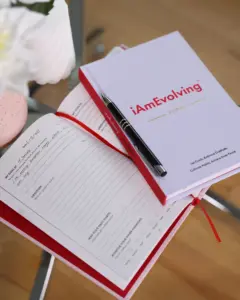
Start your daily practice of gratitude, goals, and growth.
Get the Journal →
A free 30-day goal setting journal PDF with daily prompts, action steps, and reflection space. Printable, minimal, and designed to keep you focused on…
ExploreFrequently Asked Questions
What does it mean to do the work on yourself?
Where do I start doing the work on myself?
Can someone else do the inner work for me?
How long does it take to see results from working on yourself?