Higher Self-Concept: How to Become the Version of You That Feels Out of Reach

A higher self-concept is the version of you that you can almost picture but haven’t quite stepped into yet. The one who already speaks calmly under pressure, who follows through on the thing you keep almost starting, who doesn’t shrink in rooms where they belong. Most personal-development advice points at this version and tells you to “be more like that,” which works for about fourteen minutes. Identity-level change works differently. It happens when you stop trying to perform the new self-concept and start assuming it, quietly, in private, one decision at a time.
This guide is about the actual practice. Not the spiritual veneer, not affirmations shouted into a mirror, but the slow, unglamorous work of replacing an old self-concept with a higher self-concept that your nervous system can hold. If you’ve tried mindset work that didn’t stick, that’s almost always because the technique stayed at the level of thoughts. A higher self-concept lives one layer underneath, in the identity that produces the thoughts in the first place.
What a Higher Self-Concept Actually Is (And Isn’t)
A higher self-concept isn’t a goal, a vision board, or a future self. It’s the quiet sentence your mind uses to describe who you are when no one’s asking. “I’m someone who finishes things.” “I’m a writer.” “I’m the kind of person who keeps promises to herself.” That sentence runs underneath everything you do. It picks which possibilities feel realistic and which feel like reaching. When the sentence changes, the behaviour changes downstream, almost automatically.
What it isn’t: a fantasy. Fantasies live in the future. A higher self-concept lives in the present tense, even when the evidence hasn’t caught up yet. The difference matters because the body responds to present-tense identity in a way it never responds to future hopes. “I will be confident” keeps you waiting. “I am someone who carries themselves with quiet confidence” rearranges your shoulders before you finish the sentence. This is the same principle that makes I AM affirmations work when they work, and useless when they don’t.
Why Assuming a Self-Concept Works When “Trying to Change” Doesn’t
Most change strategies fail because they fight the current self-concept while trying to install a new one. You set a discipline goal, push against the version of you who has never been disciplined, and burn through willpower in three weeks. The self-concept underneath never moved, so the behaviour springs back. This is the loop almost everyone has been in.
Assuming a higher self-concept skips the fight. Instead of trying to do what a more disciplined person would do, you start treating the new identity as already true and let behaviour reorganize around it. The wording matters: not “I’m trying to be more disciplined,” but “I’m someone who follows through.” Spoken from that frame, the morning workout isn’t a battle, it’s just what someone like you does. The internal argument disappears because there’s nothing left to argue with.
The Three-Step Practice: How to Actually Assume a Higher Self-Concept
This isn’t an affirmation list. It’s a daily practice with three parts, each one targeting a different layer of how identity gets installed in the body.
- Name the higher self-concept in one specific sentence. Not “I’m successful,” which is too vague to feel. Something like “I’m someone who keeps the promises I make to myself before noon.” Specific enough that you could check it against today. Vague identity statements never land. Specific ones rearrange your morning.
- Write the sentence at the top of your journal every morning for 30 days. Then underneath, write one sentence about what someone with that self-concept would do today. Not seven things, one thing. The repetition is the work. You’re carving a groove the mind eventually follows on its own.
- End the day with one observation, not a grade. “Today I noticed myself almost breaking the promise. I didn’t.” Or: “Today I broke it. The old self-concept is still strong here.” No judgment. Just the data. Self-concept change is impossible without honest observation, and impossible if observation turns into self-attack.
This practice is small on purpose. Identity work that requires an hour a day fails on the days you most need it. Ten minutes a day, every day, beats two hours twice a month by a margin that’s almost embarrassing. The daily mindset shift at the level of thought layers on top of this naturally, once the underlying identity is moving.
Get the 30-day self-concept worksheet
The Old Self-Concept Won’t Leave Quietly: Three Resistance Patterns
About week two, the old self-concept starts pushing back. It’s predictable and it’s not a sign anything’s wrong. The body has been running on the old identity for years, and it has wiring you can’t undo with a sentence at the top of a page. Three patterns show up most often.
- Sudden disinterest. The practice that felt clarifying last week suddenly feels silly. This is the old self-concept protecting itself by making the new one boring. Just write the sentence anyway.
- Memory floods. Specific moments from your past show up, the ones that contradict the new self-concept. “Remember when you said you’d start the business and didn’t?” These aren’t warnings. They’re old proof being shown to you because the new identity is making them less true.
- Logistical disruption. The schedule shifts, the journal goes missing, the timing of the morning ritual gets harder to protect. This isn’t bad luck. It’s friction from a system reorganizing. Move the journal closer to the bed and keep going.
Recognizing these patterns is half the work. Most people abandon self-concept practices in week two because they interpret the resistance as proof the practice doesn’t work. The resistance is proof it’s working. Comfort is the absence of change.
How the New Self-Concept Starts to Stick
The shift you’re looking for isn’t a thunderclap. It’s a small, repeatable moment somewhere between week three and week six where you catch yourself acting from the new identity without having decided to. You make the call you’ve been avoiding without rehearsing it. You leave the room when the old version of you would have stayed and managed everyone else’s mood. You sit down to write and the resistance that used to take forty-five minutes to negotiate just isn’t there. That’s it. That’s the proof.
The proof never comes as a feeling first. The feeling follows the behaviour. This is why most people miss the shift: they’re waiting for an emotional confirmation that comes weeks after the change has actually started. Trust the behaviour, even if it still feels foreign. The identity catches up to the actions, not the other way around. Emotional growth through life’s challenges is built on exactly this lag.
What to Avoid: The Three Mistakes That Keep People Stuck
The practice is simple but easy to break. Three mistakes account for almost every failed attempt I’ve seen.
- Announcing the new self-concept publicly. Identity work is private work. Telling others about it triggers the social-validation circuit and converts internal change into performance. Keep the practice between you and the page for the first 60 days at least.
- Borrowing someone else’s self-concept word for word. An identity sentence has to be in your own voice or it can’t take root. “I’m the kind of person who…” needs an ending you’d actually say out loud.
- Trying to change three self-concepts at once. One at a time. Always. Stack two and neither lands. The brain can only hold one identity rewrite at a time without splitting attention.
Sixty days, one sentence, written every morning, tracked at night without judgment. That’s the whole method. The reason it works isn’t magic. It’s that almost no one else does it for sixty consecutive days, and consistency at this layer of the self is where genuine identity-level change actually lives.
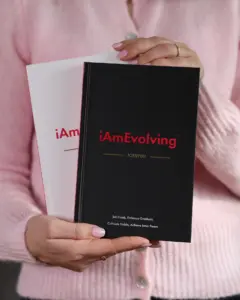
Start your daily practice of gratitude, goals, and growth.
Get the Journal →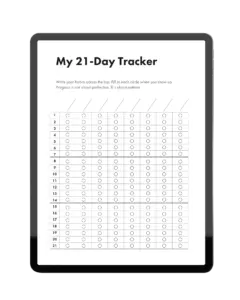
A free 21-day habit tracker PDF with daily check-ins, guided reflection prompts, and mindset reminders. Clean, minimal, and printable.
ExploreFrequently Asked Questions
What does “higher self-concept” actually mean?
How long before I see results?
Is a higher self-concept the same as positive thinking?
What if my higher self-concept feels like a lie?
Can I work on multiple self-concepts at once?