Imagination and Mindset: How to Use Your Imagination on Purpose

Imagination and mindset are more closely linked than most people realize. Imagination is your mind’s ability to picture what has not happened yet, and your mindset is shaped, in large part, by which pictures you rehearse most often. You are already using your imagination every day. The question is whether you are directing it, or letting it run on habit.
Worry is a good example. When you lie awake replaying a conversation that has not happened, you are imagining in vivid detail. The same capacity can help you prepare for a hard moment, see more than one possible outcome, and follow through on what matters to you. This guide shows how imagination shapes your mindset and gives you three simple ways to use it on paper, without forcing positivity or pretending things are fine.
How Imagination and Mindset Work Together
Your mind is constantly running small simulations. Before a meeting, you picture how it might go. After an argument, you replay what you should have said. Each of these mental scenes leaves a trace. Rehearse the same kind of scene often enough, and it starts to feel like the most likely version of the future.
That is why imagination matters so much for mindset. If most of your mental rehearsals end in embarrassment or failure, your default outlook tilts toward caution and dread. If you regularly rehearse handling difficulty well, you build a quieter kind of confidence. It comes from having already practiced responding when things go wrong, rather than from believing everything will go perfectly.
Research on mental practice supports this in a practical way. Studies on mental rehearsal, used widely in sports and performance, show that imagining a task in detail can improve how well people carry it out, especially when it is combined with real practice. Imagination is not a substitute for action. It is a rehearsal space for it.
This is also why imagination sits so close to how you see yourself and your life. Shifting the scenes you rehearse is one of the most direct ways to change your perspective, which is the heart of perspective shifts and personal evolution.
Directed Imagination vs. Wishful Thinking
Not all imagining helps. One of the most useful findings in this area comes from research on positive fantasies: daydreaming alone about a perfect outcome can make people feel as if they have already arrived, which can lower the effort they put in. What tends to work better is pairing the picture of what you want with an honest look at what will get in the way. Researchers call this mental contrasting.
| Wishful thinking | Worry | Directed imagination | |
|---|---|---|---|
| What you picture | Only the best outcome | Only the worst outcome | The goal and the obstacle |
| How it feels | Pleasant, then flat | Tense, looping | Steady, practical |
| What it leads to | Little action | Avoidance | A plan for the hard part |
| Best used for | Rest and inspiration | Nothing on repeat | Goals and hard moments |
If you want to picture a goal clearly and emotionally, that has its own practice in goal visualization. This page focuses on something different: using imagination to prepare for real life, including the parts you would rather not think about.
Three Ways to Use Your Imagination in a Journal
Writing slows imagination down enough to work with it. A picture in your head can loop for hours. The same picture on paper has edges, details, and an ending you get to choose.
1. Rehearse a hard moment before it happens
Choose something coming up that you are dreading: a difficult conversation, a presentation, saying no to someone. Write the scene in a few sentences. Then write the hardest moment in it, and how you want to respond. Keep it realistic. The aim is a practiced response rather than a perfect script, so the real moment feels a little less new.
2. Widen the worst case
When fear takes over, imagination tends to show only one ending. Give it three. Write the worst realistic outcome, the best realistic outcome, and the most likely one. Then write one thing you would do if the worst case happened. Most people find the most likely outcome is far more ordinary than their fear suggested, and that the worst case, once written down, feels more manageable.
If your thoughts tend to loop on the same worries no matter what you write, that is a sign of overthinking rather than imagination. Journaling for overthinking offers a different approach for breaking that cycle.
3. Write from one year ahead
Write a short letter from yourself, one year from now, looking back on the season you are in today. Keep it grounded: what did you keep doing, what did you let go of, what turned out not to matter as much as you feared? This is not a prediction or a promise. It is a way to borrow a calmer, wider view of your current situation, and to notice what that future self would want you to start doing now.
Get more like this, every week
When Imagination Works Against You
The same capacity that helps you prepare can also wear you down. Watch for these patterns:
- Replaying the past on a loop. Imagining what you should have said, over and over, rarely leads anywhere new.
- Comparing against imagined lives. Picturing how much easier things are for other people turns imagination into a measuring stick you always lose against.
- Rehearsing only disaster. Preparing once is useful. Rehearsing the same catastrophe every night just practices fear.
- Living in the perfect picture. Spending more time imagining a goal than working toward it can start to replace the effort.
When you notice one of these, you do not need to fight the thought. Write it down, label which pattern it is, and ask one question: what is one small thing I can actually do about this today? That simple shift moves imagination back toward action. If heavy thoughts are constant or start affecting your sleep, work, or relationships, it is worth talking to a doctor or mental health professional as well.
Over time, these small redirections add up to a different relationship with your own mind, the kind of slow, honest shift described in growth mindset vs fixed mindset.
How to Use Imagination With Your Daily Goal: A 10-Day Practice
Write your goal for the day
Picture the hardest moment
Write an if-then plan
Check in with how you feel
Review on day ten
Your Imagination Is Already Working
You do not need to become more imaginative. You already imagine all day long. What changes your mindset is learning to direct that imagination: rehearsing the hard moments, widening the worst case, and pairing every hopeful picture with an honest plan for the obstacles.
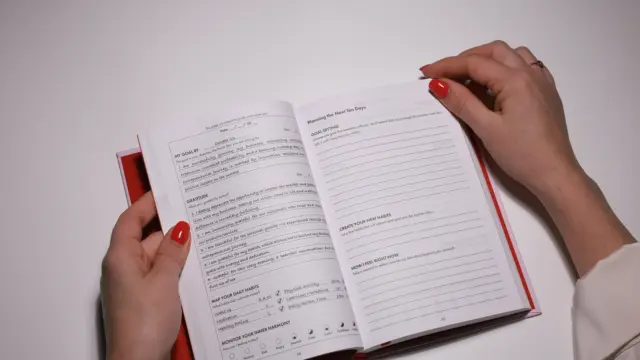
Start with one entry tonight. Pick tomorrow’s hardest moment and write how you want to meet it. If you want a daily structure for this, the iAmEvolving Journal gives you a page each day for your goal, gratitude, habits, and an inner harmony check-in, with a reflection page every ten days to see what your imagination has been rehearsing.
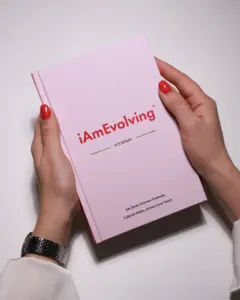
Start your daily practice of gratitude, goals, and growth.
Get the Journal →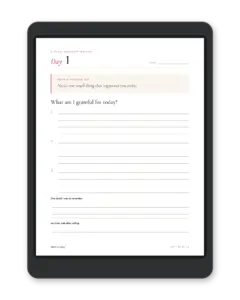
A free 30-day gratitude journal designed for a simple daily practice. Calm, minimal, and printable to help you slow down and reflect.
ExploreFrequently Asked Questions
How does imagination affect your mindset?
Is worrying a form of imagination?
Does imagining success actually help you reach goals?
How can journaling help you use your imagination better?