Ironman Training Motivation: Staying Consistent for 6 Months
Ironman training motivation is not a personality trait. It is a system, and for most age-group athletes that system fails somewhere between week 14 and week 18: long after the excitement of signing up, and long before the taper makes the finish line feel real. The training plan is rarely what breaks. What breaks is the ability to keep showing up on an ordinary Tuesday when nobody is watching, your legs are heavy, and race day is still four months away.
The fix is not more discipline. It is a daily record of why you started, what you are actually doing, and how you are actually feeling, kept in one place you touch for five minutes every morning. Triathletes measure watts, pace, heart rate and sleep with real precision, then measure the one variable that decides whether they finish the block at all, their own state, not at all. What follows is what to track, why it works, and how to structure it across a full six-month build.
Why Ironman Training Motivation Disappears Around Month Four
A full-distance triathlon is a 3.86 km swim, a 180.25 km bike and a 42.2 km run, and most plans build toward it over 24 to 30 weeks at 10 to 20 hours per week. That shape creates a predictable emotional curve. Sign-up day runs on the outcome: the finish line, the photo, the thing you will have proven. Base phase runs on novelty, because the sessions are new and the fitness gains are obvious.
Then the build phase arrives. Volume climbs, but your job does not shrink, your family does not need you less, and the sessions get long enough to eat entire weekend mornings. The fitness gains slow down at exactly the moment the cost goes up. Neither the outcome nor the novelty can carry you through that stretch, because the outcome is still months away and the novelty is gone. This is the point where understanding process goals versus outcome goals stops being theory and starts deciding whether you make it to the start line.
What replaces motivation in that window is a daily contact point with the goal. Not a monthly review, not a coach check-in, but something small enough to survive a 5 a.m. alarm and consistent enough to accumulate.
The Tools You Already Have, and the One Variable Nobody Tracks
Search for Ironman training tools and you will get hardware and software: a power meter, a GPS watch, a smart trainer, a structured plan, a nutrition strategy, maybe a coach. All of it is worth having. All of it measures the same category of thing, which is what your body produced. None of it measures whether you still want to be doing this in eight weeks.
| What it tracks | Tool | Answers the question |
|---|---|---|
| Output | Power meter, GPS watch | How hard did I go? |
| Load | Training plan, coach | Am I doing the right sessions? |
| Recovery | Sleep and HRV tracking | Is my body absorbing it? |
| Fuelling | Nutrition plan | Can I hold this for ten hours? |
| State | Usually nothing | Will I still be here in eight weeks? |
That bottom row is the gap. It is also the row that predicts the others, because an athlete whose motivation is quietly draining will start shaving sessions, sleeping worse and eating carelessly long before any of it shows up in a training file. Learning how to stay consistent with goals when life is already full is a different skill from learning to hold 220 watts, and it needs its own tool.
The tool does not need to be complicated. It needs four things: the goal, the habits underneath it, something that keeps you grateful rather than resentful, and an honest daily read on how you are doing. Five to ten minutes, every morning, on paper.
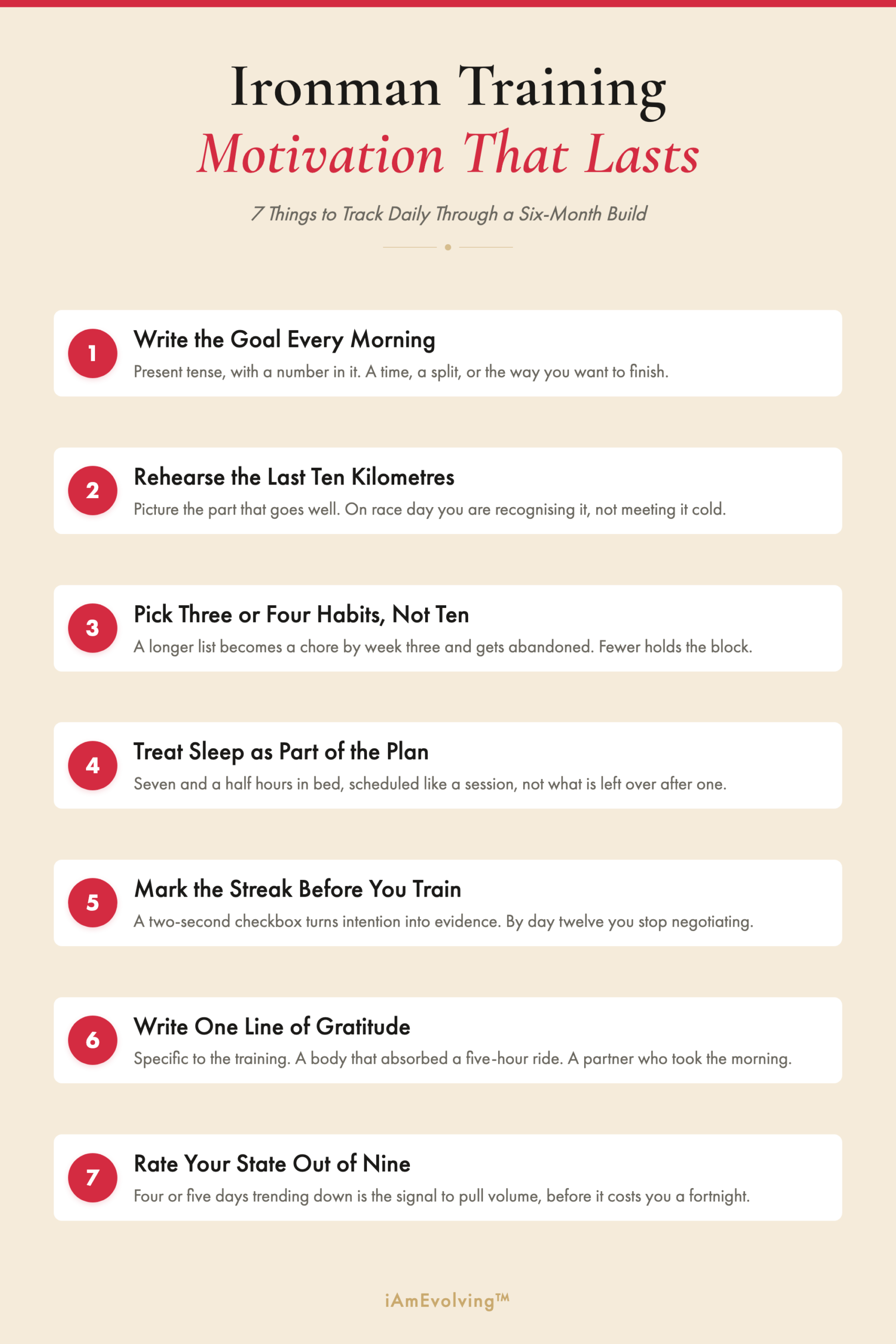
Write the Goal Every Morning, Not Once at Sign-Up
Most athletes define the goal once, on the day they pay the entry fee, and never write it again. Six months later they are executing a plan whose reason they have not consciously touched in twenty weeks. Writing the goal daily is not a motivational ritual. It keeps the target specific and current, so that every session has a visible reason attached to it rather than sitting in your calendar as an obligation.
Write it in present tense and make it concrete. A goal like “I cross the line under 12 hours, running the last 10 km” gives your brain something to rehearse. “Finish an Ironman” does not. This is where the power of visualization does its work in endurance sport: rehearsing a specific scenario in advance means that when it arrives on race day, you are recognising something rather than meeting it cold.
Three prompts worth rotating through the build:
- What does the last 10 km look and feel like when it goes well?
- Which part of today’s session is closest to something I will face on race day?
- If today were the only session that counted, what would I do differently?
Choose the Three or Four Habits That Carry the Block
Triathletes are unusually good at tracking training and unusually bad at tracking the things that make training possible. The swim, bike and run are already on the plan. The habits that determine whether those sessions land well are almost never written down anywhere.
Pick three or four and only three or four. A longer list becomes a chore by week three and gets abandoned. Common ones that carry a build:
- Seven and a half hours in bed, treated as part of the plan rather than what is left over after it.
- Protein at breakfast, which quietly decides how the afternoon session feels.
- Ten minutes of mobility, the first thing dropped and the most expensive to lose.
- One evening a week fully off, protecting the relationships that make a six-month block sustainable.
A visible streak does more work here than any amount of resolve. Checking a box is a two-second act that turns an intention into evidence, and after eleven or twelve unbroken days most people stop negotiating with themselves about it. That is the mechanism behind gentle discipline habits: you are not forcing behaviour, you are making the behaviour easy to see.
Gratitude Is a Performance Tool, Not a Soft One
Long training blocks generate resentment, and resentment is what turns a sport you chose into a sentence you are serving. It shows up in small ways: irritation at the alarm, resentment of the pool, the sense that the race is now something you have to do rather than something you get to do.
One line of gratitude a day is a cheap corrective, and it works best when it is specific to the training rather than generic. A body that absorbed a five-hour ride. A partner who took the morning. Water that was warmer than expected. Naming what is already working keeps the ledger honest, because the deficits announce themselves loudly and the assets do not.
The athlete who gets to the start line is rarely the most talented one. It is the one who was still enjoying the work in month five.
The Daily Check That Catches Burnout Before It Costs You a Week
Overtraining gets caught by heart rate and power data. Motivational collapse does not, and it is far more common. It arrives as a slow slide rather than an event: sessions start later, warm-ups get shorter, the plan gets “adjusted” three weeks running, and by the time it is obvious you have lost a fortnight of consistency you cannot get back.
Rating your emotional state on a fixed scale every morning solves this by making the slide visible while it is still small. A single number is not interesting on its own. Ninety of them in a row form a line, and that line turns downward well before you would have noticed on your own. The emotional energy of goals is not a metaphor in a build this long; it is the resource that actually runs out first.
When the trend drops for four or five consecutive days, that is the signal to act: pull volume back deliberately for a few days, move a session, or take the recovery week early. Acting on a visible trend is planning. Acting after three missed sessions is damage control.
How to Set Up a Six-Month Journal Cycle for Race Day
The structure below takes about twenty minutes to set up once and five to ten minutes a day after that. It is built to run alongside your training plan, not to replace any part of it.
- Count backward from race day. Six months of daily pages covers a standard 24 to 30 week build with room for the taper. Start on the day your plan starts, not the day you buy the journal.
- Write the outcome goal once, in present tense, with a number in it. A time, a discipline split, or a specific way you want to finish. This is the sentence you will rewrite each morning.
- Break the six months into 13-week cycles. They line up naturally with base, build and peak phases, and each cycle gets its own set of supporting habits rather than one list that has to serve the whole block.
- Choose three or four habits per cycle. Sleep, fuelling, mobility, and one that protects your life outside the sport. Change them between cycles as the demands change; peak phase needs different support than base phase.
- Do the four daily entries before your first session. Goal, gratitude, habit boxes, emotional rating. Doing it before you train rather than after means it happens on the days you skip the session, which are exactly the days it matters.
- Review every ten days, not every day. Look at the emotional trend line and the habit streaks together. Daily numbers are noise; a ten-day block is a signal you can act on.
The iAmEvolving Journal was built around exactly this shape, which is why it maps onto a race build so cleanly. Its six-month span covers 180 daily entries with a reflection checkpoint every ten days, it runs on 13-week goal cycles, and each daily page carries the same four prompts: one goal, one line of gratitude, habit boxes with a streak counter, and a nine-point emotional wellness rating that feeds a six-month trend chart. It was designed for people building something demanding over months, and a full-distance triathlon is one of the clearest versions of that there is.
Get more like this, every week
Crossing the Line Starts on an Ordinary Tuesday
Nobody’s Ironman is decided on race day. It is decided across roughly 180 ordinary mornings, most of which are unremarkable, several of which you will not want to face. The athletes who get there are not the ones who felt motivated on all of them. They are the ones who had a reason written down where they could see it, a short list of habits holding the whole thing up, and an honest read on their own state before it became a problem.
Your watch will handle the watts. If you want something that handles the other half, the iAmEvolving Journal gives you six months of daily pages structured around the goal, the habits, the gratitude and the emotional check, in five to ten minutes a morning. Set it up alongside your plan on day one of the block and you will reach race week with a record of how you got there.

Start your daily practice of gratitude, goals, and growth.
Get the Journal →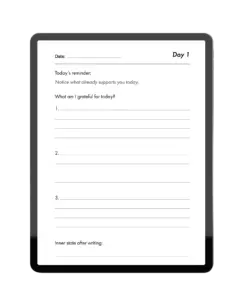
A free 30-day gratitude journal designed for a simple daily practice. Calm, minimal, and printable to help you slow down and reflect.
ExploreFrequently Asked Questions
How do you stay motivated during Ironman training?
What should you track in an Ironman training journal besides workouts?
When does Ironman training burnout usually happen?
Is journaling actually useful for endurance athletes?