Journaling Prompts for Anxiety Relief

Journaling prompts for anxiety are guided questions that help you slow racing thoughts, process worry, and return to the present moment through writing. When anxiety speeds everything up, putting pen to paper creates space between you and your fears.
For many people, anxiety isn’t always dramatic or obvious. It can be subtle and constant, showing up as restlessness, overthinking, or a feeling of being unable to fully relax. You may still function, stay productive, and move through your day, while carrying a background sense of unease.
Journaling doesn’t stop anxiety from appearing. What it does is slow the internal pace. Writing creates a pause — a small but meaningful space between you and the thoughts that feel overwhelming. By putting words on the page, you step out of mental loops and into awareness. You’re no longer only thinking the thoughts; you’re observing them.
If you’re new to journaling for anxiety, it can help to first understand what is anxiety and why it tends to pull attention into the future. From there, writing becomes a way to work with the experience rather than resist it.
Why Journaling Helps When Anxiety Is Present
Anxiety is closely tied to anticipation. The mind scans ahead, preparing for what might go wrong or what needs to be controlled. While this response can be useful in short bursts, it becomes exhausting when it stays active for long periods.
Journaling gently interrupts this cycle. Writing slows the mind and brings attention back to what’s happening now. Breathing becomes more steady. Thoughts begin to separate instead of piling up.
You don’t need to feel calm before you write. You don’t need clarity, positivity, or solutions. Journaling works because it allows whatever is present to be expressed without judgment. What felt overwhelming internally often feels more manageable once it’s written down.
Over time, journaling builds awareness. You start noticing patterns — recurring worries, familiar triggers, and moments when tension increases. Awareness creates choice, and choice creates space.
How to Use Journaling Prompts for Anxiety
Journaling prompts for Anxiety are not questions you need to answer perfectly. They are invitations. Each prompt is a place to pause and notice what’s happening within you.
You don’t need to use every prompt. Choose one that feels relevant in the moment and write honestly. Let your thoughts come out as they are — messy, repetitive, or unfinished.
If anxiety feels strong, keep your writing short. A few sentences are enough. The goal is not analysis; it’s awareness. You can return to these prompts daily or only when anxiety arises. There is no correct rhythm.
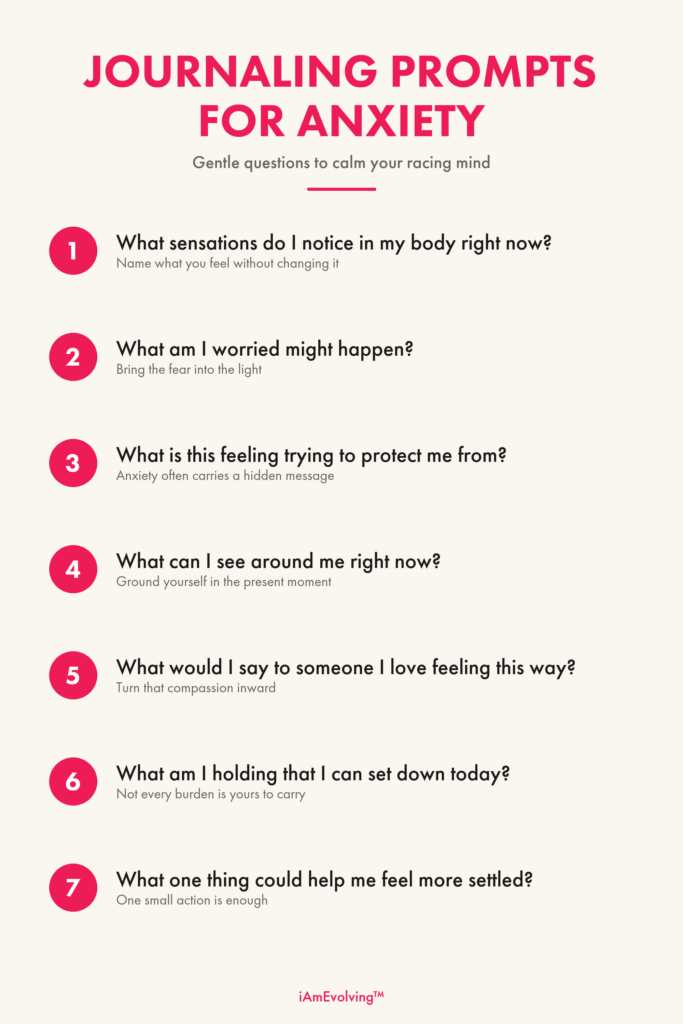
Journaling Prompts for Anxiety
The prompts below are designed to support awareness, grounding, and emotional release. They are not meant to fix anxiety, but to help you relate to it differently.
Prompts to Notice What You’re Experiencing
These prompts help you name what’s happening right now, without trying to change it.
- What sensations do I notice in my body at this moment?
- What thoughts keep returning today?
- When did I first notice this feeling?
- If I described this moment honestly, what would I say?
- What feels most unsettled or tense right now?
Prompts to Slow Racing Thoughts
Anxiety often speeds the mind up. These prompts help you slow things down.
- What am I worried might happen?
- What part of this situation is actually happening right now?
- What am I trying to control in this moment?
- If I stopped trying to solve this, what would I notice?
- What would it feel like to pause for one slow breath?
Prompts to Create Distance from Anxiety
These prompts reinforce an important truth: this experience is something you’re having, not who you are.
- If this feeling had a voice, what would it be saying?
- What is this response trying to protect me from?
- What reminds me that this moment will pass?
- What have I already handled that once felt overwhelming?
- What part of me is noticing this experience?
Grounding Prompts for the Present Moment
Grounding brings attention out of imagined futures and back into now.
- What can I see around me right now?
- What sounds do I notice?
- Where does my body feel supported?
- What feels steady or familiar today?
- What small action could help me feel slightly more settled?
Gentle Prompts for Self-Compassion
Anxiety is often accompanied by self-criticism. These prompts soften that response.
- What would I say to someone I care about feeling this way?
- How can I be kinder to myself right now?
- What does my nervous system need today?
- What am I doing my best at, even if it doesn’t feel like enough?
- What would permission to slow down look like?
Short Prompts for Intense Moments
When anxiety feels strong, simplicity helps.
- Right now, I feel…
- This moment is difficult because…
- One thing I can let go of today is…
- I don’t need all the answers to feel okay.
- This feeling will pass, even if slowly.
If you want a more structured way to explore these prompts over time, the iAmEvolving Journal offers guided reflections designed to support clarity, emotional awareness, and consistency.
Get more like this, every week
Why Anxiety Often Feels Worse When You Slow Down
Many people notice that anxiety becomes louder the moment they try to slow down. This is not a failure of the practice. When the mind has been operating in a heightened state for a long time, stillness can feel unfamiliar or even unsafe.
Anxiety is closely linked to vigilance. It scans for what might go wrong and what needs attention. When you pause, that scanning doesn’t stop immediately — it becomes more noticeable.
Journaling works not because it forces calm, but because it helps you build tolerance for noticing what’s already there. Over time, the nervous system learns that slowing down does not equal danger.
Journaling vs. Rumination
A common concern is whether journaling might turn into rumination. While both involve thinking about internal experiences, they are not the same.
Rumination loops without awareness. Journaling introduces observation. The difference lies in intention and structure.
If you notice yourself repeating the same thoughts without relief, gently shift your writing toward the present moment or the body. Even brief grounding can interrupt mental loops.
If you want to explore journaling as a broader mental health practice beyond anxiety, you may find value in journaling for mental health.
What Progress with Journaling Really Looks Like
Progress does not always look like calm. Often, it looks like awareness.
You may begin to notice anxiety sooner, recognize familiar patterns, or pause before reacting. Thoughts may still appear, but they carry less urgency once written down.
These changes are subtle, but meaningful. Journaling builds a relationship with your inner world rather than trying to control it.
When Journaling Feels Difficult
There will be days when journaling feels inaccessible. This doesn’t mean you’re doing something wrong.
If writing feels overwhelming, reduce the demand. One sentence is enough. You can describe the room you’re in, notice the temperature, or write a single word.
Journaling is a support, not an obligation. It’s okay to step away and return when it feels right.
Consistency Over Intensity
Writing a few lines regularly is often more helpful than occasional long sessions. Consistency builds familiarity, and familiarity builds safety.
Over time, journaling becomes less about prompts and more about presence. You begin to recognize what you need with less effort.
For additional insight into how writing supports calm and nervous system balance, you can also explore how journaling reduces stress and calms the mind.
A Final Reminder
Journaling for anxiety isn’t about fixing yourself. It’s about listening.
You don’t need perfect words or deep insight. You only need honesty.
With time, journaling becomes a space where anxiety can exist without taking over — and where awareness quietly does its work.
If you want to explore ways to work with emotional states more gently, you may find guidance in journaling prompts and guided writing.
Start your daily practice of gratitude, goals, and growth.
Get the Journal →A gentle 7-day reset to help you slow down, feel steadier, and reconnect — in just 5–10 minutes a day.
Start the ResetA simple introduction to daily journaling — gratitude, goals, and habits made easy.
Learn the MethodFrequently Asked Questions About Journaling Prompts for Anxiety
Can journaling really help with anxiety?
What should I write when I feel anxious?
How often should I use journaling prompts for anxiety?
Can journaling make anxiety worse?
Is it better to journal in the morning or at night?
What if I don’t know what I’m feeling?
Do I need to journal for a long time for it to work?
Will journaling make anxiety go away?