Mindfulness Journaling Prompts for Daily Calm

There are days when everything feels loud. Your thoughts race before your feet hit the floor, your to-do list hums in the background of every conversation, and by evening you realize you never once paused to check in with yourself. Mindfulness journaling prompts offer a way back to that quiet center — a few honest questions that slow you down long enough to actually notice how you feel, what you need, and what deserves your attention today.
This is not about writing perfectly or having deep revelations every time you open your journal. It is about giving yourself a few minutes of stillness, guided by a question that pulls your awareness into the present moment. Whether you are brand new to journaling or have been doing it for years, these mindfulness journaling prompts will help you build a practice rooted in calm, clarity, and honest self-awareness.
Why Mindfulness Journaling Prompts Bring You Back to Center
Mindfulness is the practice of paying attention — on purpose, without judgment — to whatever is happening right now. When you combine that with journaling, something shifts. Instead of letting your thoughts spiral or stack up unexamined, you give them a place to land. You meet yourself on the page with curiosity instead of criticism.
Research in psychology and neuroscience has shown that expressive writing reduces activity in the amygdala, the part of the brain responsible for your stress response. When you journal mindfully, you are not just venting — you are processing. You are creating space between what happens to you and how you respond to it. That space is where calm lives.
Prompts are what make this practice accessible. You do not need to know what to say or where to start. A good prompt meets you wherever you are and gently asks you to look a little closer. Over time, this builds a habit of awareness that extends beyond the journal and into the rest of your day. If you are exploring journaling for personal growth, mindfulness prompts are one of the most grounding places to begin.
How to Use These Mindfulness Journaling Prompts
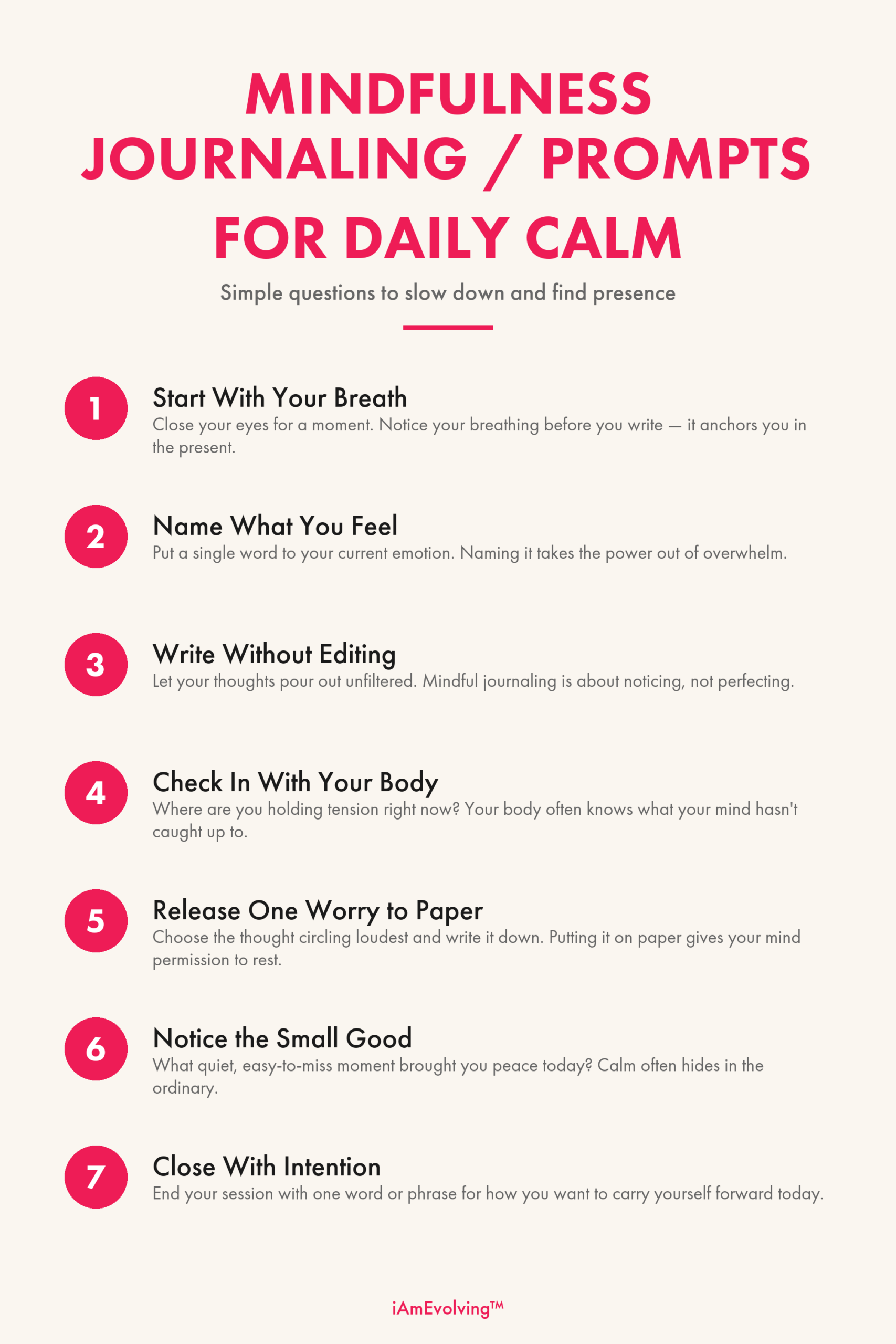
You do not need a special journal or a full hour of silence. Here are a few simple steps to cultivate a daily mindfulness journaling habit that actually sticks:
- Choose one prompt at a time. Resist the urge to answer several in one sitting. Depth matters more than volume.
- Set a gentle time limit. Five to ten minutes is enough. You are not writing an essay — you are checking in.
- Write without editing. Let your thoughts come out messy and unfiltered. There is no wrong answer.
- Start where you are. You do not need to feel calm before you begin. The calm comes through the writing itself.
- Anchor it to an existing routine. Pair your journaling with your morning coffee, your lunch break, or your evening wind-down so it becomes part of your rhythm.
- Read back with compassion. If you revisit past entries, do so with the same kindness you would offer a close friend.
If you want more structure around choosing the right prompts for your needs, explore these guided journaling prompts organized by theme and intention.
Mindfulness Journaling Prompts for Morning Awareness
Morning is when the slate is cleanest. Before the noise of the day fills in, you have a quiet window to set the tone. These prompts help you arrive in your body and in the present moment before anything else demands your attention.
- What is the first thing I notice about how I feel this morning — physically and emotionally?
- What is one thing I can do today to take care of myself, even in a small way?
- If I could carry one intention into this day, what would it be?
- What am I grateful for before the day has even begun?
- Where in my body do I feel tension, and what might it be telling me?
- What does a calm and grounded version of today look like for me?
- What thought do I want to release before I start moving through my day?
- If I could give this morning a single word, what would it be?
Get more like this, every week
Prompts for Emotional Check-Ins
Emotions do not wait for convenient moments. They show up in the middle of meetings, in traffic, at 2 a.m. These prompts give you a way to pause and name what is moving through you, without trying to fix it or push it away. That kind of honest noticing is the heart of mindfulness.
- What emotion has been following me through most of today, and when did it first show up?
- If I could name what I am feeling right now without judging it, what would I call it?
- What is one feeling I have been avoiding, and what might it be trying to tell me?
- When was the last time I felt truly at ease — and what was different about that moment?
- Am I reacting to something that is happening right now, or something I am carrying from the past?
- What would I say to a friend who was feeling the way I feel right now?
- How does my inner voice sound today — critical, gentle, tired, hopeful?
- What is one kind thing I can acknowledge about how I have handled today so far?
If anxiety tends to drive your emotional patterns, you may also find comfort in these journaling prompts for calming anxiety — they go deeper into the specific loops that keep your nervous system on alert.
Prompts for Slowing Down and Finding Stillness
Stillness is not something you have to chase. It is already there, underneath the noise. These prompts help you peel back the urgency long enough to notice it. They are especially useful on days when everything feels like it is moving too fast and you cannot find a place to land.
- What would change if I stopped rushing through this moment?
- What am I hurrying toward, and is it actually urgent?
- Where in my day can I create 60 seconds of quiet — and what would I do with that pause?
- What sound, texture, or sensation can I notice right now that I usually overlook?
- What would it feel like to do less today and still consider it enough?
- When was the last time I sat with silence, and how did it feel?
- What is one thing I am holding onto that I could set down, even temporarily?
- If stillness had a message for me today, what would it say?
If you have been craving that sense of quiet in the rest of your life too, not just on paper, take a look at this guide on finding stillness in a busy world. And if breath-based grounding appeals to you, these mindful breathing practices pair beautifully with journaling.
Mindfulness Journaling Prompts for Evening Reflection
Evening is when the day asks to be put down. These prompts help you close the loop — to look back with honesty and forward with gentleness. They are not about reviewing your productivity. They are about noticing what mattered, what you carried, and what you are ready to release before sleep.
- What moment from today do I want to remember, and why?
- What is one thing that felt heavy today — and can I set it down now?
- Did I give myself permission to rest at any point today? If not, why?
- What small, quiet thing brought me a sense of peace today?
- What am I still thinking about that I can write down and leave on this page?
- How did I show up for myself today, even imperfectly?
- What do I want to let go of before I close my eyes tonight?
- If I could thank one part of myself for getting through today, what would it be?
There is a deep connection between gratitude and mindfulness that becomes especially clear in the evening. When you notice what brought you calm — not what you achieved — your mindful journal becomes a record of presence, not performance.
Building a Daily Mindfulness Journaling Practice
Start with just one prompt a day. That is it. You do not need to fill a full page or cover every section. Choose whichever question pulls you in, set a timer for five minutes, and write. Some days you will barely scratch the surface. Other days you will surprise yourself with what comes out. Both are valuable.
Consistency matters more than length. A mindfulness journal works best when it becomes a rhythm — something your body and mind begin to expect and rely on. It does not need to be dramatic. It needs to be regular. Even three sentences written with full attention carry more weight than three pages written on autopilot.
Let the practice evolve with you. Some weeks you will be drawn to morning prompts. Other times evening reflection will feel more needed. Follow that instinct. The goal is not to complete a checklist but to stay in honest conversation with yourself. If your mind tends to spiral, try pairing this practice with journaling prompts for overthinking to untangle the noise before it builds.
Trust what shows up on the page. You are not writing to impress anyone. You are writing to listen. And in that listening, something shifts. The day feels a little less heavy. The next step feels a little more clear. That is what a daily mindfulness journaling practice offers — not perfection, but presence.
You do not need to overhaul your life to feel calmer. You just need a few honest questions and the willingness to sit with them. These mindfulness journaling prompts are not about fixing anything. They are about noticing — what is here, what is real, what matters. And that noticing, done consistently, becomes the foundation for a quieter mind and a more grounded life. Start with one prompt today. Let it meet you where you are. That is more than enough.
Start your daily practice of gratitude, goals, and growth.
Get the Journal →A gentle 7-day reset to help you slow down, feel steadier, and reconnect — in just 5–10 minutes a day.
Start the ResetA simple introduction to daily journaling — gratitude, goals, and habits made easy.
Learn the MethodWhat are mindfulness journaling prompts?
How long should I journal for mindfulness?
Can mindfulness journaling help with anxiety?
What is the best time for mindfulness journaling?