
The science of gratitude has moved far beyond feel-good advice and motivational quotes. Over the past two decades, psychologists and neuroscientists have studied gratitude with the same rigor they apply to depression, anxiety, and cognitive performance. What they have found is remarkable. Gratitude is not just an emotion you feel when something nice happens. It is a measurable psychological state that changes brain chemistry, strengthens the immune system, and reshapes how you experience daily life. When you understand the research, practicing gratitude stops feeling like a soft suggestion and starts feeling like a serious tool for well-being.
If you have ever dismissed gratitude as too simple to make a real difference, the evidence might surprise you. Scientists at institutions like UC Berkeley, Indiana University, and the University of California, Davis have published hundreds of peer-reviewed studies showing that gratitude practice produces concrete, measurable results. This is not theory. These are findings backed by brain scans, controlled experiments, and longitudinal data.
The Science of Gratitude: What Happens in Your Brain
When you experience genuine gratitude, two key areas of your brain light up. The first is the medial prefrontal cortex, which is involved in decision-making, learning, and reward processing. The second is the anterior cingulate cortex, which plays a role in emotional regulation and empathy. These are not minor brain regions. They are central to how you process experiences and relate to others.
A landmark study from the National Institutes of Health found that participants who thought about what they were grateful for showed higher activity in the hypothalamus, the part of the brain that controls eating, sleeping, and stress hormones. When your hypothalamus functions well, you sleep better, manage stress more effectively, and maintain a more stable metabolism. Gratitude, in other words, communicates directly with the parts of your brain responsible for keeping you healthy.
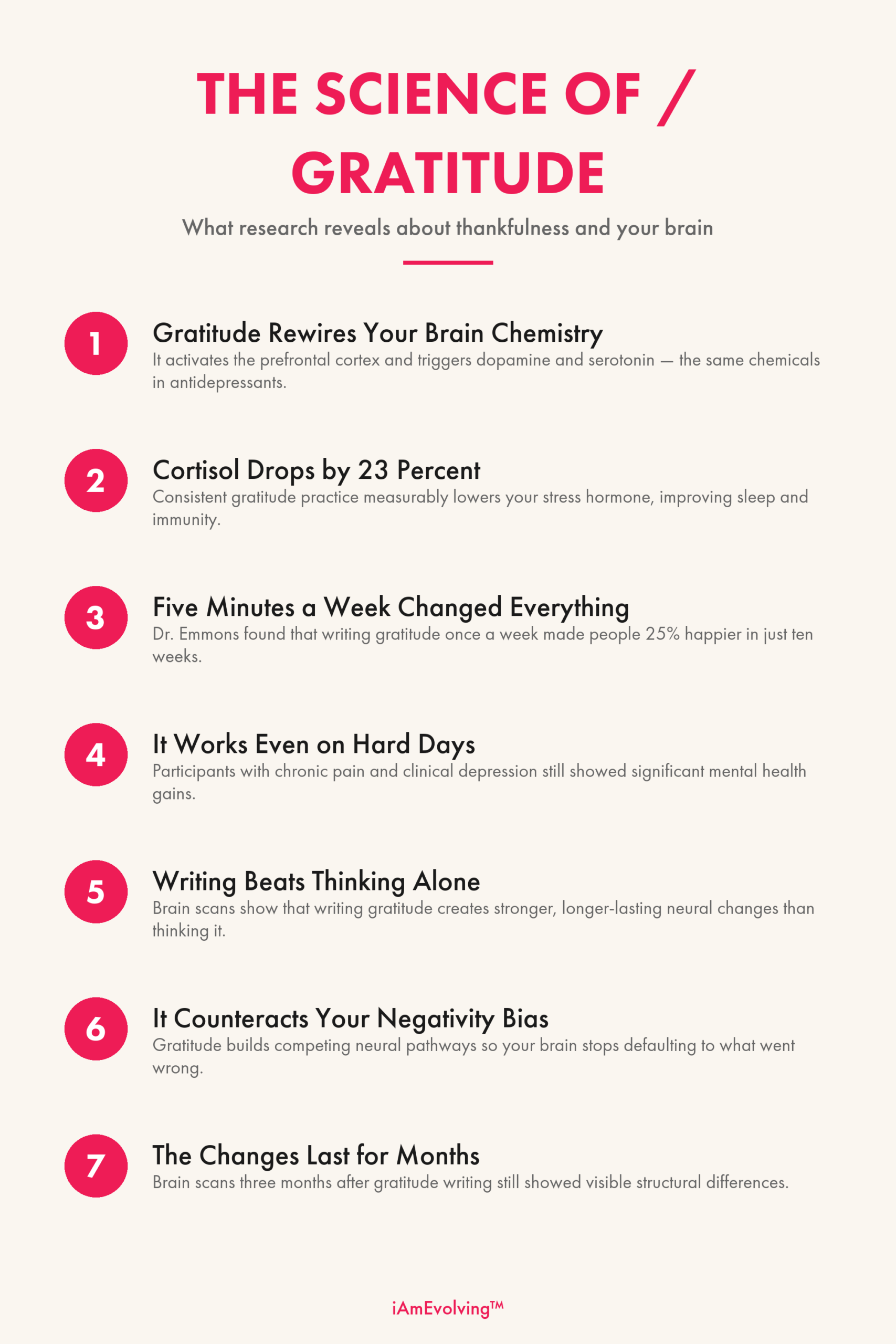
Gratitude also triggers the release of dopamine and serotonin. These neurotransmitters are the same ones targeted by many antidepressant medications. When you practice gratitude consistently, you create a natural supply of these chemicals. This does not mean gratitude replaces medical treatment. It means it supports the same biological systems that keep your mood stable.
Dr. Robert Emmons and the Gratitude Research Project
Dr. Robert Emmons at the University of California, Davis is considered the leading scientific authority on gratitude. His research, spanning more than fifteen years, provides some of the most cited evidence for why gratitude practice works.
In one of his most well-known studies, Emmons divided participants into three groups. The first group wrote about things they were grateful for each week. The second group wrote about things that irritated or bothered them. The third group wrote about events that affected them without any positive or negative framing. After ten weeks, the gratitude group reported feeling 25 percent happier than the other groups. They exercised more. They had fewer physical complaints. They were more optimistic about the coming week.
What makes this study powerful is that the gratitude group did not have easier lives. They had the same range of difficulties as everyone else. The difference was where they directed their attention. That simple redirection, five minutes a week of writing about what went well, produced measurable improvements in both mental and physical health.
Emmons later replicated these findings with people living with neuromuscular disease. Even in populations dealing with chronic pain and disability, gratitude journaling improved mood, sleep quality, and sense of connection. The benefits were not limited to healthy, privileged populations. They worked across a wide range of life circumstances.
How Gratitude Affects Your Body
The science of gratitude extends well beyond mental health. Researchers have found that grateful people have stronger immune systems, lower blood pressure, and fewer aches and pains. A study published in the journal Personality and Individual Differences found that people who scored higher on gratitude measures reported better physical health and were more likely to take care of themselves through exercise and regular medical check-ups.
Gratitude also lowers cortisol. Cortisol is your body’s primary stress hormone. When it stays elevated for long periods, it contributes to weight gain, sleep disruption, weakened immunity, and increased anxiety. Studies from the Institute of HeartMath found that people who practiced gratitude and appreciation had a 23 percent reduction in cortisol levels. Their heart rhythms became more coherent, a pattern associated with calm, focused states.
These physical changes explain why people who keep a daily gratitude journal often report sleeping better within the first few weeks. When your cortisol drops and your serotonin rises, your body naturally settles into more restful sleep patterns. You are not forcing relaxation. You are creating the internal conditions for it.
Get more like this, every week
Mindful insights, journaling prompts, and subscriber-only content — straight to your inbox.
Gratitude and the Negativity Bias
Your brain is wired to pay more attention to negative experiences than positive ones. Psychologists call this the negativity bias, and it is one of the most well-established findings in cognitive science. Negative events are processed more thoroughly, remembered more vividly, and weighted more heavily in decision-making than equivalent positive events.
From an evolutionary perspective, this makes sense. Noticing threats kept your ancestors alive. But in modern life, the negativity bias means you dwell on criticism while forgetting compliments. You remember the one thing that went wrong in a day full of things that went right. You feel anxious about the future even when the present is stable.
Gratitude is one of the few practices shown to directly counteract the negativity bias. When you deliberately focus on what is good, you create competing neural pathways. Over time, with consistent practice, these pathways become stronger. Your brain does not stop noticing problems, but it balances that awareness with an equal ability to notice what is working. Neuroscientists describe this as experience-dependent neuroplasticity. Your repeated experiences change the structure of your brain itself.
The Indiana University Letter-Writing Study
One of the most fascinating gratitude studies comes from Indiana University. Researchers worked with nearly 300 adults who were seeking counseling for anxiety and depression. They divided participants into three groups. All three groups received counseling. The first group also wrote gratitude letters to other people once a week for three weeks. The second group wrote about their negative experiences and feelings. The third group only received counseling with no writing assignment.
The results were striking. The gratitude letter group reported significantly better mental health four weeks after the writing exercise ended. By twelve weeks, the difference was even more pronounced. Brain scans taken three months later showed that the gratitude group had distinctly different patterns of brain activity. Their medial prefrontal cortex showed greater activation when experiencing gratitude, suggesting that the practice had created lasting neural changes.
Two findings from this study are especially important. First, the benefits of gratitude writing were not immediate. They built over time. Participants did not feel dramatically different during the first week, but by the third month, the changes were clear. Second, the gratitude practice worked even for people dealing with clinical-level anxiety and depression. It was not just helpful for people who were already doing well.
How to Apply the Science to Your Daily Life
The research points to several practical principles for making gratitude work:
- Be specific. Writing “I am grateful for my health” every day does not engage your brain the way writing “I am grateful I could walk to the park today and feel the sun on my face” does. Specificity activates memory and emotion.
- Be consistent. The benefits of gratitude build over time. Daily practice for a few minutes is more effective than long sessions once a week.
- Write it down. Thinking grateful thoughts is helpful, but writing them down produces stronger results. The act of writing engages different neural circuits and makes the experience more concrete.
- Include others. Gratitude that involves other people, appreciating what someone did for you, noticing kindness, produces stronger emotional and social benefits than gratitude focused only on circumstances.
- Be patient. The Indiana University study showed that the biggest benefits appeared weeks or months after the practice began. Trust the process even when the early days feel unremarkable.
The iAmEvolving Journal builds these principles directly into your daily routine. Each day includes a dedicated space for gratitude reflection that encourages specificity and consistency without overwhelming you. When the structure is already there, all you have to do is show up and write.
Why Writing Gratitude Works Better Than Thinking It
You might wonder whether thinking about gratitude is enough, or whether you actually need to write it down. The research is clear. Writing produces stronger and more lasting effects than mental reflection alone.
When you write, you slow down your thinking process. You translate abstract feelings into concrete words. This translation process engages your prefrontal cortex more fully and creates a more detailed memory of the experience. It also forces you to commit to a specific statement rather than letting a vague feeling drift through your mind.
A study from the Greater Good Science Center at UC Berkeley found that participants who wrote gratitude letters showed neural differences visible on brain scans even three months after the writing stopped. Their brains had literally changed in response to the practice. Participants who only thought about gratitude did not show the same degree of change.
This is why gratitude journaling is more effective than gratitude meditation or gratitude affirmations alone. The physical act of writing anchors the experience in your body and your brain. It turns a fleeting thought into a permanent record you can return to on difficult days.
Gratitude Is a Skill You Can Build
Perhaps the most encouraging finding from gratitude research is that gratitude is not a fixed trait. You are not born grateful or ungrateful. Gratitude is a capacity that grows with practice, like a muscle that gets stronger the more you use it. Even people who describe themselves as naturally pessimistic or cynical have shown significant improvements after consistent gratitude practice.
This matters because it means you are not stuck. If gratitude does not come naturally to you right now, that is normal. Your brain has simply been trained to focus elsewhere. With deliberate daily practice, you can retrain it. The science says so, and the evidence is strong enough that many therapists and counselors now include gratitude exercises in their treatment protocols.
Start where you are. One thing. One honest moment of appreciation each day. The science will do the rest over time. If you want a deeper look at how gratitude fits into a complete daily practice, the gratitude journaling guide maps the full path. Your brain is already designed to change in response to what you practice. Give it something worth practicing.
Not sure where to begin? Start with a simple reset — then continue when you're ready.
FAQ: The Science of Gratitude
Is there real scientific evidence that gratitude works?
How does gratitude change your brain chemistry?
Is writing gratitude better than just thinking about it?
Can gratitude help with anxiety and depression?