Bedtime Affirmations for Deep, Restful Sleep

Bedtime affirmations for sleep are calming statements you repeat before bed to quiet a racing mind and prepare your body for rest. When your head hits the pillow and thoughts refuse to stop, affirmations offer something peaceful to hold onto.
This practice isn’t about forcing positive thoughts or pretending everything is fine. It’s about giving your mind something calm to hold onto as you transition from the noise of the day into the stillness of night. When you speak or think words of peace before sleep, you’re training your brain to associate bedtime with safety, calm, and release. Over time, this simple ritual can reshape how you experience rest — and how deeply you actually sleep.
Why Bedtime Affirmations for Sleep Work
Your mind doesn’t automatically know when to stop processing the day. Without a clear signal, it continues running — analyzing, planning, worrying. Bedtime affirmations act as that signal. They tell your brain: the day is done, and it’s safe to let go now.
Research in cognitive psychology shows that the thoughts you hold before sleep influence both sleep quality and how you feel upon waking. Repetitive negative thinking at night is linked to insomnia and poor sleep architecture. Affirmations work in the opposite direction — they interrupt the worry loop and replace it with calming, present-focused statements that lower cortisol and activate the parasympathetic nervous system.
This isn’t magic. It’s neuroplasticity in action. The more you repeat calming thoughts at bedtime, the more your brain builds pathways that associate nighttime with peace rather than anxiety. If you’ve ever noticed how writing before bed calms your mind, affirmations work through a similar mechanism — they externalize internal noise and give your thoughts a gentler direction.
How to Practice Bedtime Affirmations
You don’t need a complicated ritual. The simplest approach is often the most effective. Here’s how to begin:
1. Create a transition moment. Before you start your affirmations, take three slow breaths. This signals to your body that you’re shifting from doing mode to resting mode. Place one hand on your chest or stomach if it helps you feel grounded.
2. Choose 3-5 affirmations. You don’t need dozens. A handful of statements that feel true and calming is enough. Speak them silently or whisper them aloud — whatever feels natural.
3. Repeat slowly. Let each affirmation land before moving to the next. This isn’t a race. The slower you go, the more your nervous system absorbs the message.
4. Pair with breath. Inhale before each affirmation, then speak or think it on the exhale. This connects the words to your body’s natural calming rhythm.
5. Release expectations. You don’t need to feel instantly peaceful. Some nights will feel easier than others. The practice itself is what matters — not the immediate result.
30 Bedtime Affirmations for Deep, Restful Sleep
Choose the affirmations that resonate most with you. You might use the same ones each night to build consistency, or rotate based on what you need. There’s no wrong way to do this.
Affirmations for Releasing the Day
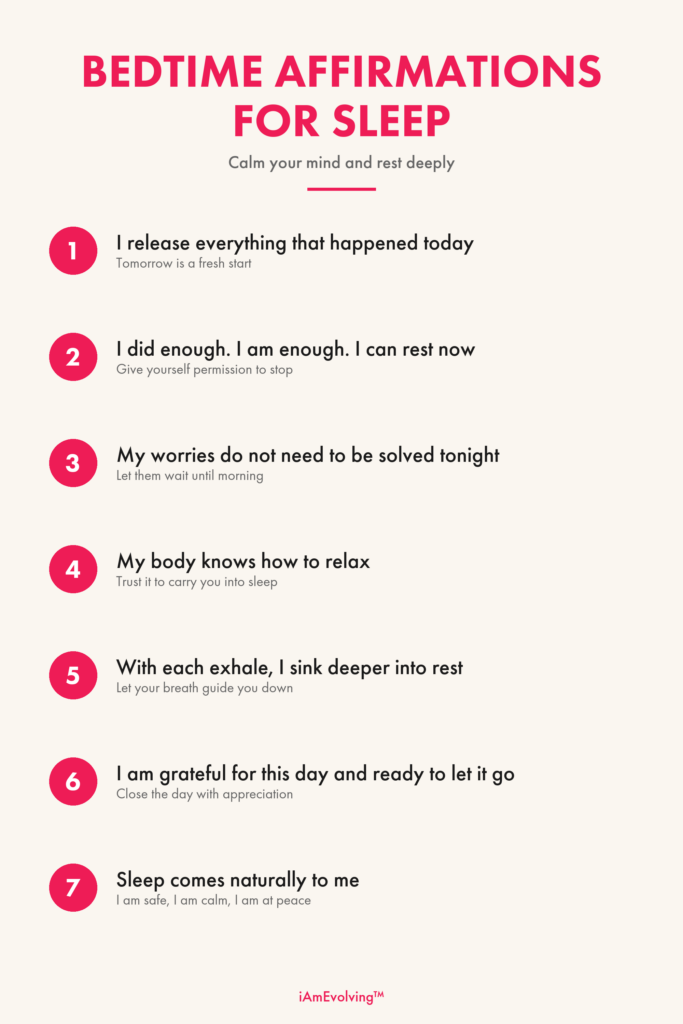
- I release everything that happened today. Tomorrow is a fresh start.
- I did enough. I am enough. I can rest now.
- I let go of what I cannot control.
- Today is complete. I give myself permission to stop.
- I forgive myself for any mistakes. I am learning and growing.
- Whatever didn’t get done can wait. My rest matters.
Affirmations for Calming Anxiety
- I am safe in this moment. Nothing requires my attention right now.
- My worries do not need to be solved tonight.
- I choose peace over panic. I choose rest over rumination.
- My body knows how to relax. I trust it to carry me into sleep.
- I release tension from my mind, my shoulders, my chest.
- Calm washes over me with every breath.
If anxiety is a regular visitor at bedtime, you might also find comfort in affirmations specifically designed for healing and inner peace. The key is consistency — repeating these words night after night until they become your mind’s default at rest.
Affirmations for Physical Relaxation
- My body is heavy, warm, and ready for sleep.
- I feel my muscles softening, my breath slowing.
- With each exhale, I sink deeper into rest.
- Sleep comes naturally to me. My body knows what to do.
- I welcome the heaviness in my limbs. It means rest is near.
- Every cell in my body is relaxing now.
Affirmations for Self-Compassion
- I am worthy of rest, even when I feel unproductive.
- I don’t need to earn sleep. It is my birthright.
- I am gentle with myself as I close this day.
- I accept myself fully, including the parts still healing.
- I deserve peace. I deserve sleep. I deserve to feel whole.
- I honor my need for rest without guilt or apology.
Affirmations for Trust and Surrender
- I trust that everything is working out, even while I sleep.
- I surrender this day to the universe. It is no longer mine to carry.
- I trust the process of rest and renewal.
- While I sleep, my mind and body heal.
- I wake renewed, refreshed, and ready for a new day.
- Sleep is a gift I gratefully receive.
Get more like this, every week
Building a Nightly Affirmation Ritual
Affirmations work best when they’re part of a consistent routine. Your brain responds to patterns — when you repeat the same calming sequence each night, your nervous system begins to anticipate rest before you even lie down.
Consider pairing your affirmations with other calming practices:
- Evening journaling. Write down three things you’re grateful for, then transition into your affirmations. An evening journaling routine creates the mental space for affirmations to land more deeply.
- Mindful breathing. Practice mindful breathing techniques for two to three minutes before your affirmations. This primes your body for relaxation.
- Gratitude reflection. End your day by naming what went well. An evening gratitude ritual shifts your focus from problems to presence.
The goal is to create a wind-down sequence that your body learns to recognize. Over time, simply beginning your routine will trigger relaxation — your brain will know that sleep is coming.
What to Do When Affirmations Feel Hollow
Some nights, the words might feel empty. You might repeat “I am calm” while your heart races. This is normal — and it doesn’t mean the practice isn’t working.
Affirmations aren’t about believing every word instantly. They’re about giving your mind a different script to run. Even if part of you resists, another part is listening. Over time, the resistant voice quiets and the affirmations take root.
If a particular affirmation feels too far from your current state, try softening it:
- Instead of “I am completely at peace,” try “I am open to feeling peace.”
- Instead of “I release all worry,” try “I am learning to release worry.”
- Instead of “I sleep deeply every night,” try “I am building the habit of restful sleep.”
These softer versions acknowledge where you are while gently pointing toward where you want to be. They feel more honest — and honesty helps affirmations land.
The Connection Between Sleep and Inner Harmony
Sleep isn’t separate from your emotional wellbeing — it’s foundational to it. When you sleep poorly, everything feels harder. Emotions run hotter. Patience runs thin. The small stresses of life feel overwhelming.
Bedtime affirmations address this at the source. By calming your mind before sleep, you improve the quality of your rest. And when you rest well, you wake with more capacity for inner harmony — the emotional balance that helps you navigate whatever the day brings.
This creates a positive cycle. Better sleep leads to better emotional regulation. Better emotional regulation makes it easier to fall asleep. Affirmations are one simple tool that can set this cycle in motion.
Using a Journal for Bedtime Affirmations
While you can practice affirmations silently, writing them down adds another layer of effectiveness. When you write an affirmation, you engage more of your brain — the visual, motor, and cognitive systems all participate. This deepens the imprint.
Try keeping a journal on your nightstand. Before sleep, write your three to five chosen affirmations by hand. Don’t rush. Let each word flow slowly. This physical act of writing becomes part of your wind-down ritual, signaling to your body that the day is truly done.
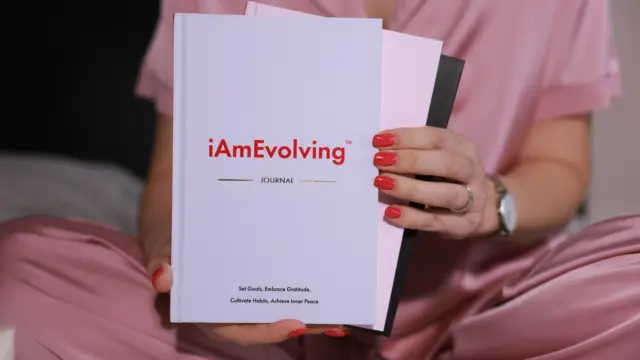
The iAmEvolving Journal includes dedicated space for evening reflection and intention-setting — a natural place to incorporate your bedtime affirmations alongside gratitude and daily review.
Start Tonight
You don’t need to wait for the perfect moment or the perfect words. Tonight, choose one affirmation from this list. Just one. Repeat it slowly as you lie in bed, matching it to your breath. Notice what happens — not with expectation, but with curiosity.
Tomorrow night, try two. Build from there. Within a week, you’ll have a small collection of phrases that feel like yours — words that your mind reaches for automatically when it’s time to rest.
Sleep is not a luxury. It’s the foundation everything else rests upon. And you deserve to rest well.
For a complete approach to building affirmations into your daily rhythm, explore our guide to daily affirmation rituals.
Start your daily practice of gratitude, goals, and growth.
Get the Journal →A gentle 7-day reset to help you slow down, feel steadier, and reconnect — in just 5–10 minutes a day.
Start the ResetA simple introduction to daily journaling — gratitude, goals, and habits made easy.
Learn the MethodFAQ: Bedtime Affirmations for Sleep
Do bedtime affirmations actually help you sleep?
How many affirmations should I use before bed?
Should I say affirmations out loud or silently?
What if I don’t believe the affirmations I’m saying?