Journaling for Overthinking: A Practical Way to Slow Your Mind

Overthinking is not a sign that something is wrong with you. It is a sign that your mind is trying to solve a problem it cannot solve by thinking alone. The thoughts loop because they have nowhere to go. They bounce between the same worries, the same what-ifs, the same replayed conversations, searching for resolution that never comes. Journaling for overthinking works because it gives those thoughts a destination. When you write them down, they stop circling and start settling. The loop breaks. The mind quiets. Not because the problem disappears, but because the thoughts finally have somewhere to land.
If you have tried to stop overthinking by sheer willpower, you already know it does not work. Telling yourself to stop thinking about something is like telling yourself not to picture a red car. The instruction itself reinforces the thought. Journaling takes a completely different approach. Instead of fighting your thoughts, you give them space. You write them out, look at them on the page, and realize they are not as powerful as they felt when they were locked inside your head. This is practical, evidence-based, and available to you right now with nothing more than a pen and a blank page. Whether you are new to writing or already have a journaling foundation, this approach meets you where you are. It sits within a broader understanding of how journaling supports mental health, and it gives you something you can use tonight.
Why Your Brain Gets Stuck in Overthinking Loops
Overthinking is technically called rumination, and psychologists have studied it extensively. Rumination happens when your brain identifies something as unresolved, a threat, a decision, a conflict, an unanswered question, and keeps returning to it in an attempt to find a solution. The problem is that most of the things we overthink do not have clear solutions. They involve uncertainty, ambiguity, or situations beyond our control.
Your prefrontal cortex, the rational thinking part of your brain, keeps trying to analyze the situation. But without new information or a clear path forward, the analysis just repeats itself. Meanwhile, your amygdala, the emotional alarm center, stays activated because the threat feels unresolved. This creates a feedback loop: your thinking brain keeps thinking, your emotional brain keeps alerting, and neither one finds rest.
Writing disrupts this loop in a specific way. When you transfer thoughts from your mind to the page, you engage different neural circuits. You move from abstract rumination to concrete language. You shift from internal recycling to external processing. Your brain treats the written thought differently than the mental thought. It registers it as captured, addressed, and placed. The urgency decreases because the thought has been acknowledged rather than suppressed.
Journaling for Overthinking: The Basic Approach
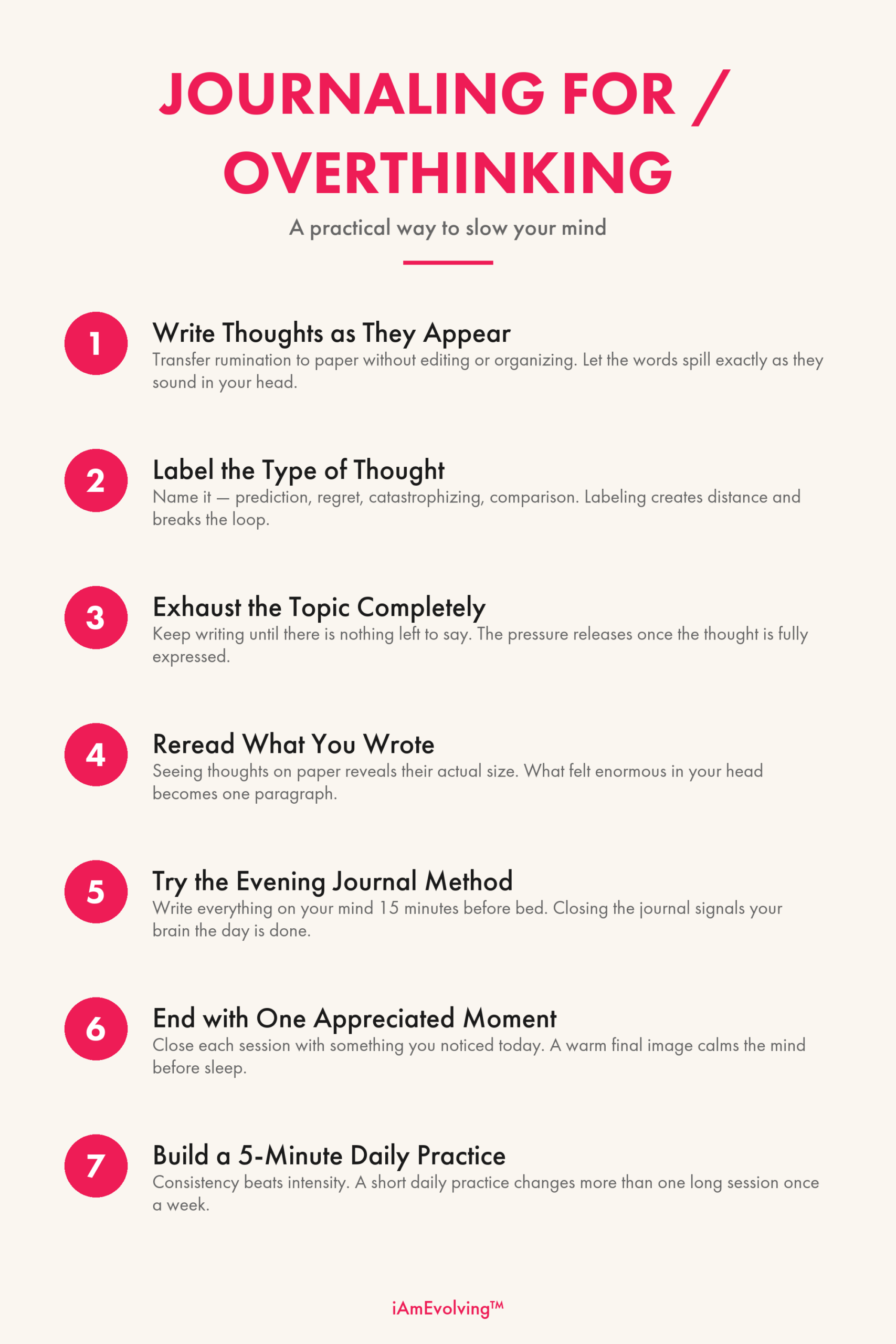
The simplest way to journal for overthinking is to write the thought that is bothering you, exactly as it appears in your mind, and then keep writing until you run out of things to say about it. Do not organize. Do not edit. Do not try to be insightful. Just let the thought pour out in its full, messy, repetitive form.
This might look like:
I keep thinking about what she said at the meeting. It felt dismissive. Maybe she did not mean it that way. But it felt like she was saying my idea was not good enough. I keep replaying the moment. I wish I had said something different. I do not know if I should bring it up or let it go. If I bring it up, it might make things awkward. If I do not, I will keep thinking about it. I hate that this is taking up so much space in my head.
That paragraph is not polished. It is not resolved. But it is out. And once it is on the page, your brain does not need to hold it with the same intensity. The thought has been heard. It has been expressed. The internal pressure releases, not completely, but enough to create breathing room.
After writing, reread what you wrote. Often, seeing the thought in writing reveals its actual size. The thing that felt enormous and all-consuming looks like one paragraph. That shift in perspective is immediate and powerful.
The Thought Labeling Technique for Overthinking
One of the most effective journaling methods for overthinking is thought labeling. Instead of arguing with your thoughts or trying to fix them, you simply name what type of thought you are having. Write the thought down, then label it in brackets. Is it a worry? A prediction? A regret? A comparison? A self-criticism?
For example:
- “She probably thinks I said something stupid at lunch.” [prediction]
- “I should have handled the meeting differently.” [regret]
- “What if the project fails and I lose credibility?” [catastrophizing]
- “Everyone else seems to have it together except me.” [comparison]
- “I always mess things up when it matters.” [self-criticism]
Labeling your thoughts creates immediate psychological distance. You shift from being inside the thought to observing it from the outside. Your brain treats a labeled thought differently than an unlabeled one. Once you see “this is a prediction, not a fact,” the emotional grip loosens. You do not need to disprove the thought or replace it with something positive. You just need to see it clearly for what it is.
After labeling five to ten thoughts, you will often notice that most of your overthinking falls into just two or three categories. Maybe you are mostly catastrophizing. Maybe you are mostly regretting. That pattern is valuable information. It tells you where your mind defaults under stress, and awareness of that default is the first step toward changing it. If you want specific prompts to guide this process further, targeted journaling prompts for overthinking can give your practice more structure.
Get more like this, every week
The Evening Journaling Method for Quieting Your Mind Before Sleep
Overthinking is often worst at night. When the distractions of the day fall away and you are alone with your thoughts, the loops intensify. Racing thoughts before bed are one of the most common causes of insomnia, and night journaling is one of the most effective remedies.
Fifteen minutes before bed, sit with your journal and write everything that is on your mind. Do not filter. Do not organize. Dump every worry, every unfinished task, every lingering thought onto the page. Then close the journal. Physically closing the journal signals to your brain that these thoughts have been captured and will be there tomorrow. You do not need to carry them into sleep.
A study published in the Journal of Experimental Psychology found that participants who wrote a to-do list before bed fell asleep significantly faster than those who wrote about tasks they had already completed. The act of writing future concerns and unfinished items externalized the cognitive load, allowing the brain to disengage from problem-solving mode and transition into rest.
You can strengthen this practice by ending your writing with one thing you appreciate from the day. This is not about forcing positivity. It is about giving your brain a final image to hold as you fall asleep, something warm and real rather than something anxious and unresolved.
Why Journaling Works Better Than Talking for Overthinking
Talking about what is bothering you can be helpful, but for overthinkers, it sometimes makes things worse. When you verbalize an overthinking spiral to a friend, you often just repeat the loop out loud. You re-experience the anxiety without processing it differently. And if the friend offers advice you are not ready to hear, you add their perspective to your already crowded mental space.
Journaling is different because it is a conversation with yourself that moves at the speed of your hand. Writing is slower than thinking, which forces your brain to organize thoughts sequentially rather than all at once. This sequential processing is what breaks the loop. You cannot write in circles as easily as you can think in circles. The pen pulls you forward.
Writing also gives you a record. When the same worry returns next week, you can open your journal and see that you already addressed it. You can read your own rational response instead of rebuilding it from scratch. Over time, your journal becomes a library of your own wisdom, a resource you can return to whenever the overthinking starts again.
Building a Consistent Practice to Manage Overthinking Long-Term
Journaling for overthinking is not a one-time fix. It is a practice that gets more effective the more you use it. Over weeks and months, you start to notice patterns. You see that certain triggers produce the same spirals. You recognize the thoughts that always lead nowhere. This awareness is the beginning of change. You cannot interrupt a pattern you cannot see.
To build a sustainable practice:
- Keep your journal in the same place so it is always accessible when overthinking hits
- Set a minimum of five minutes rather than a page count, which removes the pressure of writing a lot
- Use the same time each day, either morning or evening, to create a habit loop your brain can rely on
- Review your entries weekly to spot recurring themes and patterns
- Be patient with yourself on days when the writing does not feel productive, since the act of writing is productive even when it does not feel that way
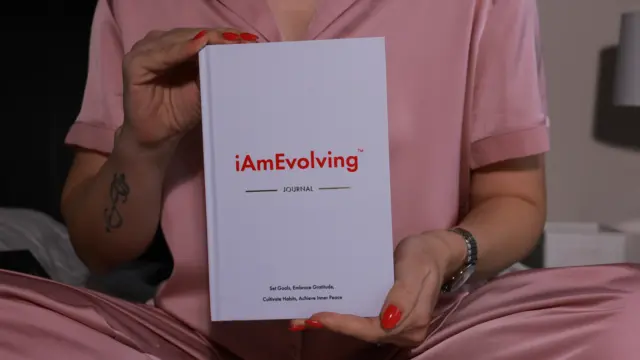
The iAmEvolving Journal provides a daily structure that supports this kind of reflective practice. By guiding you through gratitude, goal-setting, and emotional reflection each day, the journal creates a natural space for processing the kind of thoughts that would otherwise loop endlessly. When you have a structured place to put your thoughts, they stop ambushing you at random moments throughout the day.
Overthinking is not a character flaw. It is a sign that your mind is working hard on something it needs help with. Give it the help it is asking for. Open the journal. Write the thoughts down. Let the page hold what your mind cannot carry alone. The loop does not break through willpower. It breaks through expression. Write it out. Watch it settle. Then move on. For a complete look at how journaling serves every part of your inner life, explore the full journaling guide.
Start your daily practice of gratitude, goals, and growth.
Get the Journal →A gentle 7-day reset to help you slow down, feel steadier, and reconnect — in just 5–10 minutes a day.
Start the ResetA simple introduction to daily journaling — gratitude, goals, and habits made easy.
Learn the Method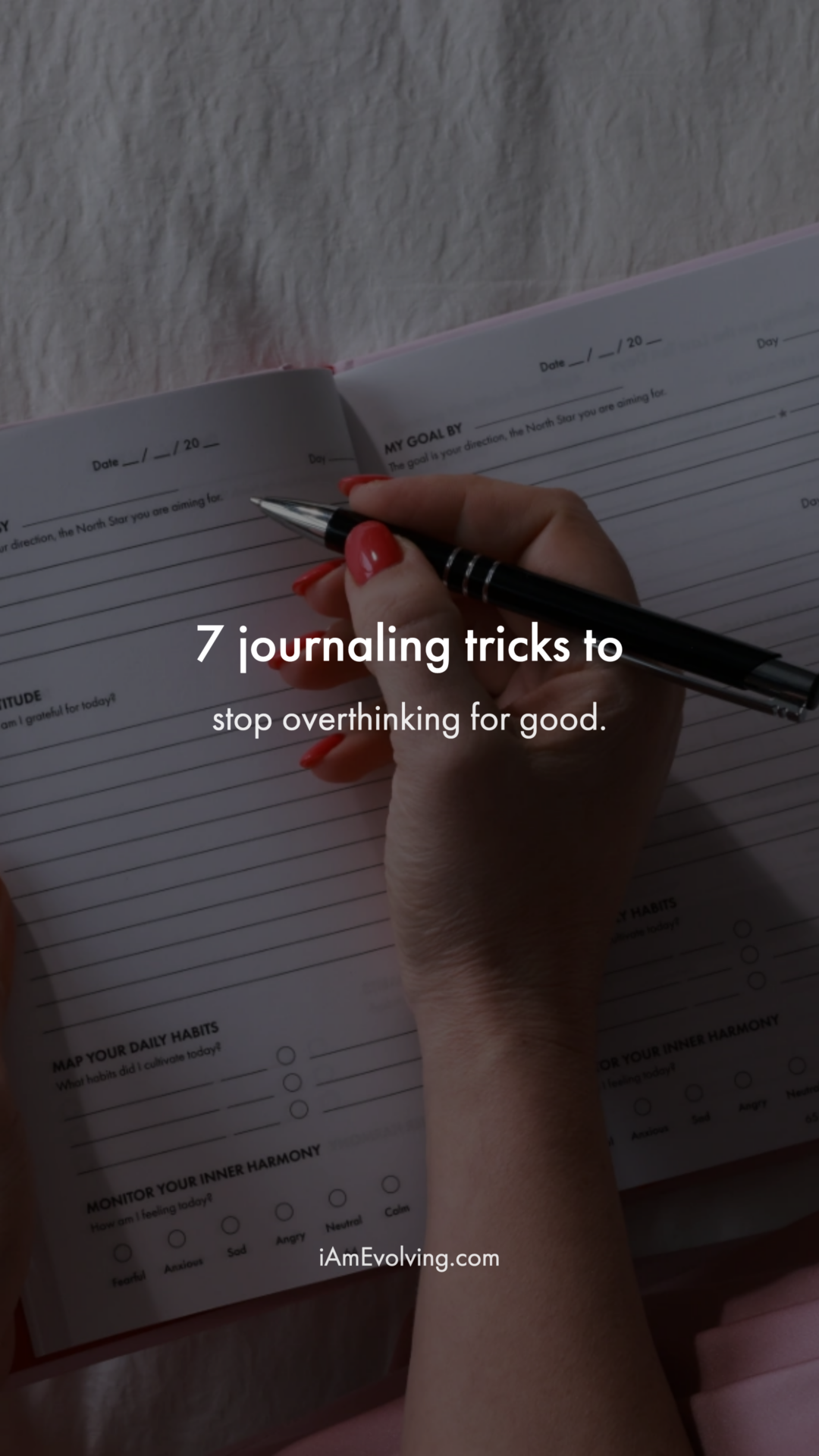
FAQ: Journaling for Overthinking
Does journaling actually help with overthinking?
How long should I journal when I am overthinking?
Should I journal in the morning or at night for overthinking?
What if writing about my worries makes me feel worse?