How Journaling Improves Focus and Productivity

In a world full of distractions, staying focused and productive can feel like an uphill battle. Between constant notifications, mental clutter, and shifting priorities, it’s easy to lose track of what truly matters.
Journaling is one of the simplest, most effective ways to regain control of your attention. By writing things down, you clear mental space, prioritize intentionally, and structure your day for meaningful work.
If you want a complete guide that helps you use journaling to sharpen your focus, improve your productivity, and bring more clarity into your daily life, explore my full guide on The Ultimate Journaling Guide. It will show you how to turn writing into a powerful mental reset that keeps you organized, intentional, and aligned.
Why Focus and Productivity Decline
Most people don’t lack time. They lack clarity. When your mind is crowded with ideas, to-dos, worries, and goals, it’s difficult to focus deeply. You end up reacting to whatever is loudest instead of moving toward what’s important.
Journaling helps because it acts like a mental filter. It takes the chaos in your head and turns it into clear, actionable priorities on paper.
How Journaling Improves Focus
When you journal daily, you:
- Offload mental clutter, so your brain can concentrate on the present task.
- Clarify priorities by identifying your most important goals.
- Reduce distractions through intentional planning.
- Train your attention : writing helps your brain focus on what you write about.
- Create space for reflection, so you don’t get lost in constant reactivity.
This clarity translates into sharper focus throughout your day.
How Journaling Boosts Productivity
Productivity isn’t about doing more. It’s about doing what matters consistently. Journaling supports productivity by:
- Helping you plan your day effectively
- Breaking big goals into manageable steps
- Encouraging accountability through written intentions
- Tracking progress over time, which reinforces momentum
Your journal becomes your daily compass, not just a place for thoughts, but a tool for directed action.
The Science Behind Journaling and Attention
Your focus isn’t just a matter of willpower. It depends on how much your working memory is carrying at any moment. Working memory is the small mental workspace that holds whatever you’re actively thinking about, and it fills up fast. Every unfinished task, half-formed worry, and “don’t forget” reminder takes up a slot. When that space is crowded, there’s little room left to concentrate on the work in front of you.
Writing things down lightens that load. The moment a thought lives on paper, your brain no longer has to keep rehearsing it to remember it. Psychologists call this offloading, and it’s one of the reasons a few minutes of journaling can make the rest of your day feel clearer. You’re not adding another task. You’re freeing up the mental bandwidth you need to do the tasks that matter.
Journaling also shifts you out of reactive mode. Instead of bouncing between alerts and impulses, you slow down long enough to notice what you’re actually doing and why. Over time, that repeated act of pausing and reflecting strengthens the habit of directing your own attention. If you’re curious about what happens in the brain when you write, this deeper look at how journaling rewires your brain explains the mechanics behind the calm.
Get more like this, every week
Simple Journaling Practices to Stay Focused
1. Start Each Morning with a Clear Goal
Write down one meaningful goal for the day. This gives you a clear anchor for your focus.
2. Brain Dump and Organize
Spend 5 minutes writing down everything on your mind, then identify what truly matters. Eliminate or postpone the rest.
3. Reflect at the End of the Day
Take a few minutes to review what worked, what didn’t, and what you’ll carry into tomorrow. Reflection improves clarity for the next day.
Using Journaling to Beat Distraction and Procrastination
Most procrastination isn’t laziness. It’s avoidance of a feeling: the task feels too big, too unclear, or too uncomfortable to start. Journaling gives you a quiet place to name that resistance instead of acting on it. When you write a single line like “I’m avoiding this because I don’t know where to begin,” the task stops being a vague cloud of dread and becomes a problem you can actually solve.
From there, the fix is usually small. Write down the very next physical action the task requires, not the whole project, just the first step you could take in two minutes. A blurry “work on the report” becomes “open the document and write the first heading.” That clarity is what moves you from stuck to started, and it’s far easier to find on paper than in a racing mind.
Distraction works the same way. When you feel the pull toward your phone, jot the urge in your journal and keep working. Naming the impulse weakens its grip and shows you your patterns over a week. Much of this comes down to managing the emotions underneath the distraction, which is why journaling for emotional clarity pairs so naturally with sharper focus.
Build a Journaling Routine That Actually Sticks
The focus benefits of journaling compound only when the practice is consistent. The good news is that consistency comes from keeping it small, not from forcing long sessions. Two or three honest lines a day will do more for your attention than a heroic page you write once and then abandon. Tie the habit to something you already do, like your morning coffee or closing your laptop at night, so it has a natural anchor.
Timing matters less than rhythm, and both ends of the day serve a purpose. A short morning journaling routine sets a clear intention before the noise begins, while an evening journaling routine helps you close open loops so your mind can rest instead of replaying the day. Pick the one that fits your life and start there.
Expect a few missed days. They’re part of the process, not proof that you’ve failed. What keeps the practice alive is returning to it without guilt and making the entry small enough that showing up feels easy. If you want a steady framework for that, this guide on how to build a journaling habit walks through the steps that turn a good intention into a routine you actually keep.
A Five-Minute Focus Journaling Session You Can Try Today
If the idea of journaling still feels abstract, here’s a short session you can run before your next block of work. It takes about five minutes and is designed to clear your head and point your attention in one direction. Keep your phone in another room and give yourself a single page.
Start with a two-minute brain dump. Write down everything competing for your attention right now, tasks, worries, ideas, errands, without organizing or judging any of it. The goal is simply to get it out of your head and onto the page so it stops pulling at you. Most people are surprised by how much quieter their mind feels once the list exists outside of it.
Next, circle the one item that matters most for the next hour. Underneath it, write a single sentence describing what “done” looks like. Then add one line about the first small step. That’s the whole session. You’ve turned a noisy mind into a clear, written intention, and you can return to that page any time your focus drifts. Run this before deep work for a week and notice how much steadier your attention becomes.
How the iAmEvolving Journal Helps You Stay Focused
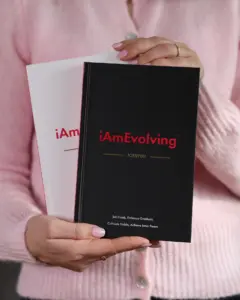
The iAmEvolving Journal is designed to make this process effortless. Each daily page includes space for goals, gratitude, habit tracking, and reflection: everything you need to create structure and mental clarity.
Instead of juggling multiple tools or scattered notes, your priorities live in one place. This structure turns journaling into a daily productivity ritual.
Available here:
Start your daily practice of gratitude, goals, and growth.
Get the Journal →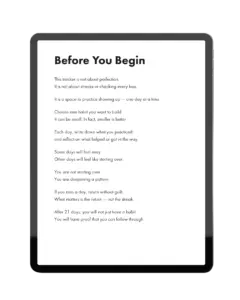
A free 21-day habit tracker PDF with daily check-ins, guided reflection prompts, and mindset reminders. Clean, minimal, and printable.
ExploreFAQ
How long should I journal to improve focus?
Can journaling replace digital productivity tools?
What if I get distracted while journaling?
How fast will I see results?
Does journaling improve productivity or only focus?
When is the best time to journal for focus?