Habits vs Motivation: Why You Don’t Need Willpower to Change

Habits and motivation serve fundamentally different roles in personal change. Motivation is a temporary emotional state that sparks action, while a habit is a repeated behavior that sustains it — and research from University College London found that it takes an average of 66 days for a new behavior to become automatic. Understanding this distinction is critical: studies suggest that only about 8 percent of people achieve their New Year’s resolutions, largely because they rely on motivation rather than systems.
You have probably felt this yourself. You wake up one morning with fire inside you — today is the day. And for a few days, everything clicks. Then a bad night’s sleep happens, or a stressful work day, or just an ordinary Tuesday where the spark is not there. The motivation disappears, taking your momentum with it. If this habits vs motivation cycle sounds familiar, it is not because something is wrong with you. It is because you have been relying on the wrong fuel. That is what this piece is about — and it starts with a truth most personal development advice skips over: the real engine of change is not willpower. It is the structure you will find in any good habits guide.
Why Motivation Feels Powerful but Cannot Be Trusted
Motivation is an emotion. That is not a criticism — it is a fact. Like excitement, anger, or joy, motivation rises and falls based on your mood, your sleep, your environment, your hormones, and a hundred other variables you cannot control. On a good day, motivation feels like a superpower. On a bad day, it is nowhere to be found.
The problem is not that motivation exists. The problem is that most people treat it as the foundation of change. They wait for it to arrive before they act. They interpret its absence as a signal that something is wrong — that they do not want the goal badly enough, that they are not disciplined enough, that maybe this is just not their thing. But motivation was never meant to carry that weight. It is a spark, not a furnace. It can start something, but it cannot sustain it.
Think about the last time you felt deeply motivated. Where did it come from? Maybe a podcast, a conversation, a moment of frustration, or a fresh start like a Monday or a new year. Now think about how long it lasted. Usually hours. Sometimes days. Rarely more than a week. That is the nature of motivation — it is intense but temporary, inspiring but unreliable.
If your entire system of personal growth depends on feeling motivated, then your growth will be as inconsistent as your moods. And your moods, by definition, are something you cannot schedule.
What a Habit Actually Is (and Is Not)
A habit is a behavior that has been repeated enough times that it no longer requires conscious decision-making. That is it. Not a personality trait. Not a talent. Not something you are born with or without. A habit is simply the result of repetition — a neural pathway that got used so often it became the default route.
Understanding how habits are formed changes how you approach personal change entirely. The process follows a simple loop: cue, routine, reward. You encounter a trigger (cue), you perform a behavior (routine), and you experience a result (reward). Repeat this loop enough times, and the behavior stops requiring effort. It becomes automatic.
Think about brushing your teeth. You do not wake up and weigh the pros and cons. You do not need motivation to do it. You do not debate whether today feels like a brushing kind of day. You just do it — because the behavior has been repeated so many times that it runs on autopilot. The neural pathway is carved so deep that skipping it would feel stranger than doing it.
That is the power of a habit. It removes decision fatigue from the equation. It does not ask how you feel. It does not depend on inspiration. It runs because it has been built to run.
What a habit is not: a rigid schedule that makes you feel trapped. Good habits are not cages. They are guardrails. They give your day structure while leaving room for flexibility and spontaneity within that structure.
Habits vs Motivation in Daily Life
The difference between habits and motivation becomes clearest when you look at how each one shows up (or does not) on an ordinary day. Not a peak day. Not a crisis day. Just a regular, unremarkable day where nothing particularly inspires you and nothing particularly challenges you.
On those days, motivation-dependent behavior looks like this: you check how you feel before deciding whether to act. If the energy is there, you do the thing. If it is not, you postpone it — telling yourself you will make up for it tomorrow when you feel better. Tomorrow, of course, often looks the same.
Habit-dependent behavior looks different: you do the thing regardless of how you feel, because the behavior is wired into your routine. You journal at 7 a.m. because that is what happens at 7 a.m. You walk after dinner because that is what happens after dinner. The decision was made once, weeks ago, and every day since then has been execution, not evaluation.
Here is a practical comparison of what this looks like with daily habits:
| Aspect | Motivation | Habits |
|---|---|---|
| Nature | Emotion — rises and falls with mood | Behavior — runs on autopilot |
| Duration | Hours to days | Permanent once formed (avg 66 days to build) |
| Requires willpower | Yes, every time | Only during formation |
| Consistency | Unreliable — depends on mood, sleep, stress | Reliable — triggered by cue, not feeling |
| Decision fatigue | High — you decide each time | None — behavior is automatic |
| Best for | Starting something new | Sustaining long-term change |
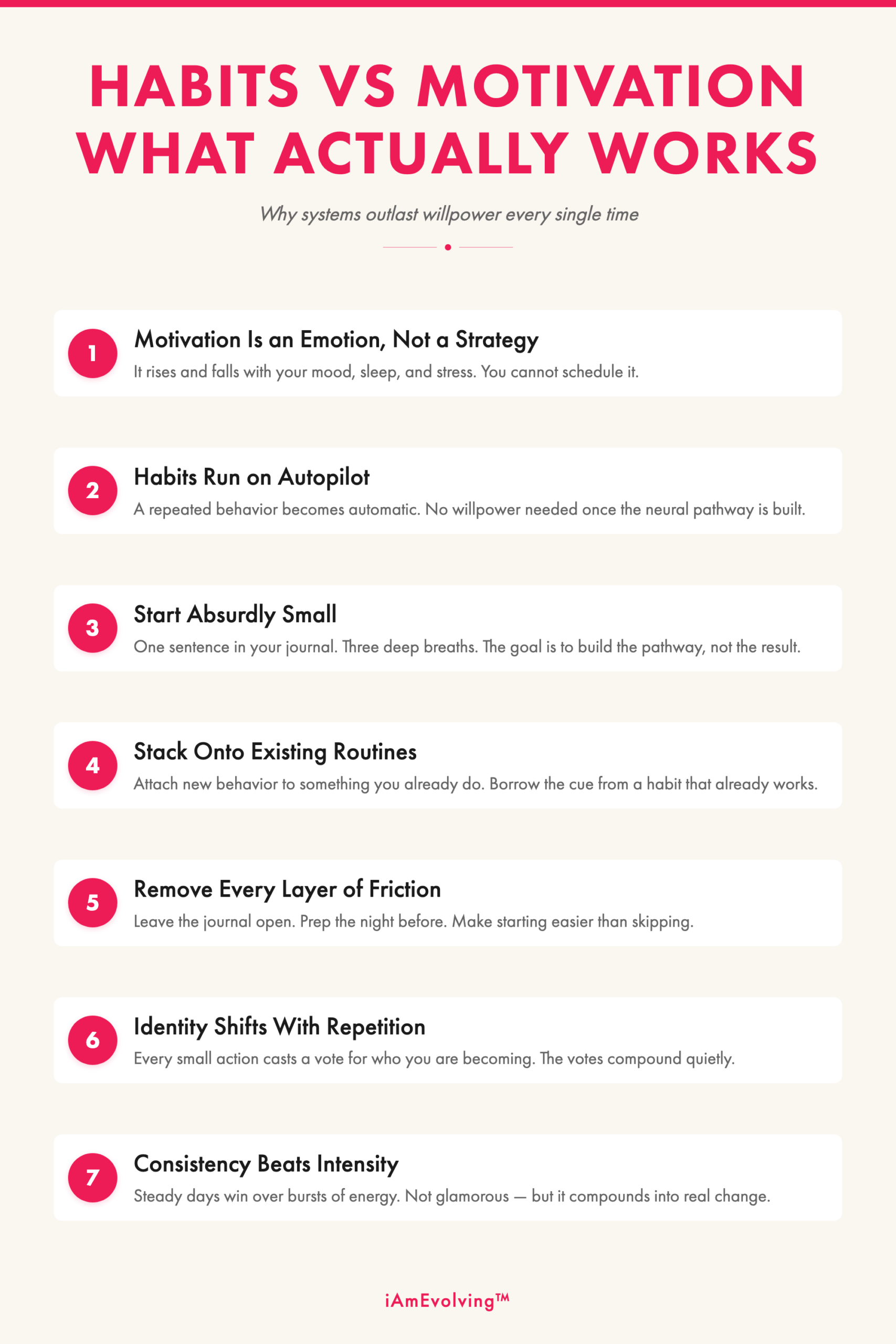
The motivated person has great days and terrible days. The person with habits for consistency has steady days. Over a year, that consistency wins by a landslide — not because it is glamorous, but because it compounds.
Get more like this, every week
How to Build a Habit When Motivation Is Low
If motivation is unreliable and habits are the answer, then the obvious question is: how do you build a habit when you do not feel motivated to build one? The answer is counterintuitive — you start so small that motivation becomes irrelevant.
- Start absurdly small. Not “journal for thirty minutes.” Start with “open my journal and write one sentence.” Not “meditate for twenty minutes.” Start with “sit still and take three deep breaths.” The goal is not to create results on day one. The goal is to create the neural pathway — to teach your brain that this behavior happens at this time, period.
- Stack it onto an existing habit. Your brain already has dozens of autopilot routines. Attach your new behavior to one that already runs automatically. “After I pour my coffee, I open my journal.” “After I brush my teeth at night, I read one page.” This technique works because it borrows the existing cue from a habit that is already wired in.
- Remove friction. Make the desired behavior as easy as possible to begin. Leave your journal open on your desk the night before. Change into your shoes before you sit down. Prep your meals on Sunday. Every layer of friction you remove makes it more likely that the behavior will happen when the moment arrives.
These are the core principles behind building habits that actually stick. They are not flashy. They do not require a dramatic lifestyle overhaul. But they work — quietly, reliably, and permanently. They are also the basis for developing gentle discipline habits that keep you moving forward without burning out.
The Role of Identity in Lasting Change
There is a deeper layer to why habits outlast motivation, and it has to do with identity. Motivation tries to change what you do. Habits, when they stick, change who you are.
Consider the difference between these two statements: “I am trying to journal more” versus “I am someone who journals.” The first is outcome-based — it is focused on a behavior you are attempting. The second is identity-based — it is a declaration of who you are. And here is what matters: your brain is wired to act consistently with the identity you hold. If you see yourself as “someone who journals,” skipping a day creates cognitive friction. Your actions naturally align with your self-image.
This is why small habits are so powerful. Every time you sit down and write one sentence in your journal, you are casting a vote for the identity of “someone who journals.” Every time you lace up your shoes and walk around the block, you are casting a vote for “someone who moves their body.” Each individual vote is tiny. But over weeks and months, the votes accumulate into a new self-image that feels natural, not forced.
Understanding habits foundations is ultimately about this: not just changing your behavior, but changing the story you tell yourself about who you are. When your identity shifts, discipline becomes less necessary — because you are no longer fighting against yourself. You are simply being consistent with the person you have become.
This connects to a broader truth about building habits for personal growth — sustainable change is not about doing more. It is about building aligned habits that reflect who you are becoming.
When Motivation Does Matter
After everything above, it might sound like motivation is the villain. It is not. Motivation has a role — it is just a different role than most people assign it.
Motivation is excellent at one thing: starting. It is the initial spark that gets you to try something new. That burst of energy after a great podcast episode, that New Year’s resolve, that moment of clarity after a tough conversation — those moments of motivation are valuable. They are doorways. The mistake is treating the doorway as the room.
Use motivation when it shows up. Ride the wave. Start the journal. Sign up for the class. Begin the project. But do not expect the wave to carry you all the way to shore. Build the habit in the first few days of high motivation, so that when the motivation fades — and it will — the habit is already taking root.
Think of motivation as a match and habits as a furnace. The match lights the fire, but the furnace is what heats the house through winter. You need the match once. You need the furnace every day.
There is also a subtler form of motivation that does not come from external inspiration — it comes from within, from seeing your own progress. When you journal consistently for three weeks and notice that your thinking is clearer, that creates a quiet internal motivation to continue. When you walk every day for a month and realize your mood is more stable, that creates its own pull. This kind of motivation is not a spark from outside. It is a byproduct of consistency. And it is far more sustainable than the kind that comes from watching a TED Talk.
Conclusion
Stop waiting for the feeling to arrive before you begin. That feeling has been unreliable for your entire life, and it will not suddenly become consistent now. Instead, build one small habit — something so easy it feels almost ridiculous — and protect it every day. Let the repetition do the heavy lifting. Let the identity shift happen quietly in the background while you simply show up.
You do not need more willpower. You do not need to overhaul your life. You need one small behavior, repeated consistently, that slowly rewires what feels normal. That is the real difference between habits and motivation — and it is the difference between people who talk about change and people who actually live it.
When I built the iAmEvolving Journal, I designed it around this exact principle — a daily structure that removes the need for motivation by giving you a built-in cue, a clear routine, and a sense of reward with every page you complete. I used to rely entirely on motivation myself, and the inconsistency was maddening. It was not until I built a system that worked without inspiration that things actually changed. And if you are ready to break old patterns and start fresh, one consistent habit is the most powerful place to begin.
Start your daily practice of gratitude, goals, and growth.
Get the Journal →A gentle 7-day reset to help you slow down, feel steadier, and reconnect — in just 5–10 minutes a day.
Start the ResetA simple introduction to daily journaling — gratitude, goals, and habits made easy.
Learn the MethodFAQ: Habits vs Motivation
Is motivation ever useful for building habits?
How long does it take for a behavior to become a habit?
What should I do when I feel no motivation at all?
Can habits work without any willpower or discipline?