The Habit Tracking Journal Method: Track, Reflect, Improve
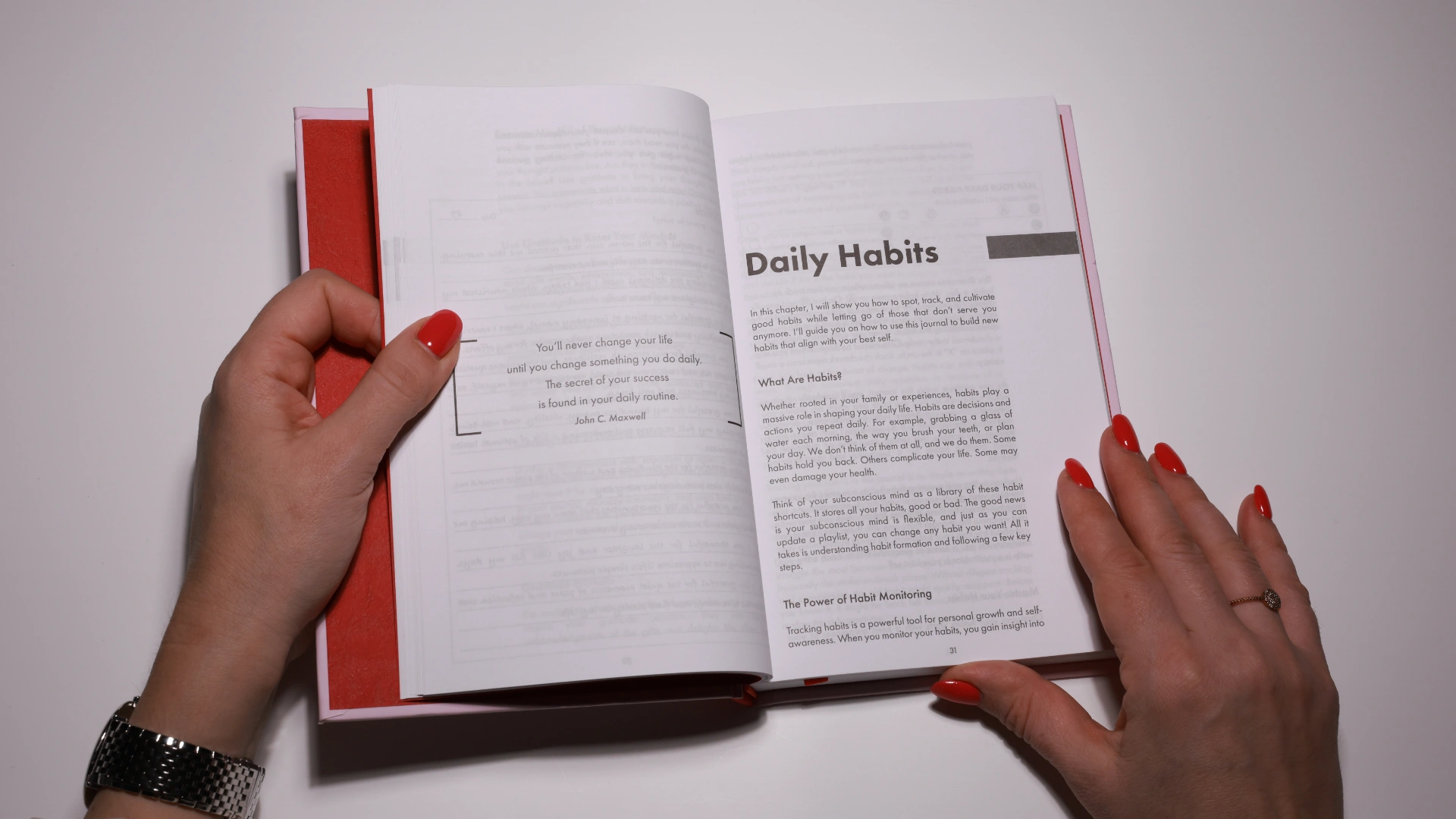
A habit tracking journal is a structured, pen-and-paper system where you record daily habits, reflect on your patterns, and make deliberate adjustments over time. Unlike digital apps that reduce habit building to a streak count, a journal-based tracker engages your brain at a deeper level, writing by hand activates neural pathways tied to memory, intention, and self-awareness. Research consistently shows that people who write down their goals and behaviors are 42% more likely to follow through than those who simply think about them. When you combine that with regular written reflection, you get a system that does not just track what you did — it helps you understand why you did it and what to change next.
The method I want to share with you is built on three pillars: Track, Reflect, Improve. It is the same approach I use in my own practice, and the same framework woven into the habits guide on this site. Most people who give up on habit tracking do so because they are only doing the first part, marking off boxes — without ever pausing to ask what those marks actually mean. When you add reflection and a structured improvement loop, your habit tracking journal becomes a living document that grows with you.
What Is a Habit Tracking Journal?
At its simplest, a habit tracking journal is a dedicated space in your notebook where you list the habits you want to build (or break) and record whether you completed them each day. It is a visual accountability tool — a grid, a chart, or a series of checkmarks that shows your behavior over time.
But what separates a true habit tracking journal from an app on your phone is what happens around that grid. A journal gives you room to write. It gives you space to note that you skipped your morning walk because you were up with a sick child, not because you were lazy. It gives you room to notice that you always meditate on days when you journal first, or that your water intake drops every Friday. Those observations are the raw material of real change, and no app checkbox can capture them.
The physical act of writing also forces a kind of honesty. When you open a blank page and write “Day 12: skipped again,” there is no algorithm softening the message. There is no notification you can swipe away. It is just you and the truth, and that directness is where growth starts. If you want to understand how habits are formed at a neurological level, the handwriting component matters more than most people realize.
The Three Pillars of the Habit Tracking Journal Method
The method I teach is not complicated, but it is complete. Most tracking systems stop at pillar one. This one uses all three, and the difference is significant.
Pillar 1: Track
This is the foundation. Every day, you record whether you completed each habit. A simple checkmark, an X, or a filled-in circle. The key here is consistency of recording, not perfection of performance. You are building the meta-habit of paying attention to your behavior. Even on days where every box is empty, the act of looking at your tracker and acknowledging what happened keeps you in the game.
What to track: Start with 3 to 5 habits. Not 12. Not “everything I want to change about my life.” Pick the behaviors that, if done consistently, would create the most positive ripple effect. One physical habit (walk, stretch, hydrate). One mental or emotional habit (journal, meditate, read). One foundational habit (sleep by 10:30, no phone in bed, meal prep). That is more than enough to start.
Pillar 2: Reflect
At the end of each week, you spend 10 to 15 minutes writing about what you observed. This is not a guilt session. It is an investigation. You are a scientist studying your own behavior, and the tracker is your data set.
Reflection questions that actually help:
- Which habits felt natural this week, and which felt like a fight?
- Were there days where everything clicked? What was different about those days?
- What got in the way on the hard days, energy, time, environment, or motivation?
- Did any habits consistently happen together or consistently get skipped together?
- What am I learning about myself from this data?
The reflection piece is what transforms your habit tracking journal from a scorecard into a growth tool. Without it, you are just collecting data. With it, you are building self-knowledge.
Pillar 3: Improve
Based on what you learned in your reflection, you make one or two small adjustments for the coming week. This is where the method becomes a loop — not a straight line. You are not trying to be perfect from day one. You are trying to get 1% better at understanding and supporting your own behavior each week.
Improvement actions might look like:
- Drop a habit that is not serving you right now (you can always add it back later)
- Modify a habit to make it easier (ten minutes of reading instead of thirty)
- Stack a new habit onto one that is already working (meditate right after journaling)
- Adjust the environment (put your journal on your pillow so it is the first thing you see at bedtime)
- Change the time (move a habit from evening to morning if you keep missing it at night)
This improvement loop is what separates people who build habits that stick from people who start strong and fade. It is the mechanism that turns short-term effort into long-term identity change.
How to Set Up Your Habit Tracking Journal
You do not need a special notebook or an elaborate system. You need one page, a pen, and five minutes to set it up. Here is exactly how I do it.
Step 1: Choose your habits (3 to 5 max). Write them down the left side of a page, one per row. Be specific. Not “exercise” but “20-minute walk before lunch.” Not “be healthier” but “drink 8 glasses of water.” Vague habits cannot be tracked.
Step 2: Create your grid. Across the top, write the days of the month (1 through 31) or the days of the week (Mon through Sun) if you prefer a weekly view. Each habit gets a row, each day gets a column. The intersection is where you will mark your progress.
Step 3: Choose your marking system. Keep it simple. A filled circle for “done,” an empty circle for “not done,” and a half circle for “partial” works well. Some people use color coding, green for done, red for missed, yellow for modified. Pick whatever feels intuitive and stick with it.
Step 4: Add a reflection space. Below or beside your grid, leave room for 5 to 10 lines of writing. This is where your weekly reflection will go. Without this space, you will skip the reflection. Guaranteed. Making it physically part of the tracker page is
Step 5: Track daily, reflect weekly. Each evening (or morning, reflecting on the previous day), take 30 seconds to fill in your marks. Each Sunday, spend 10 to 15 minutes writing your reflection and choosing your improvement action for the next week.
Get more like this, every week
What to Write During Your Habit Tracking Reflection
The reflection is the heart of this method, and yet it is the piece most people skip. They look at their tracker, feel good or feel bad, and move on. That is not reflection. That is reacting. Real reflection is structured and curious.
Here is a simple framework you can use every week:
Patterns. What trends do you see? Maybe you crush your habits Monday through Wednesday and fall apart on Thursday. Maybe you always skip your evening routine when you work late. Write down the pattern, not the judgment.
Energy. How did your energy levels relate to your habit completion? Low energy days are not failures, they are data. If you notice that your energy tanks every afternoon, that tells you something about when to schedule your most important habits.
Resistance. Which habits did you resist most? Resistance is information. Sometimes it means the habit is too big. Sometimes it means the habit is not aligned with what you actually value. And sometimes resistance shows up right before a breakthrough. Writing about it helps you tell the difference.
Wins. What went well, even slightly? Did you do a modified version of a habit on a hard day? That counts. Did you track consistently even when the results were not great? That is the meta-habit working. Acknowledging wins, even small ones, reinforces the neural pathways that support habits for consistency.
One insight. End your reflection with a single sentence that captures what you learned. Something like: “I do better when I start my day slowly” or “I resist meditation when I am already calm, I only want it when I am stressed, which is backwards.” These one-liners become your personal wisdom library over time.
The Weekly and Monthly Improvement Loop
The improvement loop is what makes this a method and not just a tracking exercise. It is the mechanism that keeps your habit system alive and evolving instead of going stale after two weeks.
Weekly Review (10 to 15 minutes)
Every week, after your reflection, ask yourself one question: What is the smallest change I can make next week to support my habits better? Not a dramatic overhaul. One small adjustment. Maybe you move your journaling from night to morning. Maybe you drop a habit that is causing more stress than growth. Maybe you add a habit stack, pairing a new behavior with one that already works.
Write your adjustment down. Make it concrete. “Next week, I will meditate for five minutes immediately after I pour my coffee” is actionable. “I will try harder” is not.
Monthly Review (30 minutes)
Once a month, zoom out. Look at the full month of tracking data and your four weekly reflections. This is where bigger patterns emerge, the kind you cannot see in a single week.
Monthly review questions:
- Which habits have become automatic? (These can graduate off your tracker to make room for new ones.)
- Which habits have been below 50% completion all month? (Time to modify, replace, or pause them.)
- Has your life context changed? (A new job, a stressful period, a season shift, your habits should adapt to your reality.)
- What is one habit you want to add next month based on what you have learned?
A monthly weekly reset routine practiced consistently is what keeps your tracking system from going stale. It is built-in maintenance for your personal growth engine. The people who sustain journaling habits over years are the ones who treat their system as a living document, not a fixed contract.
Sample Habit Tracking Journal Layouts
There is no single right way to lay out a tracker. The best format is the one you will actually use. Here are three proven layouts, each with a different strength.
The Simple Grid
This is the classic. Habits listed vertically on the left, days of the month across the top. Each cell gets a checkmark or an X. It takes up one page, requires no artistic ability, and gives you a clear visual of your month at a glance. The simplicity is the strength, there is zero friction to filling it in, which means you are more likely to do it consistently.
Best for: Beginners, people who want minimal setup, anyone who has tried and abandoned elaborate tracker systems before.
The Color-Coded Tracker
Same grid structure, but instead of checkmarks, you use three or four colors. Green means “completed fully.” Yellow means “partial or modified.” Red means “missed.” Blue means “intentionally skipped” (rest day, sick day, planned break). The color coding adds a layer of nuance that a simple yes/no cannot capture. At a glance, you can see not just whether you did your habits, but how you did them.
Best for: Visual learners, people who want to distinguish between “missed because I forgot” and “missed because I chose rest.”
The Rating-Based Tracker
Instead of a binary yes/no, you rate each habit on a 1 to 5 scale each day. A 1 means “barely touched it,” a 5 means “nailed it.” This approach works well for habits that exist on a spectrum, like “ate well” or “managed stress” or “was present with my family.” You lose the clean visual of a grid full of checkmarks, but you gain a much richer data set for your weekly reflection.
Best for: People tracking qualitative habits, those who find binary tracking too rigid, experienced trackers looking for deeper self-awareness.
Common Habit Tracking Journal Mistakes
Even good systems fail when they are misused. Here are the most common mistakes I see, and how to avoid each one.
Tracking too many habits at once. The number one killer. When you track 10 or 15 habits, filling in your tracker becomes a chore. You start skipping days. Then you feel behind. Then you quit. Start with 3 to 5. You can always add more once the first ones are running on autopilot.
Tracking without reflecting. A tracker without reflection is just a scorecard. You know your numbers, but you do not know what they mean. The whole point of the method is the insight that comes from asking “why”, and that only happens when you write about it.
Perfectionism. Expecting a perfect grid of checkmarks is a setup for failure. A missed day is not a broken streak, it is data. The goal is not perfection. The goal is awareness and gradual improvement. Some of my most useful reflection entries came from weeks where my tracker looked terrible on paper but taught me something essential about morning habits and my own energy cycles.
Giving up after missed days. This is the “what the hell” effect in psychology, once you miss one day, you feel like the whole thing is ruined and you stop entirely. The antidote is simple: leave the empty box. Do not backfill, do not cross it out, do not start a new page. Just pick up the pen the next day and keep going. Consistency over time beats perfection in the short term, every time.
Never updating your habit list. Your habits should evolve as you do. If you have been tracking the same five habits for six months and three of them are fully automatic, it is time to graduate those and add new ones. A static tracker is a stagnant one.
Using the iAmEvolving Journal for Habit Tracking
The iAmEvolving Journal was designed with this exact method in mind. It includes a built-in habit tracking section alongside daily reflection pages, so the Track-Reflect-Improve loop is baked into the structure. You do not have to create your own grid or figure out where to put your weekly review, the journal guides you through it.
What makes it particularly effective is that the habit tracker sits alongside gratitude prompts, goal-setting sections, and space for free writing. So your habits are never isolated from the bigger picture of who you are becoming. You can see how your daily behaviors connect to your deeper goals and values, and that connection is what turns a habit from something you do into something you are.
Whether you use the iAmEvolving Journal or a blank notebook, the method stays the same. Track daily. Reflect weekly. Improve continuously. The tool matters less than the practice.
How to Start a Habit Tracking Journal
Choose 3 to 5 Specific Habits
Draw Your Tracking Grid
Pick a Simple Marking System
Add a Reflection Space Below the Grid
Track Daily and Reflect Weekly
Make One Small Adjustment Each Week
Conclusion
A habit tracking journal is not about filling in boxes. It is about building an honest, ongoing conversation with yourself about who you are and who you are becoming. The Track-Reflect-Improve method gives you a structure that respects both your ambition and your humanity, because real change is not linear, and your tracking system should not pretend otherwise.
Start with three habits, one page, and a pen. Track for a week. Reflect on what you notice. Make one small adjustment. Then do it again. That is the whole method. It is simple enough to start today and deep enough to sustain for years. If you are ready to put this into practice with a journal that supports every step of the process, the iAmEvolving Journal gives you the structure to track, reflect, and improve, all in one place.
Start your daily practice of gratitude, goals, and growth.
Get the Journal →A gentle 7-day reset to help you slow down, feel steadier, and reconnect — in just 5–10 minutes a day.
Start the ResetA simple introduction to daily journaling — gratitude, goals, and habits made easy.
Learn the MethodFAQ: Habit Tracking Journal Method
How many habits should I track in my journal?
What is the difference between a habit tracker app and a habit tracking journal?
How often should I review my habit tracker?
What should I do when I miss a day of tracking?
Can I use a habit tracking journal for breaking bad habits too?