The Entrepreneur’s Journal: How Writing Daily Drives Business Success

An entrepreneur journal is one of the most underused strategic tools in business. While most founders chase the next productivity app or management framework, the practice of writing by hand each day does something no software can replicate: it forces you to slow down, think clearly, and confront the decisions that actually move your business forward. Research on expressive writing shows that journaling for as little as 15 minutes daily reduces decision fatigue, improves emotional regulation, and strengthens the kind of pattern recognition that separates reactive founders from strategic ones.
The entrepreneurs who build lasting companies tend to share one quiet habit: they write things down. Not in Slack threads or task apps, but in a dedicated space where they can process uncertainty, track what matters, and stay honest with themselves about where they are headed. If you have ever felt overwhelmed by competing priorities, stuck in a cycle of reactive decision-making, or isolated by the weight of leadership, an entrepreneur journal gives you a structured way to regain clarity, strengthen your life alignment, and run your business from a grounded place rather than a frantic one.
Why the Most Successful Entrepreneurs Journal
Running a business means making hundreds of decisions a week. Some are trivial. Some carry real consequences. The problem is that your brain does not distinguish between them. Every decision, large or small, draws from the same finite pool of mental energy. By midday, most founders are operating on depleted reserves, making choices from exhaustion rather than clarity.
Journaling interrupts that cycle. When you write down your priorities before the day begins, you remove dozens of micro-decisions from your plate. You have already decided what matters. When you review your day in the evening, you create a feedback loop that most entrepreneurs never build. You start noticing which activities generate results and which ones just feel productive. Over weeks and months, this practice compounds. You develop sharper instincts because you are training yourself to observe your own patterns instead of being swept along by them.
The founders who journal consistently report something else that rarely gets discussed: emotional steadiness. Entrepreneurship is an emotional rollercoaster by design. A journal gives you a private space to process the highs and lows without dumping them on your team, your partner, or your Twitter feed. That emotional processing is not a luxury. It is what keeps you making sound decisions under pressure instead of reactive ones driven by fear or excitement.
How an Entrepreneur Journal Improves Business Decisions
Cognitive bias is the silent killer of good business strategy. Confirmation bias makes you see evidence that supports what you already believe. Sunk cost fallacy keeps you investing in projects that should have been killed months ago. Recency bias causes you to overweight whatever happened last week while ignoring long-term trends.
A journal disrupts these patterns by creating a written record you can actually review. When you are deciding whether to pivot a product line, you can go back three months and read what you were thinking then. You can see whether your current reasoning is based on data or emotion. You can track whether a recurring frustration is a real problem or just a bad week.
This is where writing down intentions becomes a genuine competitive advantage. When you articulate your reasoning on paper before making a decision, you catch flawed logic that you would have missed in your head. The physical act of writing engages different cognitive pathways than typing or thinking. It slows you down just enough to be deliberate without being paralyzed. Many entrepreneurs find that their best business insights come not from brainstorming sessions or strategy decks, but from quiet mornings with a pen and a journal.
A Practical Entrepreneur Journal System
The biggest reason entrepreneurs abandon journaling is that they make it too complicated. You do not need a 45-minute morning routine or a complex template with fifteen sections. You need a system that takes 10 to 15 minutes and fits into the rhythm of your actual day. Here is a framework that works:
Morning Intention (5 Minutes)
Before you check email, open your journal and answer three questions:
- What is my single most important outcome today? Not a task list. One outcome that would make this day count.
- What decision am I avoiding? Write it down. You do not have to solve it now, but naming it removes its power to drain your attention.
- How do I want to show up today? This is about energy and leadership presence, not tasks. Calm and focused? Bold and decisive? Name it.
This practice builds morning habits that set your day on the right trajectory. Those five minutes create a filter for every decision you face over the next twelve hours.
Evening Review (5 Minutes)
At the end of your workday, spend five minutes on a quick debrief:
- What worked today? Capture the wins, even small ones. Entrepreneurs are notoriously bad at acknowledging progress.
- What drained my energy? This identifies patterns over time. Maybe every meeting with a particular client leaves you depleted. Maybe administrative tasks always pile up on Wednesdays.
- What did I learn? Every day teaches something. Writing it down ensures you actually retain the lesson instead of losing it to the next day’s chaos.
Weekly Strategy Reflection (15 Minutes)
Once a week, carve out fifteen minutes for a deeper review. Look at the past five days of entries and ask:
- What patterns am I seeing in my energy, decisions, and results?
- Am I spending time on what actually matters, or am I trapped in urgency?
- What needs to change next week?
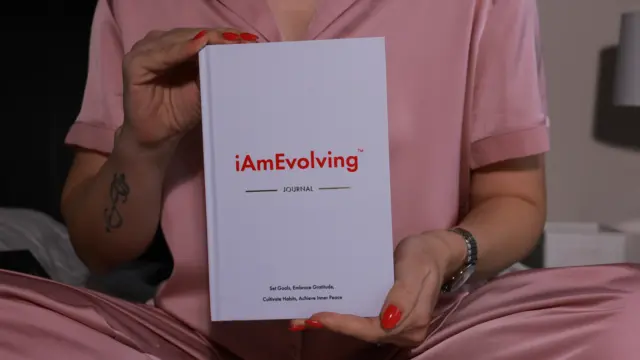
This weekly habit is where the real strategic value lives. Daily entries capture data. Weekly reviews turn that data into insight. The iAmEvolving Journal is built around this exact rhythm, combining daily intention-setting with weekly reflection and habit tracking so you are not reinventing your system every morning.
Get more like this, every week
Managing Entrepreneurial Stress and Isolation Through Journaling
Nobody tells you how lonely leadership is until you are in it. You make decisions that affect people’s livelihoods, and most of the time, you cannot talk through those decisions with the people they affect. You carry information your team does not have. You absorb stress that you cannot show. Over time, that isolation compounds into something heavier than most entrepreneurs admit.
A journal becomes the one place where you can be completely honest. You can write about the fear that your latest hire was a mistake. You can admit that you do not know if the business model will work. You can process the imposter syndrome that hits every founder, no matter how successful they appear. None of this requires a solution. The act of putting it on paper is itself a form of processing. Studies on expressive writing consistently show that articulating difficult emotions reduces their intensity and improves both mental clarity and physical health markers.
There is also a practical dimension to this. When you journal through stressful periods, you create a record of how you handled them. Six months later, when the next crisis hits, you can look back and see that you survived the last one. You can read your own words from a dark week and remember that it passed. This is not abstract self-help. It is a tangible resource that builds resilience over time and prevents the kind of emotional burnout that takes founders out of their own companies.
Using Your Entrepreneur Journal for Goal Tracking and Accountability
Most entrepreneurs set ambitious goals and then lose track of them within weeks. The goals live in a pitch deck or a planning document that gets opened once a quarter. Daily reality takes over, and the gap between intention and execution widens without anyone noticing until it is too late.
A journal closes that gap by making your goals a daily conversation, not an annual event. Here is a simple structure for goal setting steps that connects your long-term vision to what you do today:
- Quarterly goals (3-4 max): These are the big outcomes that define the next 90 days. Write them on the first page of each quarterly section and revisit them every Monday.
- Monthly milestones: Break each quarterly goal into monthly checkpoints. What needs to be true by the end of this month for you to be on track?
- Weekly action items: Each Sunday or Monday, write 3-5 specific actions that move you toward your monthly milestones. These are your non-negotiable priorities for the week.
- Daily focus: Every morning, choose the one action from your weekly list that gets your best energy today.
This cascading system means your daily journaling is never disconnected from your bigger picture. Every morning entry ties back to a weekly priority, which ties back to a monthly milestone, which ties back to a quarterly goal. When you journal this way consistently, you develop strong journaling habits that become the accountability system most entrepreneurs pay coaches thousands of dollars to provide.
20 Journal Prompts for Entrepreneurs
When you are staring at a blank page and your brain is full of noise, prompts give you a starting point. These are designed specifically for the challenges entrepreneurs face. Pick one or two that resonate and write for five to ten minutes. Do not overthink it.
Business Strategy and Decisions
- What is the one decision I have been avoiding, and what is the worst-case scenario if I make it today?
- If I could only work on one project for the next 30 days, which one would move the business furthest?
- What am I doing in my business that someone else should be doing? What is stopping me from delegating it?
- Where am I confusing being busy with being productive?
- If my business stayed exactly as it is today for the next five years, would I be satisfied? What needs to change?
Leadership and Team
- Am I leading my team the way I would want to be led? Where am I falling short?
- What conversation do I need to have that I have been putting off?
- When was the last time I asked my team what they need from me, and actually listened?
- What would my business look like if I trusted my team to handle more without my involvement?
- What is one leadership skill I need to develop in the next quarter?
Vision and Money Mindset
- What does financial success actually look like for me, beyond the numbers? What does the money enable?
- Am I making financial decisions from abundance or from fear? What would the other perspective look like?
- What is my relationship with money right now, and how is it affecting my business decisions?
- Where is my business three years from now if everything goes according to plan? What does a typical day look like?
- What part of my original vision have I compromised on, and was that compromise necessary?
Work-Life Integration and Well-Being
- What am I sacrificing for my business that I am not willing to sacrifice long-term?
- When did I last do something purely for enjoyment, with no productivity angle? How did it feel?
- What is one boundary I need to set this week to protect my energy?
- Am I building a business that serves my life, or have I built a life that serves my business?
- What would I tell a friend who was running their business the way I am running mine right now?
How to Start Your Entrepreneur Journal Practice
If you have never journaled consistently, do not try to implement everything at once. Start with just the morning intention practice: five minutes, three questions, before your first meeting or email. Do that for two weeks. Once it feels natural, add the evening review. After a month, layer in the weekly strategy reflection. Building lasting habits works better when you start small and expand gradually rather than overhauling your entire routine on day one.
Choose a journal that gives you structure without being restrictive. A blank notebook can work, but most entrepreneurs benefit from a guided format that removes the guesswork. The iAmEvolving Journal was designed with this balance in mind. It combines daily intention-setting with gratitude, habit tracking, and reflection sections that take roughly 10 minutes to complete. For entrepreneurs, that structure means you spend your journaling time writing, not deciding what to write about.
A few practical tips that make the habit stick:
- Keep your journal next to your coffee maker or on your desk. Physical proximity eliminates the friction of getting started.
- Protect the time. Block 10 minutes on your calendar if you have to. Treat it like a meeting with your most important business partner, which is yourself.
- Write by hand. Typing is faster, but handwriting engages deeper processing. For strategic thinking and emotional processing, pen on paper consistently outperforms digital input.
- Do not aim for perfection. Some entries will be three sentences. Some will fill two pages. Both count.
Conclusion
The most effective entrepreneurs do not journal because they have time for it. They journal because they cannot afford the cost of not doing it. Unclear thinking, unprocessed stress, reactive decisions, and goals that drift out of focus are all problems that compound silently until they become crises. An entrepreneur journal is the daily practice that prevents that compounding. It gives you a space to think strategically, stay accountable, process the emotional weight of leadership, and maintain the kind of clarity that drives real business growth.
You do not need to overhaul your morning. You need 10 minutes, a pen, and a journal that meets you where you are. Start tomorrow. Write down your single most important outcome for the day, name the decision you have been avoiding, and describe how you want to show up. Do that for two weeks and watch how it changes the way you lead. For a deeper look at how intentional daily practices connect to lasting growth, explore the personal growth guide and see how small, consistent actions build something extraordinary over time.
Start your daily practice of gratitude, goals, and growth.
Get the Journal →A gentle 7-day reset to help you slow down, feel steadier, and reconnect — in just 5–10 minutes a day.
Start the ResetA simple introduction to daily journaling — gratitude, goals, and habits made easy.
Learn the MethodFrequently Asked Questions
What should an entrepreneur write in a journal every day?
How does journaling help with business decision-making?
How much time should entrepreneurs spend journaling each day?
Can journaling prevent entrepreneur burnout?
Should entrepreneurs use a physical journal or a digital app?