30-Day Gratitude Journal Challenge (Free Daily Template)
A 30 day gratitude challenge does something that random journaling cannot: it builds a pattern. When you practice gratitude every day for 30 days, you are not just writing nice things — you are training your brain to notice what is already good in your life. Research in positive psychology shows that consistent gratitude practice rewires neural pathways, reduces stress hormones, and shifts your default emotional baseline toward resilience and calm.
This challenge is not a list of 30 generic prompts. It is structured around four weekly themes — awareness, goals, habits, and inner harmony — so that by Day 30, gratitude is not just something you do in the morning. It becomes the lens through which you see your entire life. All you need is a journal, five to ten minutes a day, and the willingness to notice what you have been overlooking.
How This 30-Day Gratitude Challenge Works
Each week focuses on a different dimension of your life. This matters because most gratitude challenges lose people by Day 10 — the prompts feel repetitive, and listing “three things you are grateful for” starts to feel hollow. By rotating through four themes, the practice stays fresh, and you discover gratitude in areas you never thought to look.
- Week 1: Awareness and Appreciation — Train your eyes to see what is already good. Start simple.
- Week 2: Gratitude and Your Goals — Recognize your progress, celebrate growth, and reconnect with your direction.
- Week 3: Gratitude in Your Daily Habits — Find meaning in the small, ordinary moments that quietly hold your life together.
- Week 4: Gratitude and Inner Harmony — Go deeper. Practice self-compassion, emotional honesty, and gratitude during difficult seasons.
Each day takes five to ten minutes. Some days are reflection prompts — you write. Some days are action prompts — you do something. Every week ends with a review day where you look back at what you wrote and notice what patterns are forming. If you already have a morning gratitude ritual, this challenge will deepen it. If you do not, it will help you build one.
Week 1: Awareness and Appreciation (Days 1-7)
The first week is about opening your eyes. You are not reaching for anything deep yet — you are just training yourself to notice. Most of us walk through life on autopilot, taking the good things for granted until they disappear. This week, you slow down and pay attention.
Day 1: Write three small things from today you are grateful for. For each one, write one sentence about why it matters to you.
Day 2: What is one thing your body did for you today that you did not think about? Your heartbeat, your breath, your ability to walk to the kitchen — notice it.
Day 3 (Action): Name a person who made your week better — even in a small way. Send them a message and tell them. Watch how it feels to express gratitude out loud.
Day 4: What is something in your daily routine you would miss if it disappeared tomorrow? Your morning coffee, a quiet walk, a favorite playlist — write about why it anchors your day.
Day 5: Look around the room you are in right now. Name three objects that hold meaning for you — not because they are expensive, but because of what they represent.
Day 6 (Honest Day): What is one hard thing from your past that you can now see differently? Not everything difficult has a silver lining — but some of it shaped you in ways you did not expect. Write honestly about that.
Day 7 (Weekly Review): Look back at your six entries. Which one surprised you? Which was hardest to write? Write a short gratitude snapshot of your first week — what you noticed, what shifted, what you want to carry forward.
Week 2: Gratitude and Your Goals (Days 8-14)
This week connects gratitude with growth. Most people think about goals in terms of what is missing — what they have not achieved, where they have not arrived. This week, you practice looking at how far you have already come. Gratitude does not slow your ambition. It gives your ambition a foundation of confidence instead of anxiety.
Day 8: What is one goal you have already achieved that you never properly celebrated? Write about the effort it took and why it mattered.
Day 9: Write about a skill you have built over time. How does it serve you now? Whether it is cooking, listening, leading, or staying calm under pressure — acknowledge it.
Day 10: What is one thing about your work or career you genuinely appreciate? It does not have to be your dream job — maybe it is a colleague, a flexible schedule, or a lesson you are learning.
Day 11: Name someone who believed in you before you believed in yourself. Write what they did and how it changed your path.
Day 12: What is a dream you are still working toward? Write what you appreciate about the journey so far — not just the destination.
Day 13 (Action): Write a short letter of thanks to your past self for one decision that changed your direction. You do not need to send it. Just write it and let yourself feel proud of who you were becoming.
Day 14 (Weekly Review): How does recognizing your progress change the way you feel about your goals? Write about the connection between gratitude and forward momentum. For more ways to use gratitude journal prompts to clarify your direction, explore the full collection.
Get more like this, every week
Week 3: Gratitude in Your Daily Habits (Days 15-21)
This week is about the ordinary. The big moments of gratitude are easy — weddings, promotions, sunsets. The harder and more transformative practice is finding gratitude inside the small, repeated actions that make up your actual life. This is where the challenge starts to change how you see your days.
Day 15: What is a daily habit that quietly makes your life better? Not a dramatic practice — something small, like making your bed, drinking water first thing, or putting your phone away at dinner.
Day 16: What is one healthy choice you made this week — even a small one? Choosing the stairs, going to bed on time, saying no to something that would drain you. Write about it.
Day 17: Write about a meal, a cup of coffee, or a moment of rest you truly savored. Not rushed through — actually noticed and enjoyed.
Day 18: What is something you do for someone else every day without thinking? Packing a lunch, listening to a friend, cleaning a shared space. Appreciate yourself for it.
Day 19 (Action): Pick one routine task tomorrow — making coffee, washing dishes, driving to work — and do it with full attention. No phone, no rush. Afterward, write about how the experience felt different.
Day 20 (Honest Day): What is a habit you tried to build but struggled with? What did the struggle teach you about yourself? Gratitude is not only for success — sometimes the effort itself deserves acknowledgment.
Day 21 (Weekly Review): What small daily moments deserve more of your attention? Look back at this week and notice how your relationship with the ordinary has shifted. To deepen this practice, see how to build a lasting gratitude habit that extends beyond this challenge.
Week 4: Gratitude and Inner Harmony (Days 22-30)
The final week goes deeper. You have spent three weeks noticing, appreciating, and finding gratitude in your goals and habits. Now you turn inward — toward self-acceptance, emotional honesty, and the kind of gratitude that holds space for pain and peace at the same time. This is the week that separates a gratitude challenge from a real transformation.
Day 22: What is something about yourself you have learned to accept — not fix, not improve, but simply accept? Write about how that acceptance feels.
Day 23: Write about a relationship that brings you peace. Not excitement, not drama — just quiet, steady peace.
Day 24: What is one way you have grown emotionally in the past year? Maybe you react differently to stress, set better boundaries, or listen more than you used to.
Day 25: Write about a time you chose rest over productivity — and did not feel guilty about it. If you have never done this, write about what it would feel like to try.
Day 26 (Honest Day): What is something difficult you are currently navigating? Find one small thing inside it to appreciate — not to minimize the pain, but to acknowledge that even in hard seasons, something is still holding you together.
Day 27 (Action): Write a short message of compassion to yourself, as if you were writing to a close friend going through the same thing. Read it out loud. Notice how your body responds.
Day 28: What does inner peace feel like to you? When was the last time you felt it — even for a moment? Describe it in detail so you can return to it when you need to.
Day 29: Name one thing from this challenge you want to carry forward into your daily life. Not all of it — just one practice, one prompt, one shift that felt real.
Day 30 (Final Review): Read back through all 29 entries. What patterns do you see? What surprised you? What shifted in how you see your life? Write your final reflection — not as an ending, but as the beginning of a practice you now own.
How to Make This Challenge Stick
A challenge only works if you finish it. Here is what separates people who complete all 30 days from those who stop at Day 8:
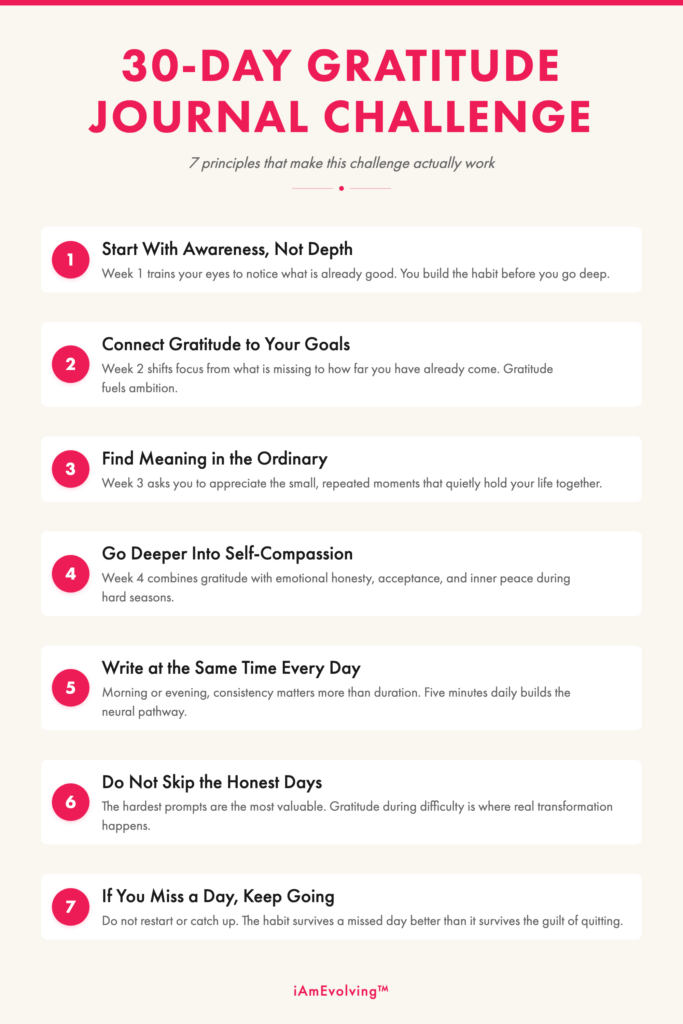
Pick a consistent time. Morning works best for most people — before the day pulls your attention in ten directions. But evening works too, especially if you want to end the day with reflection. What matters is that the time is the same every day.
Use a dedicated journal. Writing gratitude on a random piece of paper or in your phone notes does not create ritual. A physical journal you return to every day builds the association between opening that book and entering a state of reflection.
Do not skip the honest days. Days 6, 20, and 26 ask you to find gratitude during difficulty. These are the hardest prompts — and the most valuable. Gratitude is not about pretending everything is fine. It is about seeing clearly, even when things are hard.
If you miss a day, keep going. Do not restart. Do not catch up. Just open your journal the next morning and write the next prompt. Consistency matters more than perfection — and the habit survives a missed day better than it survives the guilt of quitting.
Share one entry with someone. Not every day — just once during the 30 days, read an entry to someone you trust. Gratitude spoken out loud creates a different kind of connection than gratitude written in silence.
Conclusion
This 30 day gratitude challenge is not about becoming a more positive person. It is about becoming a more aware one — someone who notices the good without ignoring the hard, who celebrates progress without losing hunger for growth, and who finds peace in the ordinary moments that make up a real life.
All you need is a journal and five minutes a day. If you want one that already has space for gratitude, goals, habits, and inner reflection built into every page, the iAmEvolving Journal was designed for exactly this kind of practice. For more options, explore the best gratitude journals available right now. Start Day 1 tomorrow morning.
Start your daily practice of gratitude, goals, and growth.
Get the Journal →A gentle 7-day reset to help you slow down, feel steadier, and reconnect — in just 5–10 minutes a day.
Start the ResetA simple introduction to daily journaling — gratitude, goals, and habits made easy.
Learn the MethodFrequently Asked Questions
Do I need a specific journal for this challenge?
What if I miss a day during the challenge?
What if I do not feel grateful during a difficult time?
What happens after the 30 days are over?
How long does each day take?