A 30-day personal growth challenge is one of the most effective ways to build self-awareness, shift your mindset, and create lasting momentum in your life. By committing to one focused journaling prompt each day for 30 days, you give yourself the structure and space to examine your thoughts, question your patterns, and grow with intention.
Most people want to grow but don’t know where to start. They read books, watch videos, and set vague goals — but nothing sticks because there’s no daily practice holding it together. This challenge changes that. Each prompt is designed to meet you where you are today and guide you toward the person you’re becoming. Whether you’re just beginning your personal evolution practices or deepening an existing routine, these 30 days will give you clarity you didn’t know you were missing.
Thirty days is not arbitrary. It’s long enough to build a real habit but short enough to stay committed without burning out. Research on habit formation shows that repeating a behavior consistently for at least three to four weeks strengthens the neural pathways that make it automatic. When you journal with intention every day for a month, you’re not just answering prompts — you’re rewiring how you process your life.
There’s also something powerful about giving yourself a container. Open-ended goals like “work on myself” have no traction. But a structured 30-day personal growth challenge with a clear prompt each day gives you direction. You don’t need to figure out what to write. You just show up, answer honestly, and let the process do its work.
I’ve watched people transform through structured journaling more than through any other practice. It’s not the dramatic breakthroughs that change your life — it’s the quiet accumulation of honest pages. Day after day, you build a relationship with yourself that no course or podcast can replicate.
How to Get the Most From This 30-Day Personal Growth Challenge
Before you begin, here are a few guidelines that will help you get the most from these 30 days.
Set a consistent time. Morning works best for most people — your mind is fresh and less cluttered. But evening journaling works too if that’s when you have space. The key is consistency, not perfection.
Write by hand. There’s a reason handwriting sticks deeper than typing. The physical act of writing slows your thoughts down and forces you to be more intentional with your words.
Don’t overthink it. Some prompts will hit hard. Others will feel easy. Let both happen. The goal isn’t to produce perfect prose — it’s to be honest on paper.
Give yourself at least 10 minutes. You can write for longer, but 10 minutes is the minimum needed to move past surface-level answers and into real reflection.
Don’t skip days. If you miss one, do two the next day. The sequence matters because the prompts build on each other — earlier reflections create the foundation for deeper ones later.
Week 1: Building Self-Awareness (Days 1–7)
The first week is about getting honest with yourself. Before you can grow, you need to understand where you actually are — not where you think you should be. These prompts help you examine your current reality with compassion and clarity. True self awareness and identity starts with this kind of unflinching honesty.
Day 1: What does personal growth mean to you right now, in this season of your life? Write your honest definition — not what you’ve read in books, but what it feels like from the inside.
Day 2: What are you avoiding? Name the conversation, decision, or truth you’ve been pushing aside. Write about why it feels easier to avoid it than face it.
Day 3: Describe your average day from morning to night. Where do you feel most alive? Where do you feel like you’re just going through the motions?
Day 4: What are three beliefs you hold about yourself that might not actually be true? Where did those beliefs come from?
Day 5: Write about a recent moment when you felt genuinely proud of yourself. What were you doing? What made that moment meaningful?
Day 6: What would your life look like if you trusted yourself more? Be specific — describe the decisions you’d make, the risks you’d take, the way you’d carry yourself.
Day 7: Look back at your first six entries. What patterns do you notice? What surprised you? Write a short letter to yourself acknowledging what you’ve uncovered so far.
Now that you’ve built the foundation of honest self-awareness, the real work begins. Weeks 2 through 4 take you deeper — into your mindset, your purpose, and the daily actions that turn insight into lasting change.
This article continues for subscribers
Subscribe for free to unlock the rest of this article.
Week 2: Shifting Your Mindset (Days 8–14)
With a clearer picture of where you stand, it’s time to examine the lens through which you see everything. Your mindset shapes your choices more than your circumstances ever will. This week’s prompts challenge the mental patterns that keep you stuck. You may start to notice signs you are growing — even if they’re subtle at first.
Day 8: What is the most limiting story you tell yourself on repeat? Write it out in full. Then write the opposite version — the story where you are capable, worthy, and enough.
Day 9: Think about someone you admire. What qualities do they have that you wish you had? Now ask yourself: where do you already have those qualities, even in small ways?
Day 10: What does failure mean to you? Write about a time you failed and what it actually taught you. How would your life be different if you saw failure as information rather than identity?
Day 11: What are you afraid of becoming? Sometimes our fears about growth reveal more than our hopes. Name the fear and explore what’s underneath it.
Day 12: Write about a time you changed your mind about something important. What made you open to seeing it differently? What does that tell you about your capacity to evolve?
Day 13: If your inner critic had a name, what would it be? Write a conversation between yourself and that voice. Let both sides speak honestly.
Day 14: Halfway through. Read back over the past week. Where has your thinking already started to shift? Write about one belief that feels lighter or less rigid than it did seven days ago.
Week 3: Finding Purpose and Direction (Days 15–21)
Self-awareness and mindset work create the conditions for clarity. Now it’s time to point that clarity somewhere. This week is about discovering what actually matters to you — not what you’ve been told should matter, but what pulls you forward from the inside. These prompts draw from the same territory as journaling prompts for self-discovery, but with a specific focus on direction and meaning.
Day 15: If money, time, and other people’s opinions were removed from the equation, how would you spend your days? Describe your ideal ordinary Tuesday.
Day 16: What do people come to you for? What do they trust you with, ask your opinion on, or lean on you for? These clues often point toward your natural strengths.
Day 17: Write about a time when you were so engaged in something that time disappeared. What were you doing? What made that experience so absorbing?
Day 18: What values do you want your life to reflect? List five to seven core values, then rank them. Which ones are you living right now? Which ones are you neglecting?
Day 19: Write a letter to your future self — the version of you one year from now. What do you hope that person has learned, started, or let go of?
Day 20: What would you do if you knew you wouldn’t be judged? Where are you holding back because of what others might think? Name one area where you’re ready to stop performing and start living.
Day 21: Three weeks in. Look back at your entries from Week 1 and Week 2. How has your understanding of yourself deepened? Write about the version of you that’s emerging through this process.
Week 4: Taking Aligned Action (Days 22–30)
Insight without action is entertainment. The final stretch of this challenge is where reflection meets reality. These prompts help you translate everything you’ve uncovered into a daily growth routine that moves with you beyond these 30 days.
Day 22: What is one small habit you can start this week that aligns with the person you’re becoming? Make it specific, simple, and repeatable.
Day 23: What needs to leave your life to make room for what you want? This could be a habit, a commitment, a relationship pattern, or a way of spending your time. Write about what you’re ready to release.
Day 24: Who in your life supports your growth? Who makes it harder? You don’t need to cut people out — but you do need to be honest about the influence your environment has on your evolution.
Day 25: Write about one area of your life where you’ve been waiting for permission. What would it look like to give yourself that permission today?
Day 26: What does consistency look like for you — not in theory, but in practice? Describe the version of your daily routine that would make you feel grounded and purposeful.
Day 27: What’s one uncomfortable conversation you need to have? Write out what you’d say if you had the courage. Sometimes writing it first makes saying it possible.
Day 28: Think about the gap between who you are and who you want to be. What’s one thing you can do this week to close that gap — even by a fraction?
Day 29: Write about what you’ve learned about yourself over the past 29 days. What has changed in how you see yourself? What surprised you most?
Day 30: Write a commitment letter to yourself. Not a list of goals — a promise. What will you carry forward from this challenge? How will you continue showing up for yourself after today?
What to Do After the 30 Days
Finishing this challenge doesn’t mean the work is done. It means the foundation is set. Here’s how to keep the momentum going without starting from scratch.
Reread your entries. Go back through all 30 days and highlight the insights that still resonate. You’ll see themes you didn’t notice while you were in the middle of it.
Choose three prompts to revisit monthly. Some of these prompts are worth returning to every four to six weeks. Your answers will change — and that change is proof of growth.
Build a daily journaling practice. You don’t need a new challenge every month. Even five minutes of free writing each morning keeps the self-awareness alive. The iAmEvolving Journal is designed specifically for this — combining gratitude, goals, habits, and reflection into one daily practice.
Share what you’ve learned. Growth deepens when you articulate it. Tell a friend, write a social post, or simply say it out loud to yourself. Naming your evolution makes it real.
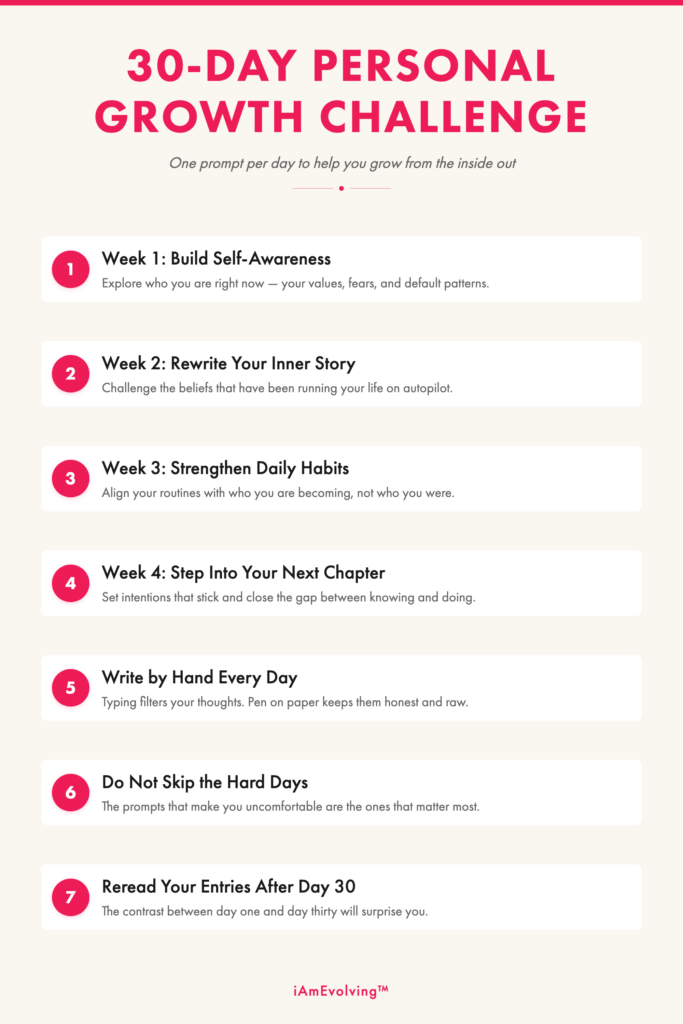
A 30-day personal growth challenge — one journaling prompt per day to help you grow from the inside out.
Conclusion
Personal growth isn’t a single event — it’s a series of small, honest conversations with yourself. This 30-day personal growth challenge gives you the structure to have those conversations consistently, one prompt at a time. You don’t need to overhaul your life to start evolving. You just need a pen, a page, and the willingness to look.
If this challenge resonated with you, keep the practice going through reflective journaling. The prompts end after 30 days, but the growth doesn’t have to. Every page you write is a step forward — and you’ve already taken the hardest one by starting.
iAmEvolving™ Journal
Start your daily practice of gratitude, goals, and growth.
Each prompt in a 30-day personal growth challenge works best with 10 to 15 minutes of focused writing. That’s enough time to move past surface-level responses and reach genuine self-reflection. Some days will naturally pull more from you — let those sessions run longer if the words are flowing. The important thing is showing up consistently rather than writing for a specific length of time.
Can I do this challenge without a journal?
A dedicated journal makes the experience more grounded and intentional, but you can start with any notebook, loose paper, or even a digital document. Handwriting tends to produce deeper reflection because the physical act of writing slows your thinking down and creates a stronger connection to your words. If you want a structured tool designed for daily personal growth, the iAmEvolving Journal combines prompts, gratitude, goals, and habits into a single practice.
What if I miss a day during the challenge?
Missing a day does not mean the challenge is over. The most effective approach is to do two prompts the next day — the one you missed and the current day’s prompt. The 30-day sequence builds intentionally, so skipping a prompt entirely means missing a piece of the foundation. That said, progress matters more than perfection. If you fall behind by a few days, pick up where you left off rather than starting over from the beginning.
Is this challenge suitable for beginners who have never journaled before?
A 30-day personal growth challenge is an excellent starting point for people who have never journaled before. Each prompt gives you a specific question to answer, which removes the pressure of staring at a blank page and wondering what to write. The prompts are structured to start with simpler self-awareness questions in the first week before moving into deeper mindset and action-oriented reflection in later weeks. Beginners often find that having this kind of guided structure makes journaling feel natural from the very first day.
is passionate about personal growth and mindful living. He created the iAmEvolving Journal to help people gain clarity, strengthen habits, and cultivate inner peace through simple daily practices. Through his work, Victor shares practical, heart-centered tools that support consistent growth and lasting positive change.