Manifestation Journaling: Writing Your Dreams Into Reality

A manifestation journal is a dedicated space for writing down your desired outcomes, intentions, and goals in a way that trains your brain to recognize and act on the opportunities that move you toward them. Research in neuroscience has shown that the reticular activating system — the part of your brain responsible for filtering information — prioritizes whatever you consistently focus on, which means writing about your goals literally changes what your mind notices in everyday life. This is not magic. It is attention management, and it works whether you call it manifestation, intention-setting, or focused goal writing.
If you have ever written down a goal and then started seeing opportunities related to it everywhere, you have already experienced what a manifestation journal does at a neurological level. The difference between vague wishing and effective manifesting comes down to structure, specificity, and consistency. When you learn to combine clear written intentions with daily reflection, you create a feedback loop between what you want and what you do — and that is where real change begins.

What Is a Manifestation Journal?
A manifestation journal is a dedicated space where you write about your goals, desires, and intentions as if they are already happening or firmly within reach. Unlike a standard diary that records what happened, a manifestation journal focuses on what you want to create. It combines elements of goal-setting, visualization, gratitude, and self-reflection into a single daily writing practice.
The key difference between manifestation journaling and ordinary journaling is direction. A regular journal looks backward — processing the day, expressing emotions, recording events. A manifestation journal looks forward. It asks you to clarify what you want, describe it in vivid detail, and connect emotionally with that future version of your life. Both are valuable. But when your intention is growth and change, writing toward something pulls you forward in a way that writing about something does not.
A manifestation journal entry might include any combination of the following:
- Clear statements of your goals written in present tense
- Vivid descriptions of what achieving those goals looks and feels like
- Gratitude for progress you have already made
- Affirmations that reinforce the identity of someone who achieves those goals
- Reflection on limiting beliefs or fears that come up — and reframes for each one
You do not need a special notebook for this. Any journal works. But a guided journal like the iAmEvolving Journal makes the process easier because it already includes intention-setting prompts, gratitude sections, and goal-tracking pages — so you are not starting from a blank page every morning.
The Psychology Behind Manifestation Journaling
Manifestation gets a bad reputation because it is often sold as magical thinking — the idea that writing something down or visualizing it hard enough will make it appear. That is not how it works. But the practice itself, when stripped of the mysticism, is grounded in well-established psychological principles. Here is what actually happens when you write about your goals consistently.
The Reticular Activating System
Your brain processes roughly 11 million bits of information per second, but your conscious mind can only handle about 50. The reticular activating system (RAS) is the filter that decides what gets through. When you write about a goal repeatedly, you are essentially programming your RAS to flag anything related to that goal as important. This is why people who journal about their goals start noticing relevant conversations, opportunities, and resources they would have previously ignored. The opportunities were always there — your brain just was not looking for them.
Goal-Setting Theory
Edwin Locke and Gary Latham’s goal-setting theory, developed over decades of research, found that specific and challenging goals lead to higher performance than vague or easy ones. Writing in a manifestation journal forces you to move from “I want to be successful” to “I am building a business that earns $10,000 per month by December.” That shift from vague to specific is not just motivational — it gives your brain a concrete target to work toward and a way to measure progress.
Mental Rehearsal and Visualization
Studies in sports psychology have consistently shown that mental rehearsal activates many of the same neural pathways as physical practice. When you write about your goals in vivid, sensory detail — describing not just what happens but how it feels, what you see, what you hear — you are conducting a form of mental rehearsal on paper. Understanding what the power of visualization can do for your goals helps you see why writing is such an effective tool. Your brain begins to treat the imagined experience as partially real, which reduces the fear and uncertainty that typically block action.
Emotional Encoding
Neuroscience research shows that memories and intentions attached to strong emotions are processed and stored more deeply. When your journaling practice connects your goals to genuine feelings — excitement, pride, gratitude, relief — those goals become more than items on a list. They become emotionally encoded priorities that influence your decisions throughout the day, often without you even noticing.
How to Start a Manifestation Journal
Starting a manifestation journal does not require any prior experience with journaling, visualization, or personal development. You just need a journal, ten minutes, and a willingness to be honest about what you want. The following steps will help you build a practice that is grounded, consistent, and actually produces results.
Step 1: Get Clear on What You Want
Before you write a single word, spend time thinking about what you genuinely want — not what sounds impressive, not what others expect from you, and not what you think you should want. Manifestation journaling only works when the goals carry real emotional weight. If a goal does not make you feel something when you imagine it, it will not sustain your attention over weeks and months.
Start with three to five goals across different areas of your life: health, relationships, career, personal growth, financial. Write each one as a clear, specific statement. “I want more money” becomes “I earn $8,000 per month from work that I find meaningful.” “I want to be healthier” becomes “I have the energy and strength to hike for three hours without fatigue.”
Step 2: Write in Present Tense
This is where manifestation journaling diverges from traditional goal-setting. Instead of writing “I will start a business,” you write “I am building a business that serves 100 clients.” Instead of “I hope to feel confident,” you write “I walk into rooms with quiet confidence and self-trust.”
Present tense writing is not about pretending or denying reality. It is about giving your subconscious mind a clear picture of who you are becoming, stated as if the process is already underway. Your brain responds differently to “I am” than it does to “I wish I could.” The first creates identity. The second reinforces lack.
Step 3: Add Sensory Detail
The most effective manifestation journal entries are not lists — they are scenes. Describe what your desired outcome looks like, sounds like, and feels like. Where are you? Who is with you? What are you doing? What emotions are present?
For example, instead of writing “I have a successful coaching practice,” try something like: “I open my laptop on Monday morning and see four client sessions booked for the week. I feel a calm sense of purpose. My inbox has a message from a client saying our last session helped her finally set a boundary she had been avoiding for years. I close my laptop and take my coffee outside, feeling grateful and energized.”
This level of detail is what activates the neural pathways associated with mental rehearsal. The more vivid the scene, the more real it feels to your brain — and the more naturally you start making decisions that align with it.
Step 4: Include Gratitude and Acknowledgment
Manifestation journaling is not just about wanting more. It is equally about recognizing what you already have and the progress you have already made. Every entry should include at least two or three sentences of gratitude — genuine, specific gratitude, not the performative kind.
This matters for two reasons. First, gratitude shifts your emotional baseline from scarcity to abundance, which makes your goals feel possible rather than desperate. Second, acknowledging small wins trains your RAS to notice more of them. The more progress you recognize, the more progress you see — and the more motivated you become to keep going.
Step 5: Address Resistance Honestly
Here is where most manifestation advice falls short. It tells you to stay positive, think good thoughts, and ignore doubt. That is a mistake. Doubt, fear, and resistance are not obstacles to manifestation — they are information. They tell you exactly where your limiting beliefs live, and those beliefs are the real barriers between you and your goals.
When resistance shows up in your journaling — and it will — write about it. Name the fear. Describe where it comes from. Then gently reframe it. “I am afraid no one will pay for my work” can become “My skills have value, and the right clients will recognize that.” This is not about forcing positivity. It is about meeting fear with honesty and redirecting your attention to what is true and possible.
Get more like this, every week
Step 6: Journal Daily, Even Briefly
Consistency matters more than length. A five-minute daily practice is more effective than an hour-long session once a week. The repetition is what programs your RAS, builds emotional connection to your goals, and creates the steady momentum that leads to action. Morning is ideal — writing about your goals first thing sets the tone for how you move through the day. But any time you can commit to consistently will work.
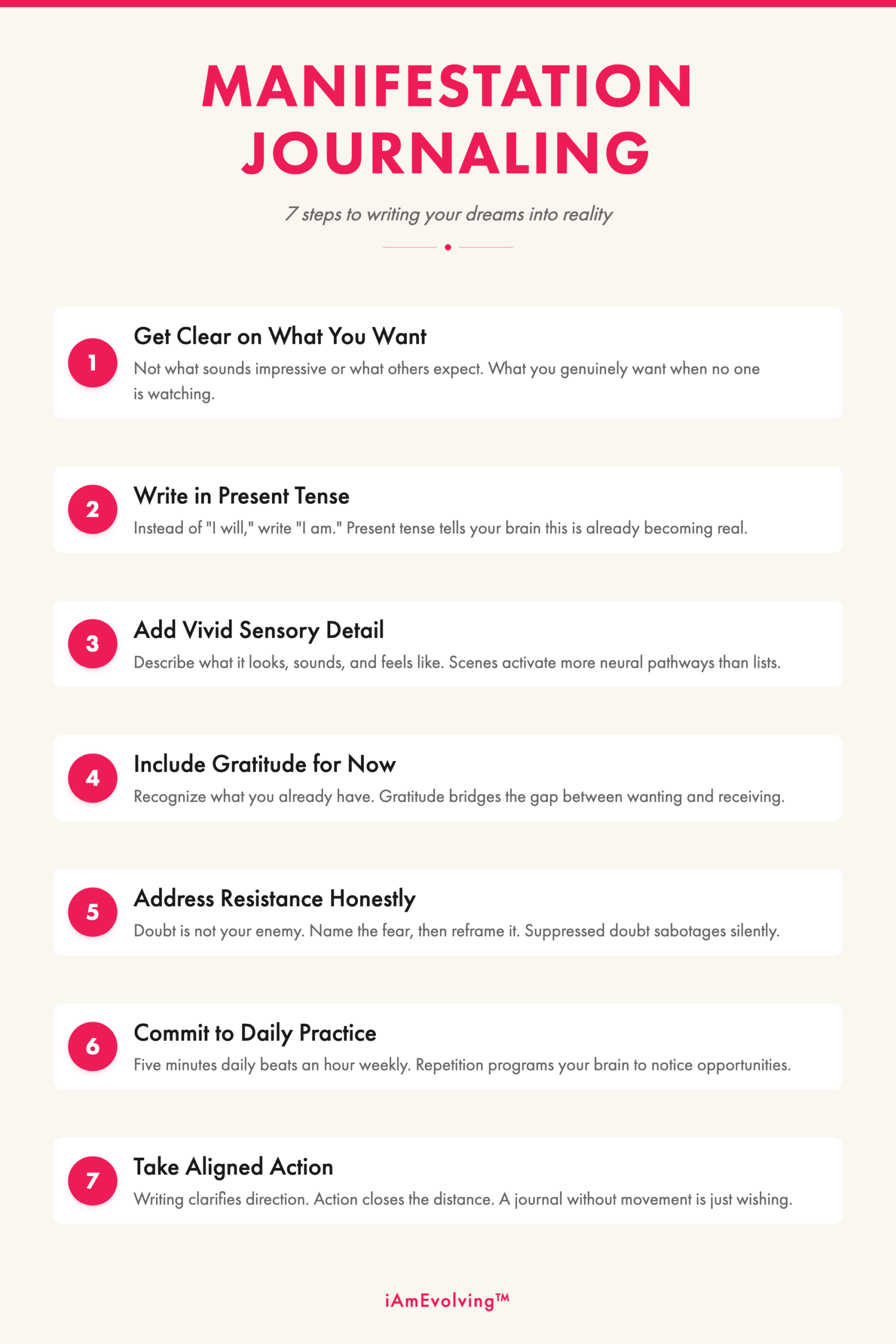
How to Start a Manifestation Journaling Practice
Get Clear on What You Want
Write Your Goals in Present Tense
Add Vivid Sensory Detail
Include Gratitude for Current Progress
Address Resistance and Reframe Limiting Beliefs
Commit to Daily Practice
Manifestation Journal Prompts to Get You Started
If staring at a blank page feels overwhelming, prompts can help you get into the flow of manifestation journaling without overthinking. Use these as starting points and let your writing go wherever it needs to go.
For clarity:
- If I could design my ideal day one year from now, what would it look like from morning to night?
- What is the one goal that would change how I feel about my life if I achieved it this year?
- What do I keep saying I want but have not taken action on — and what is really stopping me?
For visualization:
- Describe the moment you achieve your biggest current goal. Where are you? Who is with you? What are you feeling?
- Write a journal entry from your future self, six months from now, describing how life has changed.
- What would you do differently tomorrow if you fully believed your goal was guaranteed to happen?
For releasing resistance:
- What fear comes up most often when I think about this goal? Is it based on evidence or assumption?
- What belief about myself would I need to let go of in order to receive what I am asking for?
- Write a letter to your doubt. Acknowledge it, thank it for trying to protect you, and explain why you are moving forward anyway.
For gratitude and momentum:
- What are three things that went well this week that are connected to my larger goals?
- What small step did I take recently that my past self would be proud of?
- What am I grateful for today that I used to wish for?
Common Manifestation Journaling Mistakes
Manifestation journaling is simple, but there are a few patterns that undermine it. Recognizing these early will save you frustration and keep your practice effective.
Writing Without Feeling
If your journal entries read like a grocery list of goals, they are not doing much for you neurologically. The emotional component is what encodes your intentions into long-term memory and primes your RAS to act on them. When you write, pause and actually feel what you are describing. If you cannot feel it, the goal might not be real enough yet — or it might not be yours.
Treating It as a One-Time Exercise
Writing your goals down once and expecting transformation is like going to the gym one time and expecting visible results. Manifestation journaling works through repetition and refinement. Each time you revisit a goal, you deepen your connection to it, notice new details, and naturally course-correct your approach. The magic — if you want to call it that — is in the daily return.
Ignoring Doubt and Fear
Toxic positivity has no place in a manifestation journal. If you suppress doubt, it does not disappear — it goes underground and sabotages you from there. The most honest journals include fear alongside ambition, doubt alongside vision. Writing about your resistance does not make it stronger. It makes it visible, which is the first step to moving through it.
Being Too Vague
Vague goals produce vague results. “I want abundance” means nothing to your brain. It cannot build a mental map toward a destination it cannot see. Be ruthlessly specific. Name numbers, dates, feelings, environments. The clearer your vision, the easier it is for your mind to find the path toward it.
Journaling Without Action
This is the trap that gives manifestation a bad name. Writing about your goals is not a replacement for working toward them. It is a complement. The journal clarifies your direction and strengthens your commitment. But you still need to show up, make decisions, have conversations, and do the work. Think of your manifestation journal as the compass, not the legs. It tells you where to go. You still have to walk.
Choosing the Right Journal for Manifestation
The best manifestation journal is one you will actually use. That said, the format matters more than most people realize, because it shapes the quality of your practice.
A blank notebook gives you total freedom but offers no structure. This works well if you are already an experienced journaler who knows how to guide your own writing. But for most people starting out, a blank page is more intimidating than inspiring — and intimidation leads to skipping days.
A guided journal solves this problem by providing prompts, frameworks, and built-in structure that keep you focused and consistent. The iAmEvolving Journal is designed with exactly this kind of intentional practice in mind. It includes dedicated pages for setting intentions, daily gratitude reflections, and structured goal-setting — the three pillars of effective manifestation journaling — all within a single guided format. Instead of reinventing your practice every morning, you simply open to the next page and follow the prompts.
Whatever you choose, pick something you enjoy using physically. The texture of the paper, the weight of the cover, how it feels to write in — these small details affect whether you reach for your journal each day or leave it on the shelf. Manifestation journaling is a sensory practice. Make it one you look forward to.
Conclusion
Manifestation journaling is not about wishing on paper. It is about getting clear on what you want, training your brain to notice the path toward it, and building the emotional connection that turns intention into action. The science supports it. The practice is simple. And the only real requirement is consistency — a few minutes each day of honest, vivid, emotionally connected writing about the life you are building.
You do not need to believe in anything mystical for this to work. You just need to believe that where you put your attention matters — because it does. Start today. Open your journal, write about one goal as if it is already underway, and notice how it shifts the way you move through the rest of your day. That small shift, repeated daily, is how lives change. If you are ready to build a practice that ties together intention-setting, gratitude, and personal growth in one place, the personal growth guide is a good next step.
Start your daily practice of gratitude, goals, and growth.
Get the Journal →A gentle 7-day reset to help you slow down, feel steadier, and reconnect — in just 5–10 minutes a day.
Start the ResetA simple introduction to daily journaling — gratitude, goals, and habits made easy.
Learn the MethodFAQ: Manifestation Journaling
Does manifestation journaling actually work?
How long should I spend on manifestation journaling each day?
What should I write in a manifestation journal?
Is manifestation journaling the same as the law of attraction?
Can I use a regular notebook as a manifestation journal?