Journaling for Teens: Why Every Teenager Should Have a Journal

Journaling is one of the most effective tools a teenager can use to process emotions, build self-awareness, and navigate the intense pressures of adolescence, and research consistently supports this. Studies published in the journal Advances in Psychiatric Treatment found that expressive writing reduces anxiety symptoms, improves mood, and strengthens emotional regulation, making journals for teens not just a creative outlet but a genuine mental health practice. Whether you are a teenager looking for a way to make sense of your own mind or a parent hoping to offer your child something meaningful beyond another screen, journaling meets that need in a way few other habits can.
The teenage years are a period of rapid brain development, identity formation, and emotional intensity. Everything feels louder, friendships, academic pressure, social media comparisons, and the constant question of who you are becoming. A journal gives you a private space to slow down, sort through what matters, and hear your own voice clearly. It is not about writing perfectly or filling a certain number of pages. It is about building a relationship with yourself during the years when that relationship matters most. If you are interested in how journaling for mental health works at every age, the principles apply powerfully to teenagers as well.
Why Journaling Matters During the Teen Years
Between the ages of 12 and 25, the prefrontal cortex, the part of the brain responsible for decision-making, impulse control, and long-term planning, is still under construction. That means teenagers feel emotions with the full force of an adult brain but do not yet have the neural wiring to regulate those emotions consistently. This is not a flaw. It is biology. And it explains why a bad day at school can feel catastrophic, why a friend’s offhand comment can replay on a loop for hours, and why everything from grades to social standing can feel impossibly high-stakes.
Journaling works directly with this developmental reality. When you write down what you are feeling, you activate the prefrontal cortex and create a bridge between raw emotion and structured thought. You move from reacting to reflecting. Over time, this builds neural pathways that make emotional regulation easier — not by suppressing feelings, but by understanding them. For a teenager, that is an enormous advantage.
There is also the identity piece. Adolescence is when you start asking the big questions: Who am I, separate from my family? What do I actually believe? What kind of person do I want to become? These questions deserve more than a passing thought between classes. A journal gives them room to breathe. It becomes a record of your thinking, your growth, and your evolution. Something you can look back on and see just how far you have
Science-Backed Benefits of Journals for Teens
The benefits of journaling for teenagers are not anecdotal. They are measurable and well-documented across multiple areas of well-being and performance.
Reduced anxiety and stress. A 2018 study in the journal JMIR Mental Health found that participants who engaged in online expressive writing showed significant reductions in anxiety and perceived stress after just one month. For teenagers dealing with social anxiety, academic pressure, or the general overwhelm of growing up in a hyperconnected world, even 10 minutes of daily writing can lower cortisol levels and create a sense of emotional release. If anxiety is something you or your teen struggles with, journaling helps anxiety and depression in ways that complement professional support.
Improved self-awareness. Journaling forces you to articulate what you are actually thinking and feeling, rather than just reacting to it. For teens, this is transformative. It turns vague emotional fog into something specific and manageable. Instead of “I feel terrible,” journaling helps you land on “I feel left out because my friends made plans without me, and that triggered my fear of not belonging.” That level of clarity changes everything.
Better emotional regulation. Research from the University of California, Los Angeles found that labeling emotions through writing — a process called “affect labeling”, actually reduces the intensity of those emotions in the brain. For teenagers, who often feel emotions at full volume, learning to name and write about feelings is one of the most practical coping skills available.
Stronger academic performance. A study published in Science found that students who spent 10 minutes writing about their anxieties before exams performed significantly better than those who did not. Journaling clears mental clutter, improves focus, and strengthens working memory, all of which translate directly to better schoolwork.
Healthier relationships. When you understand your own emotions better, you communicate more clearly with the people around you. Teens who journal regularly report better conflict resolution skills, more empathy toward peers, and a stronger sense of self that makes them less susceptible to peer pressure.
How to Start Journaling as a Teen
The most common reason teenagers give up on journaling is that they put too much pressure on it from the start. They imagine they need to fill pages, write beautifully, or journal every single day without fail. None of that is true. The goal is simply to show up, write honestly, and let the practice grow at its own pace.
Here are practical, low-pressure ways to begin.
Start with five minutes. Set a timer for five minutes and write whatever comes to mind. Do not edit, do not judge, do not worry about grammar. This is called free-writing, and it is one of the fastest ways to get past the blank page. When the timer goes off, stop. You can always write more if you want to, but five minutes is enough to build the habit.
Use prompts when you are stuck. A blank page can feel intimidating. Prompts give you a starting point, which makes it easier to get into the flow. You will find a list of teen-specific prompts later in this post, but the simple question “What is on my mind right now?” is always a good place to start.
Write at the same time each day. Consistency matters more than duration. Whether it is first thing in the morning, during a free period, or right before bed, linking your journaling to an existing routine makes it easier to stick. If you are curious about building routines that last, journaling habits are built the same way any sustainable habit is, through small, repeated actions.
Do not reread immediately. Give yourself permission to write without looking back for at least a week. This removes the self-consciousness that kills early journaling attempts. You are not writing for an audience. You are writing for yourself.
Try different formats. Not everyone connects with traditional long-form writing. Some teens prefer bullet journaling, where they jot down short thoughts in list form. Others like doodling alongside their entries, writing letters to their future selves, or answering one prompt per day. There is no wrong format, the best journal practice is the one you actually do.
Get more like this, every week
20 Journal Prompts Designed for Teenagers
These prompts are designed to meet you where you are, in the real, messy, complicated territory of being a teenager. Pick one that grabs you, set a timer for five to ten minutes, and write honestly. There are no right answers.
Identity and self-discovery
- What are three things I know to be true about myself that have nothing to do with school or grades?
- If I could design my life five years from now, what would a typical day look like?
- What is one belief I hold because I actually believe it, not because someone told me to?
- When do I feel most like myself? What am I doing, and who am I with?
Friendships and relationships
- What qualities do I value most in a friend? Do my current friendships reflect those qualities?
- Is there a relationship in my life that drains me? What would it look like to set a boundary there?
- What is the kindest thing someone has done for me recently? How did it make me feel?
- If I could say something honest to a friend without any consequences, what would it be?
Emotions and mental health
- What emotion have I been avoiding this week? What would happen if I let myself feel it fully?
- When I feel anxious, where do I notice it in my body? What helps it pass?
- What is one thing I am struggling with right now that I have not told anyone about?
- Write about a time I was hard on myself. What would I say to a friend in the same situation?
School and pressure
- What subject or activity makes me lose track of time? What does that tell me about what I enjoy?
- Am I working toward goals that matter to me, or goals that matter to someone else?
- What would I do differently if grades did not exist?
- What is one pressure I feel at school that I wish adults understood better?
Screen time and social media
- How do I feel after 30 minutes on social media versus 30 minutes writing in my journal?
- Is there a version of myself I perform online that does not match who I am in real life?
- What would I do with an extra hour each day if I spent less time on my phone?
- Who do I compare myself to online, and what would happen if I stopped?
For more prompts that go deeper into understanding yourself, explore these journaling prompts for self-discovery, many of them work just as well for teenagers as they do for adults.
A Note for Parents: How to Introduce Journaling Without It Feeling Like Homework
If you are a parent reading this, you probably already sense that your teenager could benefit from journaling. Maybe you have noticed them struggling with stress, withdrawing emotionally, or spending too many hours on their phone. The instinct to hand them a journal and say “write about your feelings” is understandable, but it rarely works. Teenagers are wired to resist anything that feels imposed, and they can detect a disguised assignment from a mile away.
Here is what does work.
Model it yourself. The most powerful way to introduce journaling to a teenager is to do it yourself. Leave your journal on the kitchen table. Mention casually that you wrote about something that was bothering you. When teens see a parent engaging in a practice — without pressure to join, curiosity does the rest.
Give the journal as a gift, not an assignment. Choose a journal that looks and feels good. Something with a design that reflects their personality — not something that looks like it belongs in an elementary school classroom. Say something simple: “I thought you might enjoy this. No pressure to use it.” Then walk away. Let them come to it on their own terms.
Never read their journal. This is non-negotiable. A journal only works if it feels completely private and safe. If your teenager suspects you might read their entries, they will either stop writing or only write what they think you want to see. Both outcomes defeat the purpose. Make an explicit promise: “This is yours. I will never read it.”
Do not ask what they wrote. Resist the urge to check in with “So what did you journal about today?” Instead, notice behavioral changes over time. Are they calmer? More reflective? Better at articulating what they need? Those are the signs that the practice is working.
Suggest it during calm moments, not crises. Saying “Maybe you should write about it” during an argument or meltdown will backfire. Instead, bring up journaling casually during a relaxed conversation: “I read something interesting about how writing helps your brain process stress. Thought of you because you have been dealing with a lot lately.”
Pair it with something they already enjoy. A teen who loves music might enjoy writing about lyrics that resonate with them. A teen who is athletic might journal about their training mindset. A teen interested in art might combine sketching with written reflection. Meet them where they are, not where you think they should be.
What to Look for in Journals for Teens
Not all journals are created equal, and what works for a 40-year-old professional will not necessarily resonate with a 15-year-old. When choosing journals for teens, consider these factors.
Guided versus blank. Completely blank journals can feel intimidating to a teenager who has never journaled before. Guided journals, the kind with prompts, questions, or structured sections, lower the barrier to entry significantly. They provide direction without being prescriptive, which is exactly what most teens need to get started. As confidence builds, many teenagers naturally transition to blank journals where they create their own prompts.
Design matters. A journal that looks like it was designed for a child will sit untouched on the shelf. Teenagers care about aesthetics, and rightly so. Look for journals with clean, modern designs, something they would be proud to carry in a backpack. Avoid anything with cartoons, glitter, or overly juvenile branding. Minimalist designs with quality paper tend to appeal to a wide range of teens.
Privacy features. Some teens prefer journals with covers that do not obviously scream “JOURNAL” or “DIARY.” A simple, understated cover gives them the confidence to use it in shared spaces without feeling self-conscious. Some journals come with elastic closures or pockets for loose notes, which adds a sense of personal ownership and security.
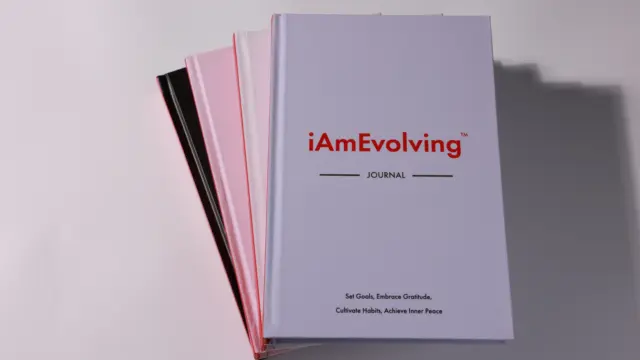
Structure that does not overwhelm. The best journals for teens strike a balance between guidance and freedom. A few prompts per page, some space for free-writing, and sections that encourage goal-setting, gratitude, or self-reflection create a well-rounded practice without making the journal feel like a workbook. The iAmEvolving Journal is designed with this balance in mind, it combines guided prompts for gratitude, goal-setting, and self-reflection with open space for personal writing, making it a strong fit for teenagers who want structure without rigidity.
Quality paper. This sounds minor, but teenagers notice when ink bleeds through cheap paper. A journal with thick, smooth pages feels more substantial and makes the act of writing more enjoyable. It signals that their thoughts are worth recording on something that lasts.
Why Journaling Beats Scrolling
The average teenager spends over seven hours per day on screens outside of schoolwork. Much of that time is spent consuming content that is designed to capture attention, trigger comparison, and keep you scrolling. Social media platforms are engineered to make you feel like you are not enough, not popular enough, not attractive enough, not successful enough. That is not a conspiracy theory. It is the business model.
Journaling is the antidote to that loop. Where social media asks you to perform a version of yourself for an audience, journaling asks you to sit with the real version. Where scrolling fills your head with other people’s opinions and highlight reels, writing fills it with your own thoughts and authentic experiences. Where social media speeds everything up, journaling slows everything down.
This is not about demonizing technology. It is about balance. A teenager who spends even 10 minutes a day journaling is building a counterweight to the constant noise of digital life. They are training their brain to focus, reflect, and create instead of just consume. Over weeks and months, that shift compounds into genuine self-knowledge and emotional resilience that no app can provide.
Conclusion
Journaling is not a magic fix for the challenges of being a teenager. It will not eliminate stress, resolve friendship drama, or make school pressure disappear. What it will do is give you a reliable, private, always-available tool for understanding yourself better, and that understanding becomes the foundation for everything else. Better decisions, clearer communication, less anxiety, and a stronger sense of who you are and who you are becoming.
If you are a teenager, the best time to start is now, not when life gets harder, not when you feel ready, but today. Grab a journal, set a timer for five minutes, and write one honest sentence. That is enough. If you are a parent, trust that your teenager is capable of this. Give them the space, the tools, and the privacy to figure it out on their own terms. For anyone looking for a journal that balances guided reflection with personal freedom, the iAmEvolving Journal is a strong place to begin.
Start your daily practice of gratitude, goals, and growth.
Get the Journal →A gentle 7-day reset to help you slow down, feel steadier, and reconnect — in just 5–10 minutes a day.
Start the ResetA simple introduction to daily journaling — gratitude, goals, and habits made easy.
Learn the MethodFAQ: Journaling for Teens
What age should a teenager start journaling?
How long should a teen journal each day?
Should parents read their teenager’s journal?
What type of journal is best for a teenager?
Can journaling replace therapy for teens with anxiety or depression?