Healing Journal: How Writing Supports Your Recovery Journey
When you are moving through grief, anxiety, burnout, or any season that feels heavier than you can carry, words can become a lifeline. A healing journal is not a cure — it is a container. A place where the weight of what you are feeling can be set down, examined, and slowly released. Research by psychologist James Pennebaker at the University of Texas found that writing about emotionally significant experiences for just 15 to 20 minutes a day over four consecutive days led to measurable improvements in immune function, reduced anxiety, and better emotional processing. His studies, replicated across more than 200 trials over three decades, show that expressive writing helps the brain organize fragmented emotional memories into coherent narratives — and that process alone reduces their power to overwhelm you.
You do not need to be a writer to heal through writing. You do not need to produce something beautiful or even something that makes sense. You need a safe space, a few minutes, and the willingness to put what is inside you onto a page. Whether you are processing the loss of someone you love, recovering from emotional exhaustion, or navigating a life transition that has left you unsteady, a healing journal meets you where you are — without judgment, without a timeline, and without requiring you to have the answers. If you have been exploring journaling for mental health, this practice takes that foundation and brings it into the most tender corners of your experience.
Why Writing Heals: The Science Behind a Healing Journal
The question of why writing heals has been studied for decades, and the answer is both simple and profound. When you experience something painful — a loss, a betrayal, a period of sustained stress — the emotional memory of that event gets stored in a fragmented, disorganized way. It sits in your body and your mind as a collection of sensations, images, and feelings without a clear narrative. This is why difficult experiences often feel like they are replaying on a loop. Your brain has not finished processing them.
Writing changes that. When you sit down and put words to your experience, you activate the prefrontal cortex — the part of your brain responsible for language, reasoning, and making sense of things. You are essentially translating raw emotion into structured thought. Pennebaker’s research calls this the “cognitive processing” effect of expressive writing. By giving your experience a beginning, a middle, and even a tentative ending, you help your brain file it properly. The emotional charge does not disappear overnight, but it begins to lose its grip.
This is not the same as venting. Studies have shown that simply complaining or listing grievances on paper without reflecting does not produce the same benefits. The healing happens when you move beyond “this happened” and begin to explore “what does this mean to me” and “how has this changed me.” It is the reflection that transforms writing from a record into a tool for recovery.
Other studies have confirmed what Pennebaker first observed. Research published in the journal Psychotherapy Research found that participants who wrote expressively about traumatic events showed reductions in depressive symptoms comparable to several sessions of talk therapy. A meta-analysis in Psychological Bulletin across 146 studies concluded that expressive writing leads to small but reliable improvements in psychological health, physical health, and overall functioning. The evidence is clear: writing about difficult experiences does not make you weaker. It makes you more integrated.
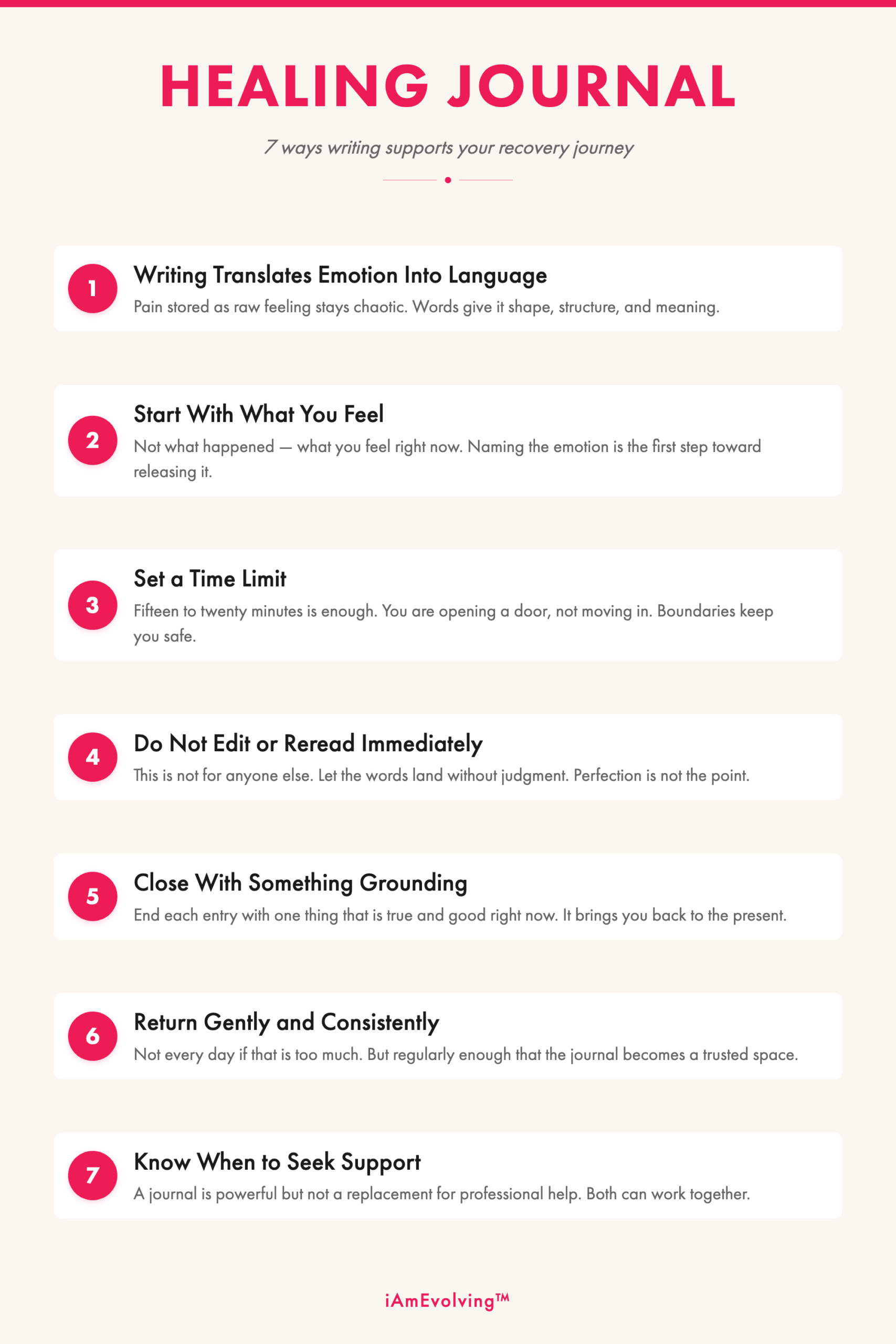
How to Start a Healing Journal Safely
Choose a Private, Physical Space
Set a Time Limit of 15–20 Minutes
Begin With What You Feel, Not What Happened
Do Not Edit or Reread Immediately
Close With Something Grounding
Healing Journal Prompts for Different Types of Pain
Not all pain is the same, and not all healing writing should follow the same prompts. Grief feels different from burnout, which feels different from anxiety, which feels different from the disorientation of a major life change. The following prompts are designed to meet you in the specific kind of difficulty you are experiencing. Choose the section that resonates most, and start with whichever prompt feels the least intimidating.
Prompts for Grief and Loss
- What do I miss most that I have not said out loud yet?
- If I could say one more thing to the person I lost, what would it be?
- What did this person or experience teach me that I want to carry forward?
- Where do I feel the grief in my body right now? What does it feel like?
- What small moment of connection or beauty showed up today, even inside the sadness?
Grief does not follow a schedule. Some days you will write pages. Some days you will write a single sentence and close the journal. Both are valid. The purpose is not to “get over” the loss but to stay in relationship with it without being consumed by it.
Prompts for Anxiety
- What is the worst thing I am afraid will happen? And what is more likely to happen?
- What would I tell a friend who was carrying this same worry?
- What can I control in this situation? What is outside my control?
- When have I felt this anxious before, and what helped me through it?
- Right now, in this exact moment, am I safe? What do I know to be true?
Anxiety tends to live in the future — in the space between “what is” and “what might be.” Writing pulls you back to the present by asking you to name the fear specifically. Vague anxiety is overwhelming. Named anxiety is manageable. If anxiety is something you navigate regularly, journaling helps with anxiety and depression by creating a structured way to externalize the thoughts that cycle endlessly when left inside your head.
Prompts for Burnout
- When did I stop feeling like myself? What was happening around that time?
- What am I doing out of obligation that I no longer have the energy for?
- What would rest actually look like for me right now — not idealized rest, but real rest?
- What boundaries have I let slide that need to be rebuilt?
- What is one thing I can say no to this week?
Burnout is not about being lazy or weak. It is the result of sustained output without sufficient recovery — emotional, physical, or both. Writing about it helps you see the specific places where your energy has been leaking, rather than experiencing burnout as one undifferentiated wall of exhaustion.
Prompts for Life Transitions
- What am I leaving behind? What parts of that do I want to honor and remember?
- What scares me most about this change? What quietly excites me about it?
- Who am I becoming in this transition? What qualities do I want to carry into the next chapter?
- What would it look like to trust this process, even without knowing the outcome?
- What has held me together during past changes that I can lean on now?
Transitions are disorienting because you are no longer who you were, but you are not yet who you are becoming. Writing during transitions is like drawing a map while you are still walking — it will not show you the destination, but it will help you see where you are.
Get more like this, every week
What to Do When Your Healing Journal Feels Too Heavy
There will be days when opening the journal feels like too much. When the thought of putting words to your pain makes the pain feel bigger, not smaller. This is normal, and it does not mean the practice is failing. It means your nervous system is asking for a different kind of care in that moment.
Here are ways to stay in the practice without pushing yourself past what feels safe:
Write around the pain, not into it. You do not always have to write about the hardest thing. Write about something adjacent — how the morning light looked, what you ate, the song that came on while you were driving. Sometimes the most healing writing happens at the edges, not the center.
Use a rating scale. Instead of writing paragraphs, write a single number. “Today my pain is a 6 out of 10.” That is enough. Over weeks, those numbers become a map that shows you something your feelings alone cannot — that things are shifting, even when they do not feel like it.
Write a letter you will never send. Address it to the person, the situation, the version of yourself that is hurting. Say what you need to say without the pressure of anyone reading it. These letters are some of the most powerful healing writing you can do, precisely because they have no audience.
Draw or list instead. If sentences feel impossible, draw what you are feeling. Or make a list: five things I am carrying today. Three things I need. One thing I wish someone would say to me. Structure can hold you when freeform writing feels like falling.
Give yourself permission to stop. Put the pen down. Close the journal. Go outside, drink water, breathe. Healing is not linear, and forcing yourself to write through overwhelming pain can sometimes retraumatize rather than release. The journal will be there tomorrow. Working through feelings at your own pace is the foundation of journaling for emotional clarity — and sometimes that pace is slow.
Building a Gentle Healing Journal Practice Over Time
A healing journal is not a one-time exercise. The real benefit comes from returning to it consistently — not every day if that feels like too much, but regularly enough that it becomes a trusted part of how you process your life. Over time, the journal becomes less of a crisis tool and more of a quiet companion.
Here are principles that help a healing practice sustain itself:
Lower the bar. One sentence counts. A date and a single emotion counts. The days you show up and write the least are often the days the practice matters the most, because they are the days you almost did not show up at all.
Revisit old entries with compassion. After a few weeks or months, read back through what you wrote. You will notice patterns you could not see in the moment — recurring fears, gradual shifts in language, evidence of growth that was invisible while it was happening. Read those entries the way you would read a letter from a friend who was struggling. With kindness, not judgment.
Pair writing with a grounding ritual. Light a candle. Make tea. Sit in the same chair. These small, sensory cues tell your nervous system that you are entering a safe space. Over time, the ritual itself becomes calming — before you even pick up the pen.
Let gratitude coexist with grief. One of the most powerful things a healing journal can hold is both at the same time. “I miss my father. I am grateful for the way he taught me to laugh at myself.” These are not contradictions. They are the full truth of being human. The iAmEvolving Journal is designed with this in mind — its daily gratitude prompts and reflection pages give you a gentle structure for holding both what hurts and what sustains you, without forcing you to choose between them.
Track small wins. Healing often looks like very small things: sleeping through the night for the first time in weeks, laughing without guilt, making a decision without spiraling. Write those down. They are evidence that the work you are doing matters, even when the larger pain has not fully resolved.
When to Seek Professional Help Alongside Journaling
A healing journal is a powerful tool, but it is not a replacement for professional support. There are situations where writing alone is not enough — and recognizing those situations is a sign of strength, not failure.
Consider reaching out to a therapist, counselor, or mental health professional if:
- Writing about your experiences consistently makes you feel worse rather than providing any relief
- You are experiencing intrusive thoughts, flashbacks, or nightmares related to a traumatic event
- Your daily functioning — sleep, eating, relationships, work — has been significantly disrupted for more than a few weeks
- You are having thoughts of harming yourself or feel unable to keep yourself safe
- You feel emotionally numb or disconnected from life in a way that does not improve with time
Journaling and therapy work well together. Many therapists actually encourage clients to keep a journal between sessions because it helps track emotional patterns, provides material for discussion, and gives the client an active role in their own healing. Your journal is not competing with professional help — it is extending it into the spaces between appointments.
If you are not sure whether you need professional support, that uncertainty itself is worth exploring in your journal. Write about what you are feeling, what feels manageable, and what feels beyond what you can hold alone. Often, the act of writing about it will make the answer clearer.
Conclusion
Healing is not something you arrive at. It is something you move through — slowly, unevenly, with good days and difficult ones and everything in between. A healing journal does not promise to fix what hurts. It promises to be there while you process it. To hold whatever you need to set down, without rushing you toward an ending you are not ready for.
If you are in a difficult season right now, know this: the fact that you are here, reading about how to heal, means something is already moving inside you. You do not need to write perfectly. You do not need to understand what you are feeling before you write it. You just need a page and a few honest minutes. Start there. The iAmEvolving Journal can be a steady companion in that process — with daily prompts for gratitude, reflection, and gentle self-awareness that keep you grounded when everything else feels uncertain. But whatever journal you use, the most important step is the first one: opening the page and beginning.
You are not writing to erase the pain. You are writing to make space for what comes after it. And that — the willingness to stay present with yourself through something hard — is where real healing begins. If you want to explore more about how journaling prompts for healing can guide your writing, start with one prompt tonight. Let it take you wherever it needs to go.
Start your daily practice of gratitude, goals, and growth.
Get the Journal →A gentle 7-day reset to help you slow down, feel steadier, and reconnect — in just 5–10 minutes a day.
Start the ResetA simple introduction to daily journaling — gratitude, goals, and habits made easy.
Learn the MethodFAQ: Healing Through Writing
Can journaling really help with grief?
How long should I write in a healing journal each day?
Is a healing journal a replacement for therapy?
What should I write about if thinking about my pain feels overwhelming?
Do I need a special journal for healing writing?